



 Chat with AI
Exam 4: A: - Market Failures: Public Goods and Externalities

Exam 1: B: Limits, Alternatives, and Choices265 Questions
Exam 1: A: - Limits, Alternatives, and Choices60 Questions
Exam 2: B: The Market System and the Circular Flow119 Questions
Exam 2: A: - The Market System and the Circular Flow42 Questions
Exam 3: B: Demand, Supply, and Market Equilibrium291 Questions
Exam 3: A: - Demand, Supply, and Market Equilibrium51 Questions
Exam 4: B: Market Failures: Public Goods and Externalities133 Questions
Exam 4: A: - Market Failures: Public Goods and Externalities36 Questions
Exam 5: B: Governments Role and Government Failure121 Questions
Exam 5: A: Governments Role and Government Failure1 Questions
Exam 6: B: an Introduction to Macroeconomics65 Questions
Exam 6: A: an Introduction to Macroeconomics31 Questions
Exam 7: B: Measuring the Economys Output191 Questions
Exam 7: A: Measuring the Economys Output30 Questions
Exam 8: B: Economic Growth122 Questions
Exam 8: A: Economic Growth35 Questions
Exam 9: B: Business Cycles, Unemployment, and Inflation193 Questions
Exam 9: A: Business Cycles, Unemployment, and Inflation40 Questions
Exam 10: B: Basic Macroeconomic Relationships200 Questions
Exam 10: A: Basic Macroeconomic Relationships26 Questions
Exam 11: B: The Aggregate Expenditures Model238 Questions
Exam 11: A: The Aggregate Expenditures Model47 Questions
Exam 12: B: Aggregate Demand and Aggregate Supply203 Questions
Exam 12: A: Aggregate Demand and Aggregate Supply35 Questions
Exam 13: B: Fiscal Policy, Deficits, Surpluses, and Debt234 Questions
Exam 13: A: Fiscal Policy, Deficits, Surpluses, and Debt53 Questions
Exam 14: B: Money, Banking, and Money Creation206 Questions
Exam 14: A: Money, Banking, and Money Creation56 Questions
Exam 15: B: Interest Rates and Monetary Policy239 Questions
Exam 15: A: Interest Rates and Monetary Policy47 Questions
Exam 17: C: Financial Economics323 Questions
Exam 16: A: Long-Run Macroeconomic Adjustments28 Questions
Exam 16: B: Long-Run Macroeconomic Adjustments122 Questions
Exam 17: A: International Trade40 Questions
Exam 17: B: International Trade188 Questions
Exam 18: A: The Balance of Payments and Exchange Rates30 Questions
Exam 18: B: The Balance of Payments and Exchange Rates133 Questions
Exam 22: The Economics of Developing Countries254 Questions
Select questions type


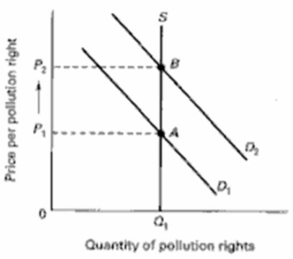
Describe how a market for externality rights would work in terms of supply and demand.
(Essay)
4.9/5  (70)
(70) The demand and supply in a market are represented by the equations P = 50 - .2QD and P = 20 + .3QS.A spillover cost in production equal to $2 per unit exists in this market.(a) What are the equilibrium price and quantity?
(b) What are the optimal price and quantity?
(c) How large must a specific tax in this market be to eliminate the market failure? Is the tax equal to the difference between the equilibrium price and the optimal price?
(Essay)
4.8/5 (71)
(71) Supply in a market is represented by the equation, P = 20 + .1QS.Suppose the market price is $30.(a) How many units do sellers wish to provide in this market?
(b) What is the minimum amount that sellers are willing to accept for this quantity of output?
(c) What is the actual amount that sellers receive for providing for this quantity of output?
(d) What is the producer surplus that sellers obtain for providing this quantity of output?
(Essay)
4.8/5 (85)
(85) The following table shows marginal costs and benefits of the optimal quantity of pollution abatement that will occur at a local factory. 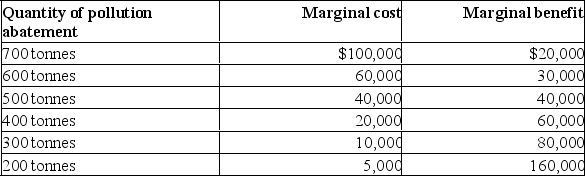 (a) What is the optimal level of pollution abatement? Why?
(b) If the marginal benefit of pollution abatement were to increase by $30,000 at each level because of the factory's desire to improve its image and environment, what would the optimal level be? Why?
(c) What might cause the optimal level of pollution abatement to be 400 tonnes?
(a) What is the optimal level of pollution abatement? Why?
(b) If the marginal benefit of pollution abatement were to increase by $30,000 at each level because of the factory's desire to improve its image and environment, what would the optimal level be? Why?
(c) What might cause the optimal level of pollution abatement to be 400 tonnes? (Essay)
4.8/5 (81)
(81) Draw a supply and demand graph on the below diagram that illustrates the market for pollution rights.Label the axes and curves.Then show what happens to price and quantity when the demand for pollution rights increases in the market. 
(Essay)
4.9/5 (70)
(70) Assume the atmosphere of an urban area is able to reabsorb 4,000 tonnes of pollutants per year.The schedule below shows the price polluters would be willing to pay for the right to dispose of 1 tonne of pollutants per year and the total quantity of pollutants they would wish to dispose of at each price. 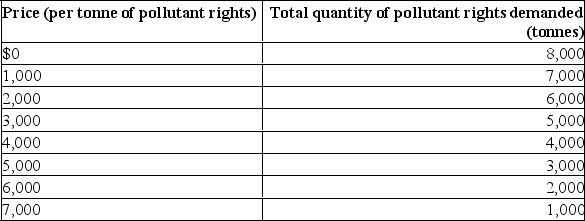 (a) If there were no emission fee, how many tonnes of pollutants would there be and how much greater would this amount be than the capacity for re-absorption?
(b) What pollution fee should the urban authorities charge to solve the problem?
(c) What would happen in this market for pollution rights if quantity demanded increased by 1,000 tonnes at each price?
(a) If there were no emission fee, how many tonnes of pollutants would there be and how much greater would this amount be than the capacity for re-absorption?
(b) What pollution fee should the urban authorities charge to solve the problem?
(c) What would happen in this market for pollution rights if quantity demanded increased by 1,000 tonnes at each price? (Essay)
4.8/5 (75)
(75) What are the basic differences between a public good and a private good?
(Essay)
4.8/5 (86)
(86) Demand is represented by the equation, P = 200 - 2QD and supply by the equation P = 25 + 3QS.(a) Suppose this market produces 30 units of output.What price would this output be sold at if consumers we going to buy all goods? What is the marginal benefit to society of the 30th unit? What is the marginal cost of the 30th unit?
(b) What is consumer surplus if the market produces 30 units of output? What is producer surplus? What is the sum of consumer and producer surplus?
(c) What are the equilibrium price and quantity?
(d) What is consumer surplus at equilibrium? What is producer surplus? What is the sum of consumer and producer surplus?
(e) Is allocative efficiency achieved when the market produces 30 units of output? Explain in three different ways.
(Essay)
4.9/5 (73)
(73) The following table shows marginal costs and benefits of the optimal quantity of pollution abatement that will occur at a local factory. 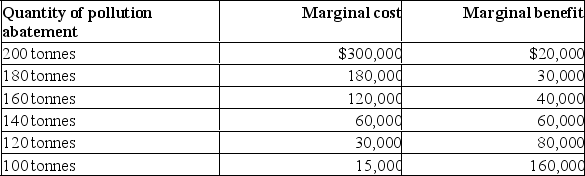 (a) What is the optimal level of pollution abatement? Why?
(b) If the marginal benefit of pollution abatement were to increase by $150,000 at each level because of the factory's desire to improve its image and environment, what would the optimal level be? Why?
(c) What might cause the optimal level of pollution abatement to be 120 tonnes?
(a) What is the optimal level of pollution abatement? Why?
(b) If the marginal benefit of pollution abatement were to increase by $150,000 at each level because of the factory's desire to improve its image and environment, what would the optimal level be? Why?
(c) What might cause the optimal level of pollution abatement to be 120 tonnes? (Essay)
4.8/5 (81)
(81) Supply in a market is represented by the equation, P = 5 + .1QS.Suppose the market price is $30.(a) How many units do sellers wish to provide in this market?
(b) What is the minimum amount that sellers are willing to accept for this quantity of output?
(c) What is the actual amount that sellers receive for providing for this quantity of output?
(d) What is the producer surplus that sellers obtain for providing this quantity of output?
(Essay)
4.9/5 (86)
(86) How do direct controls and specific taxes affect negative externalities? Briefly explain in terms of supply and demand.
(Essay)
4.9/5 (71)
(71) Demand is represented by the equation, P = 20 - 0.2QD and supply by the equation P = 5 + 0.1QS.(a) Suppose this market produces 40 units of output.What price would this output be sold at? What is the marginal benefit to society of the 40th unit? What is the marginal cost of the 40th unit?
(b) What is consumer surplus if the market produces 40 units of output? What is producer surplus? What is the sum of consumer and producer surplus?
(c) What are the equilibrium price and quantity?
(d) What is consumer surplus at equilibrium? What is producer surplus? What is the sum of consumer and producer surplus?
(e) Is allocative efficiency achieved when the market produces 40 units of output? Explain in three different ways.
(Essay)
4.8/5 (77)
(77) What is the meaning of Market Failures and how do the Demand and Supply curves cause such failures?
(Essay)
4.9/5 (94)
(94) 
Filters
- Essay(0)
- Multiple Choice(0)
- Short Answer(0)
- True False(0)
- Matching(0)