



 Chat with AI
Exam 14: A: Money, Banking, and Money Creation

Exam 1: B: Limits, Alternatives, and Choices265 Questions
Exam 1: A: - Limits, Alternatives, and Choices60 Questions
Exam 2: B: The Market System and the Circular Flow119 Questions
Exam 2: A: - The Market System and the Circular Flow42 Questions
Exam 3: B: Demand, Supply, and Market Equilibrium291 Questions
Exam 3: A: - Demand, Supply, and Market Equilibrium51 Questions
Exam 4: B: Market Failures: Public Goods and Externalities133 Questions
Exam 4: A: - Market Failures: Public Goods and Externalities36 Questions
Exam 5: B: Governments Role and Government Failure121 Questions
Exam 5: A: Governments Role and Government Failure1 Questions
Exam 6: B: an Introduction to Macroeconomics65 Questions
Exam 6: A: an Introduction to Macroeconomics31 Questions
Exam 7: B: Measuring the Economys Output191 Questions
Exam 7: A: Measuring the Economys Output30 Questions
Exam 8: B: Economic Growth122 Questions
Exam 8: A: Economic Growth35 Questions
Exam 9: B: Business Cycles, Unemployment, and Inflation193 Questions
Exam 9: A: Business Cycles, Unemployment, and Inflation40 Questions
Exam 10: B: Basic Macroeconomic Relationships200 Questions
Exam 10: A: Basic Macroeconomic Relationships26 Questions
Exam 11: B: The Aggregate Expenditures Model238 Questions
Exam 11: A: The Aggregate Expenditures Model47 Questions
Exam 12: B: Aggregate Demand and Aggregate Supply203 Questions
Exam 12: A: Aggregate Demand and Aggregate Supply35 Questions
Exam 13: B: Fiscal Policy, Deficits, Surpluses, and Debt234 Questions
Exam 13: A: Fiscal Policy, Deficits, Surpluses, and Debt53 Questions
Exam 14: B: Money, Banking, and Money Creation206 Questions
Exam 14: A: Money, Banking, and Money Creation56 Questions
Exam 15: B: Interest Rates and Monetary Policy239 Questions
Exam 15: A: Interest Rates and Monetary Policy47 Questions
Exam 17: C: Financial Economics323 Questions
Exam 16: A: Long-Run Macroeconomic Adjustments28 Questions
Exam 16: B: Long-Run Macroeconomic Adjustments122 Questions
Exam 17: A: International Trade40 Questions
Exam 17: B: International Trade188 Questions
Exam 18: A: The Balance of Payments and Exchange Rates30 Questions
Exam 18: B: The Balance of Payments and Exchange Rates133 Questions
Exam 22: The Economics of Developing Countries254 Questions
Select questions type


Give an equation that shows the relationship between actual, desired, and excess reserves.
(Essay)
4.8/5  (74)
(74) Some government bonds can be redeemed for currency or a cheque at banks.Why, then, isn't it universally agreed that government bonds are part of the money supply?
(Essay)
4.9/5 (71)
(71) Use the figures in the table below to answer the following questions. 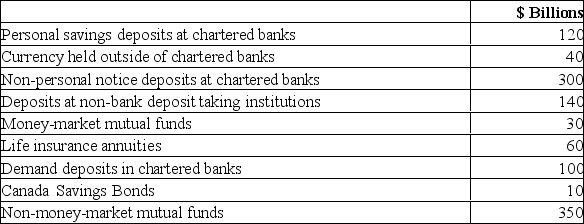 (a) What is the value of M1?
(b) What is the value of M2?
(c) What is the value of M2+?
(d) What is the value of M2++?
(a) What is the value of M1?
(b) What is the value of M2?
(c) What is the value of M2+?
(d) What is the value of M2++? (Essay)
4.9/5 (78)
(78) How does a decrease in the desired reserve ratio affect multiple-deposit expansion?
(Essay)
4.9/5 (72)
(72) What is the effect on the money supply when a chartered bank sells government securities to the public?
(Essay)
4.8/5 (65)
(65) What is the difference between the M1 and M2 definitions of the money supply?
(Essay)
4.8/5 (84)
(84) What is the effect on the money supply when a chartered bank buys government securities from the public?
(Essay)
4.9/5 (80)
(80) Suppose a fraction of any new loan was kept as cash and not deposited into a bank.How would this currency drain affect multiple-deposit expansion?
(Essay)
4.9/5 (70)
(70) How does deterioration in the quality of borrowers affect multiple-deposit expansion?
(Essay)
4.8/5 (77)
(77) When a cheque is drawn against bank A and deposited in another bank, the first bank loses reserves as the cheque is cleared.Yet the cheque collection involves no loss of reserves by the banking system.Explain what significance this has for the lending ability of the system as a whole.
(Essay)
5.0/5 (102)
(102) What are the three functions that a commodity must fulfill to be useful as money?
(Essay)
4.8/5 (76)
(76) 
Filters
- Essay(0)
- Multiple Choice(0)
- Short Answer(0)
- True False(0)
- Matching(0)