



 Chat with AI
Exam 7: B: Measuring the Economys Output

Exam 1: B: Limits, Alternatives, and Choices265 Questions
Exam 1: A: - Limits, Alternatives, and Choices60 Questions
Exam 2: B: The Market System and the Circular Flow119 Questions
Exam 2: A: - The Market System and the Circular Flow42 Questions
Exam 3: B: Demand, Supply, and Market Equilibrium291 Questions
Exam 3: A: - Demand, Supply, and Market Equilibrium51 Questions
Exam 4: B: Market Failures: Public Goods and Externalities133 Questions
Exam 4: A: - Market Failures: Public Goods and Externalities36 Questions
Exam 5: B: Governments Role and Government Failure121 Questions
Exam 5: A: Governments Role and Government Failure1 Questions
Exam 6: B: an Introduction to Macroeconomics65 Questions
Exam 6: A: an Introduction to Macroeconomics31 Questions
Exam 7: B: Measuring the Economys Output191 Questions
Exam 7: A: Measuring the Economys Output30 Questions
Exam 8: B: Economic Growth122 Questions
Exam 8: A: Economic Growth35 Questions
Exam 9: B: Business Cycles, Unemployment, and Inflation193 Questions
Exam 9: A: Business Cycles, Unemployment, and Inflation40 Questions
Exam 10: B: Basic Macroeconomic Relationships200 Questions
Exam 10: A: Basic Macroeconomic Relationships26 Questions
Exam 11: B: The Aggregate Expenditures Model238 Questions
Exam 11: A: The Aggregate Expenditures Model47 Questions
Exam 12: B: Aggregate Demand and Aggregate Supply203 Questions
Exam 12: A: Aggregate Demand and Aggregate Supply35 Questions
Exam 13: B: Fiscal Policy, Deficits, Surpluses, and Debt234 Questions
Exam 13: A: Fiscal Policy, Deficits, Surpluses, and Debt53 Questions
Exam 14: B: Money, Banking, and Money Creation206 Questions
Exam 14: A: Money, Banking, and Money Creation56 Questions
Exam 15: B: Interest Rates and Monetary Policy239 Questions
Exam 15: A: Interest Rates and Monetary Policy47 Questions
Exam 17: C: Financial Economics323 Questions
Exam 16: A: Long-Run Macroeconomic Adjustments28 Questions
Exam 16: B: Long-Run Macroeconomic Adjustments122 Questions
Exam 17: A: International Trade40 Questions
Exam 17: B: International Trade188 Questions
Exam 18: A: The Balance of Payments and Exchange Rates30 Questions
Exam 18: B: The Balance of Payments and Exchange Rates133 Questions
Exam 22: The Economics of Developing Countries254 Questions
Select questions type


Suppose the total market value of all final goods and services produced in a particular country is $600 billion and the total market value of final goods and services sold is $525 billion in 2020.We can conclude that:
(Multiple Choice)
4.7/5  (88)
(88) Only three goods are produced in an economy in the following amounts: A = 10, B = 30, C = 5.The current year per unit prices of these three goods are A = $2, B = $3, and C = $1.Refer to the above information.If the per unit prices of the three goods each were $1 in a base year used to construct a GDP price index, then real GDP in the current year:
(Multiple Choice)
4.9/5 (83)
(83) Refer to the information below.GDP is: All figures are in billions of dollars. 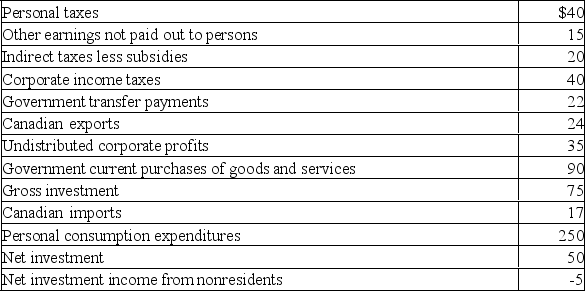
(Multiple Choice)
4.8/5 (85)
(85) Assume that the size of the underground economy increases both absolutely and relatively over time.As a result:
(Multiple Choice)
4.7/5 (82)
(82) Which of the following do national income accountants consider to be "investment"?
(Multiple Choice)
4.7/5 (93)
(93) Wages, salaries, and supplementary labour income in Canada:
(Multiple Choice)
4.8/5 (84)
(84) GDP data are criticized as being inaccurate measures of economic welfare because:
(Multiple Choice)
4.9/5 (86)
(86) Of the countries listed in Image 7.2 Global Perspective the underground economy in 2016 as a percentage of GDP, which country has the highest percentage?
(Multiple Choice)
4.8/5 (83)
(83) If depreciation (consumption of fixed capital) exceeds gross investment, it can be concluded that:
(Multiple Choice)
4.9/5 (72)
(72) The following are national income account data for a hypothetical economy in billions of dollars: government purchases ($1,050); personal consumption expenditures ($4,800); imports ($370); exports ($240); gross investment ($1,130).Personal consumption expenditures are approximately what percentage of this economy?
(Multiple Choice)
4.7/5 (69)
(69) The table below indicates the price and output data over a five-year period for an economy that produces only one good. 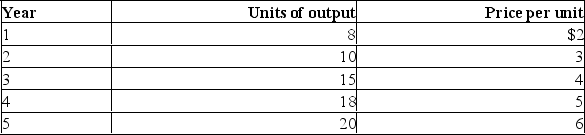 Refer to the above data.If year 2 is the base year, the price index for year 3 is:
 (Multiple Choice)
4.8/5 (82)
(82) In calculating GDP by the income approach, we should sum up:
(Multiple Choice)
4.8/5 (87)
(87) 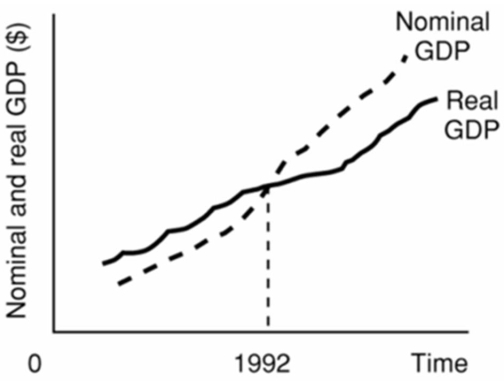 Refer to the above diagram.Which of the following statements is correct?
 (Multiple Choice)
4.9/5 (80)
(80) In an economy experiencing a declining production capacity:
(Multiple Choice)
4.8/5 (77)
(77) Which of the following of the countries listed and using Image 7.1 Global Perspective, which country had the highest GDP in 2016?
(Multiple Choice)
5.0/5 (79)
(79) The GDP figure by the income approach will be identical to the GDP by the expenditure approach if we add to the Net Domestic income:
(Multiple Choice)
4.7/5 (84)
(84) GDP tends to underestimate the productive activity in the economy because it excludes the value of output from:
(Multiple Choice)
4.9/5 (88)
(88) If in some year gross investment was $120 billion and net investment was $65 billion, then in that year the country's capital stock:
(Multiple Choice)
4.9/5 (82)
(82) Some of the production of an economy creates pollution.As a result:
(Multiple Choice)
4.8/5 (75)
(75) 
Filters
- Essay(0)
- Multiple Choice(0)
- Short Answer(0)
- True False(0)
- Matching(0)