



 Chat with AI
Exam 7: B: Measuring the Economys Output

Exam 1: B: Limits, Alternatives, and Choices265 Questions
Exam 1: A: - Limits, Alternatives, and Choices60 Questions
Exam 2: B: The Market System and the Circular Flow119 Questions
Exam 2: A: - The Market System and the Circular Flow42 Questions
Exam 3: B: Demand, Supply, and Market Equilibrium291 Questions
Exam 3: A: - Demand, Supply, and Market Equilibrium51 Questions
Exam 4: B: Market Failures: Public Goods and Externalities133 Questions
Exam 4: A: - Market Failures: Public Goods and Externalities36 Questions
Exam 5: B: Governments Role and Government Failure121 Questions
Exam 5: A: Governments Role and Government Failure1 Questions
Exam 6: B: an Introduction to Macroeconomics65 Questions
Exam 6: A: an Introduction to Macroeconomics31 Questions
Exam 7: B: Measuring the Economys Output191 Questions
Exam 7: A: Measuring the Economys Output30 Questions
Exam 8: B: Economic Growth122 Questions
Exam 8: A: Economic Growth35 Questions
Exam 9: B: Business Cycles, Unemployment, and Inflation193 Questions
Exam 9: A: Business Cycles, Unemployment, and Inflation40 Questions
Exam 10: B: Basic Macroeconomic Relationships200 Questions
Exam 10: A: Basic Macroeconomic Relationships26 Questions
Exam 11: B: The Aggregate Expenditures Model238 Questions
Exam 11: A: The Aggregate Expenditures Model47 Questions
Exam 12: B: Aggregate Demand and Aggregate Supply203 Questions
Exam 12: A: Aggregate Demand and Aggregate Supply35 Questions
Exam 13: B: Fiscal Policy, Deficits, Surpluses, and Debt234 Questions
Exam 13: A: Fiscal Policy, Deficits, Surpluses, and Debt53 Questions
Exam 14: B: Money, Banking, and Money Creation206 Questions
Exam 14: A: Money, Banking, and Money Creation56 Questions
Exam 15: B: Interest Rates and Monetary Policy239 Questions
Exam 15: A: Interest Rates and Monetary Policy47 Questions
Exam 17: C: Financial Economics323 Questions
Exam 16: A: Long-Run Macroeconomic Adjustments28 Questions
Exam 16: B: Long-Run Macroeconomic Adjustments122 Questions
Exam 17: A: International Trade40 Questions
Exam 17: B: International Trade188 Questions
Exam 18: A: The Balance of Payments and Exchange Rates30 Questions
Exam 18: B: The Balance of Payments and Exchange Rates133 Questions
Exam 22: The Economics of Developing Countries254 Questions
Select questions type


In an economy, the value of inventories rose from $100 billion in 2016 to $150 billion in 2017.In calculating the total investment for 2017, national income accountants would:
(Multiple Choice)
4.9/5  (85)
(85) (GDP figures are in billions of dollars.)  Refer to the above table.What was real GDP in Year 2?
 (Multiple Choice)
4.8/5 (69)
(69) In November 2017, General Motors produced an automobile that was delivered to a local dealership in December 2017.The auto was sold to Sharon Smith for personal use in February 2018.Following national income accounting practices, this auto would be counted as:
(Multiple Choice)
4.9/5 (72)
(72) In one-year nominal GDP was $286 billion and the price index was 88.Real GDP in that year was:
(Multiple Choice)
4.9/5 (67)
(67) Suppose nominal GDP was $360 billion in 2010 and $450 billion in 2020.The appropriate price index was 100 in 2010 and 120 in 2020.It can be concluded that between 2010 and 2020 real GDP:
(Multiple Choice)
4.8/5 (82)
(82) Which would be considered an investment according to economists?
(Multiple Choice)
4.8/5 (75)
(75) A business buys $7,000 worth of resources to produce a product.The business makes 150 units of the product and each of them sells for $90.The value added by the business to these products is:
(Multiple Choice)
4.9/5 (78)
(78) Refer to the information below.The capital consumption allowance: All figures are in billions of dollars. 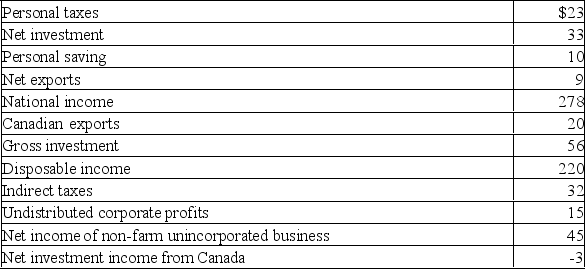
(Multiple Choice)
4.8/5 (80)
(80) The growth of GDP may understate changes in the economy's well-being over time if the:
(Multiple Choice)
4.8/5 (73)
(73) Net income from farms and unincorporated businesses is defined as:
(Multiple Choice)
4.8/5 (88)
(88) The table below indicates the price and output data over a five-year period for an economy that produces only one good. 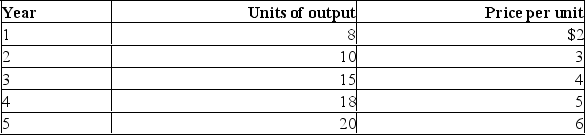 Refer to the above data.If year 2 is the base year, the percentage increase in real GDP from year 2 to year 4 is:
 (Multiple Choice)
4.7/5 (85)
(85) 
Filters
- Essay(0)
- Multiple Choice(0)
- Short Answer(0)
- True False(0)
- Matching(0)