



 Chat with AI
Exam 7: B: Measuring the Economys Output

Exam 1: B: Limits, Alternatives, and Choices265 Questions
Exam 1: A: - Limits, Alternatives, and Choices60 Questions
Exam 2: B: The Market System and the Circular Flow119 Questions
Exam 2: A: - The Market System and the Circular Flow42 Questions
Exam 3: B: Demand, Supply, and Market Equilibrium291 Questions
Exam 3: A: - Demand, Supply, and Market Equilibrium51 Questions
Exam 4: B: Market Failures: Public Goods and Externalities133 Questions
Exam 4: A: - Market Failures: Public Goods and Externalities36 Questions
Exam 5: B: Governments Role and Government Failure121 Questions
Exam 5: A: Governments Role and Government Failure1 Questions
Exam 6: B: an Introduction to Macroeconomics65 Questions
Exam 6: A: an Introduction to Macroeconomics31 Questions
Exam 7: B: Measuring the Economys Output191 Questions
Exam 7: A: Measuring the Economys Output30 Questions
Exam 8: B: Economic Growth122 Questions
Exam 8: A: Economic Growth35 Questions
Exam 9: B: Business Cycles, Unemployment, and Inflation193 Questions
Exam 9: A: Business Cycles, Unemployment, and Inflation40 Questions
Exam 10: B: Basic Macroeconomic Relationships200 Questions
Exam 10: A: Basic Macroeconomic Relationships26 Questions
Exam 11: B: The Aggregate Expenditures Model238 Questions
Exam 11: A: The Aggregate Expenditures Model47 Questions
Exam 12: B: Aggregate Demand and Aggregate Supply203 Questions
Exam 12: A: Aggregate Demand and Aggregate Supply35 Questions
Exam 13: B: Fiscal Policy, Deficits, Surpluses, and Debt234 Questions
Exam 13: A: Fiscal Policy, Deficits, Surpluses, and Debt53 Questions
Exam 14: B: Money, Banking, and Money Creation206 Questions
Exam 14: A: Money, Banking, and Money Creation56 Questions
Exam 15: B: Interest Rates and Monetary Policy239 Questions
Exam 15: A: Interest Rates and Monetary Policy47 Questions
Exam 17: C: Financial Economics323 Questions
Exam 16: A: Long-Run Macroeconomic Adjustments28 Questions
Exam 16: B: Long-Run Macroeconomic Adjustments122 Questions
Exam 17: A: International Trade40 Questions
Exam 17: B: International Trade188 Questions
Exam 18: A: The Balance of Payments and Exchange Rates30 Questions
Exam 18: B: The Balance of Payments and Exchange Rates133 Questions
Exam 22: The Economics of Developing Countries254 Questions
Select questions type


Historically, real GDP has increased less rapidly than nominal GDP because:
(Multiple Choice)
4.9/5  (68)
(68) Interest on the public debt is included as a part of government purchases in determining GDP by the expenditures method.
(True/False)
5.0/5 (79)
(79) 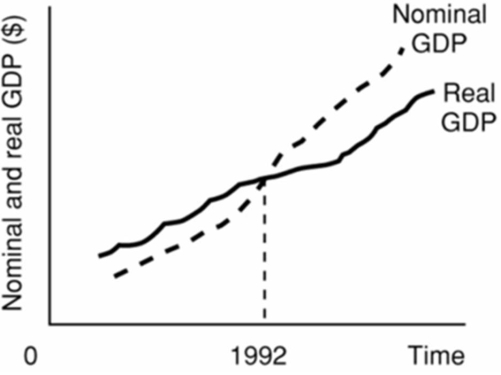 Refer to the above diagram.The base year used in determining the price indices for this economy:
 (Multiple Choice)
4.9/5 (89)
(89) To calculate the real GDP, Statistics Canada has started to consider both the quantities and prices in the base year and the following year and then average the two.
(True/False)
4.9/5 (79)
(79) In a typical year which of the following measures of aggregate output and income is likely to be the smallest?
(Multiple Choice)
4.8/5 (71)
(71) As of the publication date of the text, what years is currently being used by Statistics Canada as the base year for calculating the price index?
(Multiple Choice)
4.9/5 (87)
(87) In calculating GDP, governmental transfer payments, such as welfare payments, are:
(Multiple Choice)
4.8/5 (78)
(78) A distinguishing characteristic of public transfer payments is that:
(Multiple Choice)
4.9/5 (84)
(84) In Year 1, inventories rose by $25 billion.In Year 2, inventories fell by $20 billion.In calculating total investment, national income accountants would have:
(Multiple Choice)
4.8/5 (73)
(73) Suppose ZZZ Corporation issues new common stock worth $25 million in 2020.It uses $18 million of the proceeds to replace obsolete equipment in its factory and $7 million to repay bank loans.As a result, there is an increase in gross investment by:
(Multiple Choice)
4.8/5 (94)
(94) If we add up the figures for wages, rent, interest and profit:
(Multiple Choice)
4.8/5 (84)
(84) 
Filters
- Essay(0)
- Multiple Choice(0)
- Short Answer(0)
- True False(0)
- Matching(0)