



 Chat with AI
Exam 7: B: Measuring the Economys Output

Exam 1: B: Limits, Alternatives, and Choices265 Questions
Exam 1: A: - Limits, Alternatives, and Choices60 Questions
Exam 2: B: The Market System and the Circular Flow119 Questions
Exam 2: A: - The Market System and the Circular Flow42 Questions
Exam 3: B: Demand, Supply, and Market Equilibrium291 Questions
Exam 3: A: - Demand, Supply, and Market Equilibrium51 Questions
Exam 4: B: Market Failures: Public Goods and Externalities133 Questions
Exam 4: A: - Market Failures: Public Goods and Externalities36 Questions
Exam 5: B: Governments Role and Government Failure121 Questions
Exam 5: A: Governments Role and Government Failure1 Questions
Exam 6: B: an Introduction to Macroeconomics65 Questions
Exam 6: A: an Introduction to Macroeconomics31 Questions
Exam 7: B: Measuring the Economys Output191 Questions
Exam 7: A: Measuring the Economys Output30 Questions
Exam 8: B: Economic Growth122 Questions
Exam 8: A: Economic Growth35 Questions
Exam 9: B: Business Cycles, Unemployment, and Inflation193 Questions
Exam 9: A: Business Cycles, Unemployment, and Inflation40 Questions
Exam 10: B: Basic Macroeconomic Relationships200 Questions
Exam 10: A: Basic Macroeconomic Relationships26 Questions
Exam 11: B: The Aggregate Expenditures Model238 Questions
Exam 11: A: The Aggregate Expenditures Model47 Questions
Exam 12: B: Aggregate Demand and Aggregate Supply203 Questions
Exam 12: A: Aggregate Demand and Aggregate Supply35 Questions
Exam 13: B: Fiscal Policy, Deficits, Surpluses, and Debt234 Questions
Exam 13: A: Fiscal Policy, Deficits, Surpluses, and Debt53 Questions
Exam 14: B: Money, Banking, and Money Creation206 Questions
Exam 14: A: Money, Banking, and Money Creation56 Questions
Exam 15: B: Interest Rates and Monetary Policy239 Questions
Exam 15: A: Interest Rates and Monetary Policy47 Questions
Exam 17: C: Financial Economics323 Questions
Exam 16: A: Long-Run Macroeconomic Adjustments28 Questions
Exam 16: B: Long-Run Macroeconomic Adjustments122 Questions
Exam 17: A: International Trade40 Questions
Exam 17: B: International Trade188 Questions
Exam 18: A: The Balance of Payments and Exchange Rates30 Questions
Exam 18: B: The Balance of Payments and Exchange Rates133 Questions
Exam 22: The Economics of Developing Countries254 Questions
Select questions type


In 1933 net investment was minus $208 million.This meant that:
(Multiple Choice)
4.7/5  (68)
(68) Refer to the data below.Personal income: All figures are in billions of dollars. 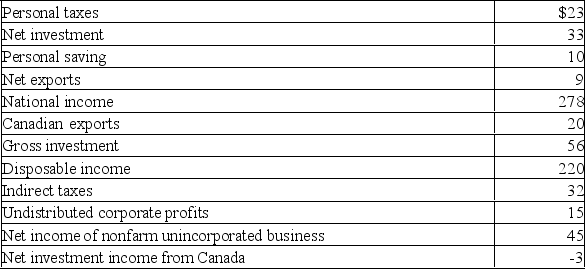
(Multiple Choice)
5.0/5 (70)
(70) A price index is 100 times the ratio of real GDP to nominal GDP.
(True/False)
4.8/5 (66)
(66) Assume an economy which is producing only one product.Output and price data for a three-year period are as follows.  Refer to the above data.The nominal GDP for year 3 is:
 (Multiple Choice)
4.8/5 (82)
(82) National income accountants can avoid multiple counting by:
(Multiple Choice)
4.7/5 (85)
(85) If all the final goods and intermediate goods and services were included in GDP:
(Multiple Choice)
4.7/5 (85)
(85) The smallest component of aggregate spending in Canada is:
(Multiple Choice)
4.8/5 (87)
(87) Which of the following is the first step for deriving real GDP from nominal GDP?
(Multiple Choice)
4.7/5 (92)
(92) Based on Canada's 2017 GDP calculation (using the expenditure approach), what areas contributed the most toward Canada's GDP (calculation based on the expenditure approach) in 2017?
(Multiple Choice)
4.9/5 (85)
(85) In an economy, the value of inventories fell from $75 billion in 2012 to $63 billion in 2013.In calculating the total investment for 2013, national income accountants would:
(Multiple Choice)
4.9/5 (83)
(83)  Refer to the above information.Negative net investment is occurring in:
 (Multiple Choice)
4.8/5 (74)
(74) GDP tends to overstate economic well-being because it takes into account:
(Multiple Choice)
4.8/5 (75)
(75) (GDP figures are in billions of dollars.) ![(GDP figures are in billions of dollars.) ] Refer to the above table.What is the GDP price index in Year 1?](https://storage.examlex.com/TB6686/11eacf22_e8d6_56b1_aab5_7d25b8aa1f9b_TB6686_00.jpg) ]
Refer to the above table.What is the GDP price index in Year 1?
]
Refer to the above table.What is the GDP price index in Year 1? (Multiple Choice)
4.7/5 (84)
(84) In 2001, in calculation of the implicit price index, Statistics Canada switched from fixed based price index method to a chain-weighted index.The main reason for this was:
(Multiple Choice)
4.9/5 (89)
(89) If nominal GDP in some year is $280 and real GDP is $160 the GDP price index for that year is:
(Multiple Choice)
4.9/5 (61)
(61) The table below indicates the price and output data over a five-year period for an economy that produces only one good. 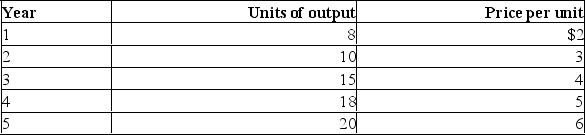 Refer to the above data.If year 2 is the base year, real GDP in year 5 is:
 (Multiple Choice)
4.8/5 (86)
(86) Only three goods are produced in an economy in the following amounts: A = 10, B = 30, C = 5.The current year per unit prices of these three goods are A = $2, B = $3, and C = $1.Refer to the above information.Nominal GDP in the current year is:
(Multiple Choice)
4.9/5 (84)
(84) 
Filters
- Essay(0)
- Multiple Choice(0)
- Short Answer(0)
- True False(0)
- Matching(0)