



 Chat with AI
Exam 3: B: Demand, Supply, and Market Equilibrium

Exam 1: B: Limits, Alternatives, and Choices265 Questions
Exam 1: A: - Limits, Alternatives, and Choices60 Questions
Exam 2: B: The Market System and the Circular Flow119 Questions
Exam 2: A: - The Market System and the Circular Flow42 Questions
Exam 3: B: Demand, Supply, and Market Equilibrium291 Questions
Exam 3: A: - Demand, Supply, and Market Equilibrium51 Questions
Exam 4: B: Market Failures: Public Goods and Externalities133 Questions
Exam 4: A: - Market Failures: Public Goods and Externalities36 Questions
Exam 5: B: Governments Role and Government Failure121 Questions
Exam 5: A: Governments Role and Government Failure1 Questions
Exam 6: B: an Introduction to Macroeconomics65 Questions
Exam 6: A: an Introduction to Macroeconomics31 Questions
Exam 7: B: Measuring the Economys Output191 Questions
Exam 7: A: Measuring the Economys Output30 Questions
Exam 8: B: Economic Growth122 Questions
Exam 8: A: Economic Growth35 Questions
Exam 9: B: Business Cycles, Unemployment, and Inflation193 Questions
Exam 9: A: Business Cycles, Unemployment, and Inflation40 Questions
Exam 10: B: Basic Macroeconomic Relationships200 Questions
Exam 10: A: Basic Macroeconomic Relationships26 Questions
Exam 11: B: The Aggregate Expenditures Model238 Questions
Exam 11: A: The Aggregate Expenditures Model47 Questions
Exam 12: B: Aggregate Demand and Aggregate Supply203 Questions
Exam 12: A: Aggregate Demand and Aggregate Supply35 Questions
Exam 13: B: Fiscal Policy, Deficits, Surpluses, and Debt234 Questions
Exam 13: A: Fiscal Policy, Deficits, Surpluses, and Debt53 Questions
Exam 14: B: Money, Banking, and Money Creation206 Questions
Exam 14: A: Money, Banking, and Money Creation56 Questions
Exam 15: B: Interest Rates and Monetary Policy239 Questions
Exam 15: A: Interest Rates and Monetary Policy47 Questions
Exam 17: C: Financial Economics323 Questions
Exam 16: A: Long-Run Macroeconomic Adjustments28 Questions
Exam 16: B: Long-Run Macroeconomic Adjustments122 Questions
Exam 17: A: International Trade40 Questions
Exam 17: B: International Trade188 Questions
Exam 18: A: The Balance of Payments and Exchange Rates30 Questions
Exam 18: B: The Balance of Payments and Exchange Rates133 Questions
Exam 22: The Economics of Developing Countries254 Questions
Select questions type


If two goods are complements (in consumption), a decline in the price of one will cause an increase in the demand for the other.
(True/False)
4.9/5  (87)
(87) 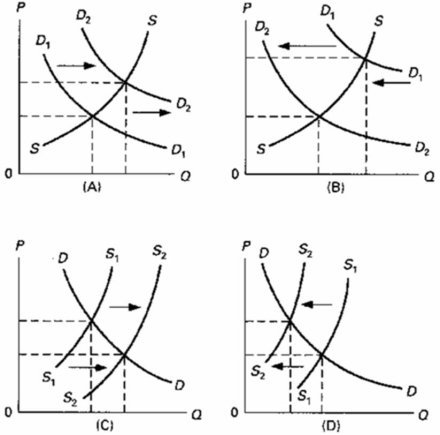 Which of the above diagrams illustrate(s) the effect of a decrease in consumer incomes upon the market for second-hand clothing? (Second-hand clothing is considered to be an inferior good)
 (Multiple Choice)
4.9/5 (76)
(76) When the price of a product falls, the purchasing power of our money income rises and thus permits us to purchase more of the product.This statement describes:
(Multiple Choice)
4.8/5 (81)
(81) A price floor in a competitive market will result in persistent shortages of a product.
(True/False)
4.8/5 (86)
(86) You are asked to determine, other things equal, the effects of a given change in a determinant of demand or supply for product Xupon (1) the demand (D) for, or supply (S) of, X, (2) the equilibrium price (P) of X and (3) the equilibrium quantity (Q) of X.Refer to the above.An improvement in the technology used to produce X will:
(Multiple Choice)
4.9/5 (81)
(81) Which of the following combinations of changes in supply and demand (listed in the same order) is likely to cause an indeterminate change in quantity?
(Multiple Choice)
4.8/5 (74)
(74) Other things equal, which of the following might shift the demand curve for gasoline to the left?
(Multiple Choice)
4.7/5 (73)
(73) Graphically, the horizontal sum of all individual demand curves is known as:
(Multiple Choice)
4.7/5 (73)
(73) The development of a new production technique that lowers the cost of producing product X will shift the supply curve of product X to the right.
(True/False)
4.7/5 (78)
(78) 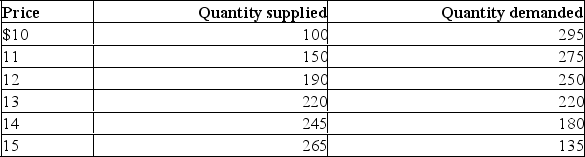 Refer to the above data.If the price in this market was $14:
 (Multiple Choice)
4.8/5 (91)
(91) A surplus of any given commodity can be expected whenever the:
(Multiple Choice)
4.9/5 (72)
(72) In the corn market, demand often exceeds supply and supply sometimes exceeds demand"."The price of corn rises and falls in response to changes in supply and demand.In which of these two statements are the terms "demand" and "supply" being used correct
(Multiple Choice)
4.8/5 (79)
(79) Shortages and surpluses can occur in markets other than those in which government imposes the price floors and ceilings.This phenomenon could be explained by the action of seller(s):
(Multiple Choice)
4.7/5 (83)
(83) You are asked to determine, other things equal, the effects of a given change in a determinant of demand or supply for product Xupon (1) the demand (D) for, or supply (S) of, X, (2) the equilibrium price (P) of X and (3) the equilibrium quantity (Q) of X.Refer to the above.If X is an inferior good, a decrease in income will:
(Multiple Choice)
4.8/5 (92)
(92) The demand for commodity X is represented by the equation P = 10 - 0.2Q and supply by the equation P = 2 + 0.2Q.Refer to the above information.After the change in demand, the new equilibrium price is:
(Multiple Choice)
5.0/5 (77)
(77) A news story states that "Videotapes lose their appeal as consumers switch to DVDs for movies." In a competitive market for the purchase of videotapes of movies, this situation would lead to a(n):
(Multiple Choice)
4.7/5 (82)
(82) 
Filters
- Essay(0)
- Multiple Choice(0)
- Short Answer(0)
- True False(0)
- Matching(0)