



 Chat with AI
Exam 3: B: Demand, Supply, and Market Equilibrium

Exam 1: B: Limits, Alternatives, and Choices265 Questions
Exam 1: A: - Limits, Alternatives, and Choices60 Questions
Exam 2: B: The Market System and the Circular Flow119 Questions
Exam 2: A: - The Market System and the Circular Flow42 Questions
Exam 3: B: Demand, Supply, and Market Equilibrium291 Questions
Exam 3: A: - Demand, Supply, and Market Equilibrium51 Questions
Exam 4: B: Market Failures: Public Goods and Externalities133 Questions
Exam 4: A: - Market Failures: Public Goods and Externalities36 Questions
Exam 5: B: Governments Role and Government Failure121 Questions
Exam 5: A: Governments Role and Government Failure1 Questions
Exam 6: B: an Introduction to Macroeconomics65 Questions
Exam 6: A: an Introduction to Macroeconomics31 Questions
Exam 7: B: Measuring the Economys Output191 Questions
Exam 7: A: Measuring the Economys Output30 Questions
Exam 8: B: Economic Growth122 Questions
Exam 8: A: Economic Growth35 Questions
Exam 9: B: Business Cycles, Unemployment, and Inflation193 Questions
Exam 9: A: Business Cycles, Unemployment, and Inflation40 Questions
Exam 10: B: Basic Macroeconomic Relationships200 Questions
Exam 10: A: Basic Macroeconomic Relationships26 Questions
Exam 11: B: The Aggregate Expenditures Model238 Questions
Exam 11: A: The Aggregate Expenditures Model47 Questions
Exam 12: B: Aggregate Demand and Aggregate Supply203 Questions
Exam 12: A: Aggregate Demand and Aggregate Supply35 Questions
Exam 13: B: Fiscal Policy, Deficits, Surpluses, and Debt234 Questions
Exam 13: A: Fiscal Policy, Deficits, Surpluses, and Debt53 Questions
Exam 14: B: Money, Banking, and Money Creation206 Questions
Exam 14: A: Money, Banking, and Money Creation56 Questions
Exam 15: B: Interest Rates and Monetary Policy239 Questions
Exam 15: A: Interest Rates and Monetary Policy47 Questions
Exam 17: C: Financial Economics323 Questions
Exam 16: A: Long-Run Macroeconomic Adjustments28 Questions
Exam 16: B: Long-Run Macroeconomic Adjustments122 Questions
Exam 17: A: International Trade40 Questions
Exam 17: B: International Trade188 Questions
Exam 18: A: The Balance of Payments and Exchange Rates30 Questions
Exam 18: B: The Balance of Payments and Exchange Rates133 Questions
Exam 22: The Economics of Developing Countries254 Questions
Select questions type


You are asked to determine, other things equal, the effects of a given change in a determinant of demand or supply for product Xupon (1) the demand (D) for, or supply (S) of, X, (2) the equilibrium price (P) of X and (3) the equilibrium quantity (Q) of X.Refer to the above.A reduction in the number of firms producing X will:
(Multiple Choice)
4.8/5  (79)
(79) Refer to the diagram, which shows demand and supply conditions in the competitive market for product X.A shift in the demand curve from D0 to D1 might be caused by a(n): 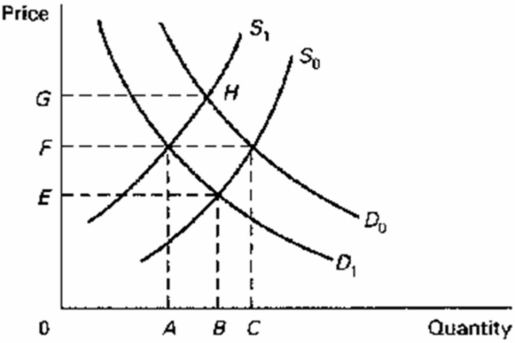
(Multiple Choice)
4.8/5 (76)
(76) Assume in a competitive market that price is initially above the equilibrium level.We can predict that price will:
(Multiple Choice)
4.9/5 (56)
(56) A headline reads "Storms destroy half of the lettuce crop." This situation would lead to a(n):
(Multiple Choice)
4.9/5 (85)
(85) Which of the following would cause an increase in the supply of a product at a given price?
(Multiple Choice)
4.9/5 (79)
(79) Refer to the diagram, which shows three demand curves for coffee.Which of the following would cause the change in the demand for coffee illustrated by the shift from D1 to D2? 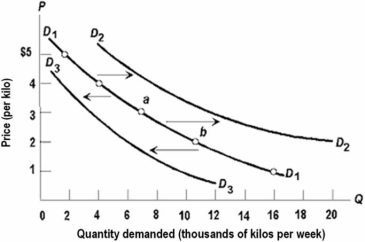
(Multiple Choice)
4.8/5 (65)
(65) Given a downward sloping demand curve and an upward sloping supply curve for product X, an increase in the price of a substitute good (in consumption) will:
(Multiple Choice)
4.9/5 (84)
(84) If the supply of a product decreases and the demand for that product simultaneously increases, we can conclude that equilibrium:
(Multiple Choice)
4.8/5 (80)
(80) Which of the following strategies is being used by Uber to attain equilibrium?
(Multiple Choice)
4.8/5 (74)
(74) The demand for commodity X is represented by the equation P = 10 - 0.2Q and supply by the equation P = 2 + 0.2Q.Refer to the above information.The equilibrium quantity is:
(Multiple Choice)
4.8/5 (80)
(80) You are asked to determine, other things equal, the effects of a given change in a determinant of demand or supply for product Xupon (1) the demand (D) for, or supply (S) of, X, (2) the equilibrium price (P) of X and (3) the equilibrium quantity (Q) of X.Refer to the above.An increase in income, if X is a normal good, will:
(Multiple Choice)
4.8/5 (80)
(80) 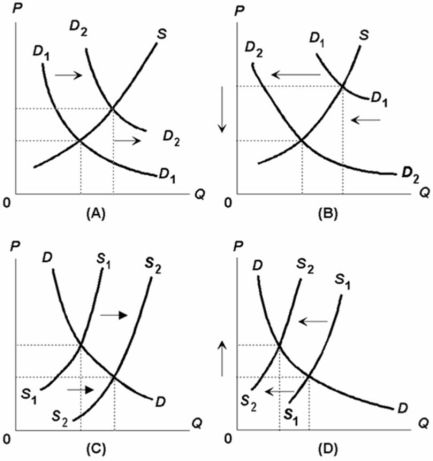 Which diagram above illustrates the effects on the peanut butter market as a result of a higher wage rate for peanut workers?
 (Multiple Choice)
4.8/5 (83)
(83) An increase in consumer incomes will cause a decrease in the demand for an inferior good.
(True/False)
4.7/5 (82)
(82) 
Filters
- Essay(0)
- Multiple Choice(0)
- Short Answer(0)
- True False(0)
- Matching(0)