



 Chat with AI
Exam 3: B: Demand, Supply, and Market Equilibrium

Exam 1: B: Limits, Alternatives, and Choices265 Questions
Exam 1: A: - Limits, Alternatives, and Choices60 Questions
Exam 2: B: The Market System and the Circular Flow119 Questions
Exam 2: A: - The Market System and the Circular Flow42 Questions
Exam 3: B: Demand, Supply, and Market Equilibrium291 Questions
Exam 3: A: - Demand, Supply, and Market Equilibrium51 Questions
Exam 4: B: Market Failures: Public Goods and Externalities133 Questions
Exam 4: A: - Market Failures: Public Goods and Externalities36 Questions
Exam 5: B: Governments Role and Government Failure121 Questions
Exam 5: A: Governments Role and Government Failure1 Questions
Exam 6: B: an Introduction to Macroeconomics65 Questions
Exam 6: A: an Introduction to Macroeconomics31 Questions
Exam 7: B: Measuring the Economys Output191 Questions
Exam 7: A: Measuring the Economys Output30 Questions
Exam 8: B: Economic Growth122 Questions
Exam 8: A: Economic Growth35 Questions
Exam 9: B: Business Cycles, Unemployment, and Inflation193 Questions
Exam 9: A: Business Cycles, Unemployment, and Inflation40 Questions
Exam 10: B: Basic Macroeconomic Relationships200 Questions
Exam 10: A: Basic Macroeconomic Relationships26 Questions
Exam 11: B: The Aggregate Expenditures Model238 Questions
Exam 11: A: The Aggregate Expenditures Model47 Questions
Exam 12: B: Aggregate Demand and Aggregate Supply203 Questions
Exam 12: A: Aggregate Demand and Aggregate Supply35 Questions
Exam 13: B: Fiscal Policy, Deficits, Surpluses, and Debt234 Questions
Exam 13: A: Fiscal Policy, Deficits, Surpluses, and Debt53 Questions
Exam 14: B: Money, Banking, and Money Creation206 Questions
Exam 14: A: Money, Banking, and Money Creation56 Questions
Exam 15: B: Interest Rates and Monetary Policy239 Questions
Exam 15: A: Interest Rates and Monetary Policy47 Questions
Exam 17: C: Financial Economics323 Questions
Exam 16: A: Long-Run Macroeconomic Adjustments28 Questions
Exam 16: B: Long-Run Macroeconomic Adjustments122 Questions
Exam 17: A: International Trade40 Questions
Exam 17: B: International Trade188 Questions
Exam 18: A: The Balance of Payments and Exchange Rates30 Questions
Exam 18: B: The Balance of Payments and Exchange Rates133 Questions
Exam 22: The Economics of Developing Countries254 Questions
Select questions type


Which of the following is most likely to be an inferior good?
(Multiple Choice)
5.0/5  (67)
(67) Because of unseasonably cold weather, the supply of oranges has substantially decreased.This statement indicates that:
(Multiple Choice)
4.7/5 (67)
(67) 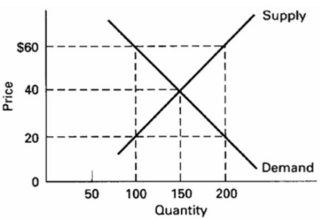 Refer to the above diagram.The highest price that buyers will be willing and able to pay for 100 units of this product is:
 (Multiple Choice)
4.8/5 (72)
(72) In which of the following instances will the effect on equilibrium price be dependent on the magnitude of the shifts in supply and demand?
(Multiple Choice)
4.8/5 (81)
(81) The demand for commodity X is represented by the equation P = 10 - 0.2Q and supply by the equation P = 2 + 0.2Q.Refer to the above information.The equilibrium price for X is:
(Multiple Choice)
4.8/5 (82)
(82) When the price of a product increases, a consumer is able to buy less of it with a given money income.This describes:
(Multiple Choice)
4.9/5 (73)
(73) 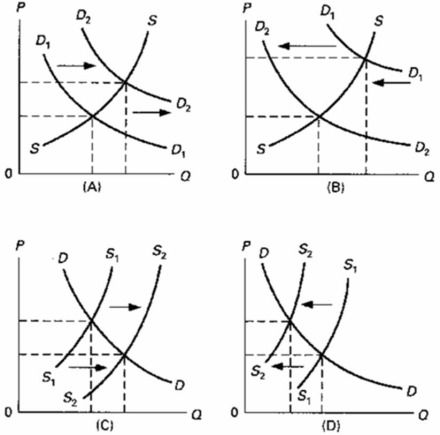 Which of the above diagrams illustrate(s) the effect of an increase in automobile worker wages on the market for automobiles?
 (Multiple Choice)
4.9/5 (69)
(69) If the price of product L increases, the demand curve for close-substitute product J will:
(Multiple Choice)
4.7/5 (87)
(87) As a result of a decrease in the price of a hamburger, consumers buy more hamburgers and fewer frankfurters.This is an illustration of:
(Multiple Choice)
4.9/5 (71)
(71) Which would cause an increase in quantity supplied of product A?
(Multiple Choice)
4.8/5 (79)
(79) Refer to the diagram.The equilibrium price and quantity in this market will be: 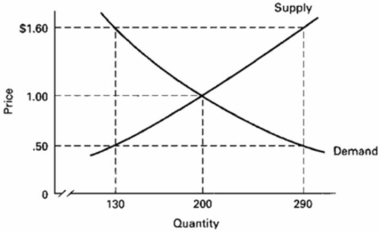
(Multiple Choice)
5.0/5 (85)
(85) You are asked to determine, other things equal, the effects of a given change in a determinant of demand or supply for product Xupon (1) the demand (D) for, or supply (S) of, X, (2) the equilibrium price (P) of X and (3) the equilibrium quantity (Q) of X.Refer to the above.An increase in the tastes and preferences for X will:
(Multiple Choice)
4.7/5 (76)
(76) Which of the following would most likely cause a decrease in current consumer demand for normal good X?
(Multiple Choice)
4.9/5 (80)
(80) Suppose product X is an input in the production of product Y.Product Y in turn is a substitute in production for product Z.An increase in the price of X can be expected to:
(Multiple Choice)
4.8/5 (77)
(77) 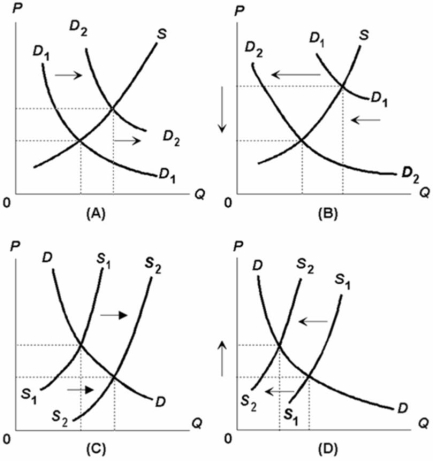 If peanut butter and cheese spread are substitute products, which diagram above illustrates the effect on the peanut butter market of a decrease in the price of cheese spread?
 (Multiple Choice)
4.9/5 (89)
(89) 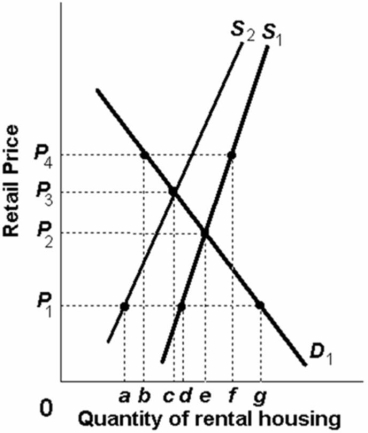 Refer to the above graph, which shows the supply and demand for rental housing in a city.Given the demand D1 and the supply S1 for rental housing, if the government established rent controls in the city at below the equilibrium, then the price of housing would most likely be at:
 (Multiple Choice)
4.8/5 (80)
(80) What combination of changes would most likely decrease the equilibrium quantity?
(Multiple Choice)
4.8/5 (98)
(98) 
Filters
- Essay(0)
- Multiple Choice(0)
- Short Answer(0)
- True False(0)
- Matching(0)