



 Chat with AI
Exam 3: B: Demand, Supply, and Market Equilibrium

Exam 1: B: Limits, Alternatives, and Choices265 Questions
Exam 1: A: - Limits, Alternatives, and Choices60 Questions
Exam 2: B: The Market System and the Circular Flow119 Questions
Exam 2: A: - The Market System and the Circular Flow42 Questions
Exam 3: B: Demand, Supply, and Market Equilibrium291 Questions
Exam 3: A: - Demand, Supply, and Market Equilibrium51 Questions
Exam 4: B: Market Failures: Public Goods and Externalities133 Questions
Exam 4: A: - Market Failures: Public Goods and Externalities36 Questions
Exam 5: B: Governments Role and Government Failure121 Questions
Exam 5: A: Governments Role and Government Failure1 Questions
Exam 6: B: an Introduction to Macroeconomics65 Questions
Exam 6: A: an Introduction to Macroeconomics31 Questions
Exam 7: B: Measuring the Economys Output191 Questions
Exam 7: A: Measuring the Economys Output30 Questions
Exam 8: B: Economic Growth122 Questions
Exam 8: A: Economic Growth35 Questions
Exam 9: B: Business Cycles, Unemployment, and Inflation193 Questions
Exam 9: A: Business Cycles, Unemployment, and Inflation40 Questions
Exam 10: B: Basic Macroeconomic Relationships200 Questions
Exam 10: A: Basic Macroeconomic Relationships26 Questions
Exam 11: B: The Aggregate Expenditures Model238 Questions
Exam 11: A: The Aggregate Expenditures Model47 Questions
Exam 12: B: Aggregate Demand and Aggregate Supply203 Questions
Exam 12: A: Aggregate Demand and Aggregate Supply35 Questions
Exam 13: B: Fiscal Policy, Deficits, Surpluses, and Debt234 Questions
Exam 13: A: Fiscal Policy, Deficits, Surpluses, and Debt53 Questions
Exam 14: B: Money, Banking, and Money Creation206 Questions
Exam 14: A: Money, Banking, and Money Creation56 Questions
Exam 15: B: Interest Rates and Monetary Policy239 Questions
Exam 15: A: Interest Rates and Monetary Policy47 Questions
Exam 17: C: Financial Economics323 Questions
Exam 16: A: Long-Run Macroeconomic Adjustments28 Questions
Exam 16: B: Long-Run Macroeconomic Adjustments122 Questions
Exam 17: A: International Trade40 Questions
Exam 17: B: International Trade188 Questions
Exam 18: A: The Balance of Payments and Exchange Rates30 Questions
Exam 18: B: The Balance of Payments and Exchange Rates133 Questions
Exam 22: The Economics of Developing Countries254 Questions
Select questions type


One reason why the quantity demanded of a good increases when its price falls is that the:
(Multiple Choice)
4.8/5  (68)
(68) 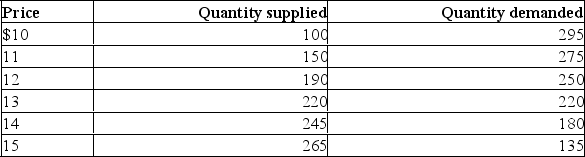 Refer to the above data.The equilibrium price in this market is:
 (Multiple Choice)
4.9/5 (95)
(95) As a result of a decrease in the price of hamburgers, consumers buy more hamburgers and more T-bone steak.This is an illustration of:
(Multiple Choice)
4.8/5 (83)
(83) In a competitive market, if the existing price is below the equilibrium price, market forces will drive the price:
(Multiple Choice)
4.9/5 (82)
(82) Given the supply curve for butter, a reduction in the price of margarine will tend to:
(Multiple Choice)
4.9/5 (96)
(96) 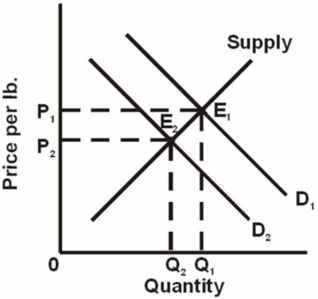 Refer to the above diagram, which shows three supply curves for corn.Which of the following would cause the change in the supply of corn illustrated by the shift from S1 to S3?
 (Multiple Choice)
4.7/5 (90)
(90) What combination of changes would most likely decrease the equilibrium price?
(Multiple Choice)
4.9/5 (82)
(82) A schedule that shows the various amounts of a product which producers are willing and able to produce at each price in a series of possible prices during a specified period of time is called:
(Multiple Choice)
4.9/5 (70)
(70) Refer to the diagram.A price of $60 in this market will result in: 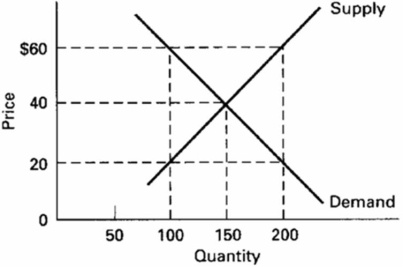
(Multiple Choice)
4.9/5 (81)
(81) We observe a market in which the price has risen and the quantity sold has risen as well.This could be caused by a(n):
(Multiple Choice)
4.8/5 (76)
(76) When the price of a product rises, consumers shift their purchases to other products whose prices are now relatively lower.This statement describes:
(Multiple Choice)
4.8/5 (79)
(79) A and B are substitute goods, but A and C are complementary goods (in consumption).If the costs of production of A decrease, then the demand for:
(Multiple Choice)
5.0/5 (80)
(80) The higher a price floor is above the equilibrium price, the greater will be the surplus output.
(True/False)
4.8/5 (69)
(69) If a legal ceiling price for gasoline is set above the equilibrium price:
(Multiple Choice)
4.9/5 (85)
(85) 
Filters
- Essay(0)
- Multiple Choice(0)
- Short Answer(0)
- True False(0)
- Matching(0)