



 Chat with AI
Exam 3: B: Demand, Supply, and Market Equilibrium

Exam 1: B: Limits, Alternatives, and Choices265 Questions
Exam 1: A: - Limits, Alternatives, and Choices60 Questions
Exam 2: B: The Market System and the Circular Flow119 Questions
Exam 2: A: - The Market System and the Circular Flow42 Questions
Exam 3: B: Demand, Supply, and Market Equilibrium291 Questions
Exam 3: A: - Demand, Supply, and Market Equilibrium51 Questions
Exam 4: B: Market Failures: Public Goods and Externalities133 Questions
Exam 4: A: - Market Failures: Public Goods and Externalities36 Questions
Exam 5: B: Governments Role and Government Failure121 Questions
Exam 5: A: Governments Role and Government Failure1 Questions
Exam 6: B: an Introduction to Macroeconomics65 Questions
Exam 6: A: an Introduction to Macroeconomics31 Questions
Exam 7: B: Measuring the Economys Output191 Questions
Exam 7: A: Measuring the Economys Output30 Questions
Exam 8: B: Economic Growth122 Questions
Exam 8: A: Economic Growth35 Questions
Exam 9: B: Business Cycles, Unemployment, and Inflation193 Questions
Exam 9: A: Business Cycles, Unemployment, and Inflation40 Questions
Exam 10: B: Basic Macroeconomic Relationships200 Questions
Exam 10: A: Basic Macroeconomic Relationships26 Questions
Exam 11: B: The Aggregate Expenditures Model238 Questions
Exam 11: A: The Aggregate Expenditures Model47 Questions
Exam 12: B: Aggregate Demand and Aggregate Supply203 Questions
Exam 12: A: Aggregate Demand and Aggregate Supply35 Questions
Exam 13: B: Fiscal Policy, Deficits, Surpluses, and Debt234 Questions
Exam 13: A: Fiscal Policy, Deficits, Surpluses, and Debt53 Questions
Exam 14: B: Money, Banking, and Money Creation206 Questions
Exam 14: A: Money, Banking, and Money Creation56 Questions
Exam 15: B: Interest Rates and Monetary Policy239 Questions
Exam 15: A: Interest Rates and Monetary Policy47 Questions
Exam 17: C: Financial Economics323 Questions
Exam 16: A: Long-Run Macroeconomic Adjustments28 Questions
Exam 16: B: Long-Run Macroeconomic Adjustments122 Questions
Exam 17: A: International Trade40 Questions
Exam 17: B: International Trade188 Questions
Exam 18: A: The Balance of Payments and Exchange Rates30 Questions
Exam 18: B: The Balance of Payments and Exchange Rates133 Questions
Exam 22: The Economics of Developing Countries254 Questions
Select questions type


A headline reads "Gasoline Prices Are Higher." A likely explanation for this event would be a(n):
(Multiple Choice)
4.8/5  (72)
(72) 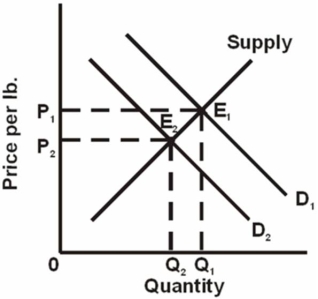 Refer to the above diagram, which shows three supply curves for corn.Which of the following would cause the change in the supply of corn illustrated by the shift from S1 to S2?
 (Multiple Choice)
4.8/5 (83)
(83) Which is most likely to be observed in a community where legal ceilings are imposed on residential rents?
(Multiple Choice)
4.9/5 (89)
(89) An increase in the supply of product X, with demand held constant, will increase the price of product X.
(True/False)
4.9/5 (83)
(83) If products A and B are complements and the price of B decreases:
(Multiple Choice)
4.9/5 (87)
(87) If consumers are willing to pay a higher price than previously for each level of output, we can say that there has occurred:
(Multiple Choice)
4.9/5 (76)
(76) A headline reads "Lumber Prices Up Sharply." In a competitive market, this situation would lead to a(n):
(Multiple Choice)
4.8/5 (76)
(76) The table below shows three individual buyers' demand for wheat.Assume that there are three buyers in the market for wheat (data are hypothetical). 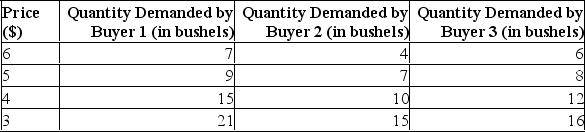 Refer to the table above.The market demand for wheat is:
 (Multiple Choice)
4.8/5 (74)
(74) You are asked to determine, other things equal, the effects of a given change in a determinant of demand or supply for product Xupon (1) the demand (D) for, or supply (S) of, X, (2) the equilibrium price (P) of X and (3) the equilibrium quantity (Q) of X.Refer to the above.An increase in the prices of resources used to produce X will:
(Multiple Choice)
4.7/5 (90)
(90) An increase in supply and demand will lead to an increase in the equilibrium price and an indeterminate change in the equilibrium quantity.
(True/False)
4.9/5 (73)
(73) The law of demand states that, ceteris paribus, there is an inverse relationship between the price of a good and the quantity demanded of the good.
(True/False)
4.8/5 (75)
(75) If producers must obtain higher prices than previously to produce various levels of output, there has occurred:
(Multiple Choice)
4.9/5 (88)
(88) 
Filters
- Essay(0)
- Multiple Choice(0)
- Short Answer(0)
- True False(0)
- Matching(0)