



 Chat with AI
Exam 3: B: Demand, Supply, and Market Equilibrium

Exam 1: B: Limits, Alternatives, and Choices265 Questions
Exam 1: A: - Limits, Alternatives, and Choices60 Questions
Exam 2: B: The Market System and the Circular Flow119 Questions
Exam 2: A: - The Market System and the Circular Flow42 Questions
Exam 3: B: Demand, Supply, and Market Equilibrium291 Questions
Exam 3: A: - Demand, Supply, and Market Equilibrium51 Questions
Exam 4: B: Market Failures: Public Goods and Externalities133 Questions
Exam 4: A: - Market Failures: Public Goods and Externalities36 Questions
Exam 5: B: Governments Role and Government Failure121 Questions
Exam 5: A: Governments Role and Government Failure1 Questions
Exam 6: B: an Introduction to Macroeconomics65 Questions
Exam 6: A: an Introduction to Macroeconomics31 Questions
Exam 7: B: Measuring the Economys Output191 Questions
Exam 7: A: Measuring the Economys Output30 Questions
Exam 8: B: Economic Growth122 Questions
Exam 8: A: Economic Growth35 Questions
Exam 9: B: Business Cycles, Unemployment, and Inflation193 Questions
Exam 9: A: Business Cycles, Unemployment, and Inflation40 Questions
Exam 10: B: Basic Macroeconomic Relationships200 Questions
Exam 10: A: Basic Macroeconomic Relationships26 Questions
Exam 11: B: The Aggregate Expenditures Model238 Questions
Exam 11: A: The Aggregate Expenditures Model47 Questions
Exam 12: B: Aggregate Demand and Aggregate Supply203 Questions
Exam 12: A: Aggregate Demand and Aggregate Supply35 Questions
Exam 13: B: Fiscal Policy, Deficits, Surpluses, and Debt234 Questions
Exam 13: A: Fiscal Policy, Deficits, Surpluses, and Debt53 Questions
Exam 14: B: Money, Banking, and Money Creation206 Questions
Exam 14: A: Money, Banking, and Money Creation56 Questions
Exam 15: B: Interest Rates and Monetary Policy239 Questions
Exam 15: A: Interest Rates and Monetary Policy47 Questions
Exam 17: C: Financial Economics323 Questions
Exam 16: A: Long-Run Macroeconomic Adjustments28 Questions
Exam 16: B: Long-Run Macroeconomic Adjustments122 Questions
Exam 17: A: International Trade40 Questions
Exam 17: B: International Trade188 Questions
Exam 18: A: The Balance of Payments and Exchange Rates30 Questions
Exam 18: B: The Balance of Payments and Exchange Rates133 Questions
Exam 22: The Economics of Developing Countries254 Questions
Select questions type


When the price of one fruit increases, consumers buy more of another fruit.This situation is an illustration of:
(Multiple Choice)
4.8/5  (86)
(86) A leftward shift of a product supply curve might be caused by:
(Multiple Choice)
4.8/5 (63)
(63) If the price of K declines, the demand curve for the complementary product J will:
(Multiple Choice)
4.8/5 (92)
(92) If an increase in consumer incomes causes the demand curve for product Z to shift to the left, then it can be said that product Z is a(n):
(Multiple Choice)
4.9/5 (77)
(77) A newspaper reports that in an urban area the average price of new homes had decreased, but the number of new homes sold had increased.This situation would best be explained by a(n):
(Multiple Choice)
4.9/5 (76)
(76) Which of the following will not cause the demand for product K to change?
(Multiple Choice)
4.8/5 (79)
(79) If an economy produces its most wanted goods but uses outdated production methods, it is:
(Multiple Choice)
4.9/5 (86)
(86) An increase in the price of a product will reduce the amount of it purchased because:
(Multiple Choice)
4.9/5 (82)
(82) A television station reports that the price of coffee has increased but the quantity sold in the market has decreased.This situation would be caused by a(n):
(Multiple Choice)
4.7/5 (83)
(83) Assume a drought in the Great Plains reduces the supply of wheat.Noting that wheat is a basic ingredient in the production of bread and that potatoes are a consumer substitute for bread, we would expect the price of wheat to:
(Multiple Choice)
4.9/5 (80)
(80) We observe a market where the price has risen and the quantity being sold has declined.This could be caused by a(n):
(Multiple Choice)
4.9/5 (79)
(79) If products C and D are close substitutes, an increase in the price of C will:
(Multiple Choice)
4.8/5 (79)
(79) The table below shows three individual buyers' demand for wheat.Assume that there are three buyers in the market for wheat (data are hypothetical). 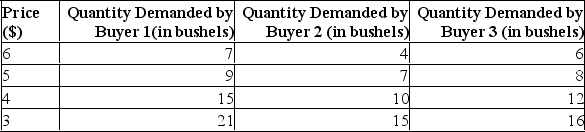 Refer to the table above.At a price of $6, the market demand for wheat is:
 (Multiple Choice)
4.9/5 (84)
(84) You are asked to determine, other things equal, the effects of a given change in a determinant of demand or supply for product Xupon (1) the demand (D) for, or supply (S) of, X, (2) the equilibrium price (P) of X and (3) the equilibrium quantity (Q) of X.Refer to the above.Consumer expectations that the price of X will rise sharply in the future will:
(Multiple Choice)
4.9/5 (78)
(78) 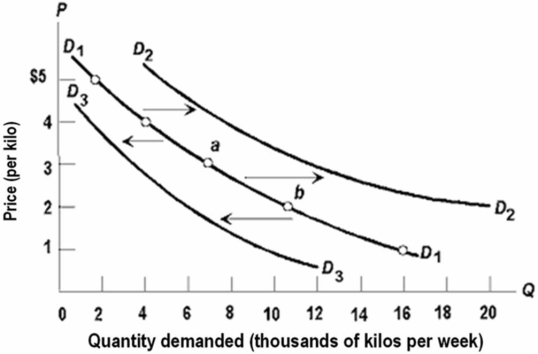 Refer to the above diagram, which shows three demand curves for coffee.Which of the following would cause the change in the demand for coffee illustrated by the shift from D1 to D3?
 (Multiple Choice)
4.8/5 (78)
(78) 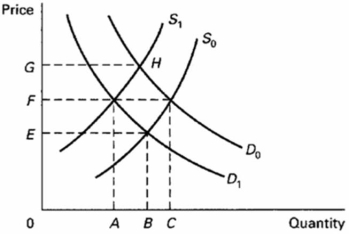 Refer to the above diagram, which shows demand and supply conditions in the competitive market for product X.Given D0, if the supply curve moved from S0 to S1, then:
 (Multiple Choice)
4.7/5 (76)
(76) 
Filters
- Essay(0)
- Multiple Choice(0)
- Short Answer(0)
- True False(0)
- Matching(0)