



 Chat with AI
Exam 17: C: Financial Economics

Exam 1: B: Limits, Alternatives, and Choices265 Questions
Exam 1: A: - Limits, Alternatives, and Choices60 Questions
Exam 2: B: The Market System and the Circular Flow119 Questions
Exam 2: A: - The Market System and the Circular Flow42 Questions
Exam 3: B: Demand, Supply, and Market Equilibrium291 Questions
Exam 3: A: - Demand, Supply, and Market Equilibrium51 Questions
Exam 4: B: Market Failures: Public Goods and Externalities133 Questions
Exam 4: A: - Market Failures: Public Goods and Externalities36 Questions
Exam 5: B: Governments Role and Government Failure121 Questions
Exam 5: A: Governments Role and Government Failure1 Questions
Exam 6: B: an Introduction to Macroeconomics65 Questions
Exam 6: A: an Introduction to Macroeconomics31 Questions
Exam 7: B: Measuring the Economys Output191 Questions
Exam 7: A: Measuring the Economys Output30 Questions
Exam 8: B: Economic Growth122 Questions
Exam 8: A: Economic Growth35 Questions
Exam 9: B: Business Cycles, Unemployment, and Inflation193 Questions
Exam 9: A: Business Cycles, Unemployment, and Inflation40 Questions
Exam 10: B: Basic Macroeconomic Relationships200 Questions
Exam 10: A: Basic Macroeconomic Relationships26 Questions
Exam 11: B: The Aggregate Expenditures Model238 Questions
Exam 11: A: The Aggregate Expenditures Model47 Questions
Exam 12: B: Aggregate Demand and Aggregate Supply203 Questions
Exam 12: A: Aggregate Demand and Aggregate Supply35 Questions
Exam 13: B: Fiscal Policy, Deficits, Surpluses, and Debt234 Questions
Exam 13: A: Fiscal Policy, Deficits, Surpluses, and Debt53 Questions
Exam 14: B: Money, Banking, and Money Creation206 Questions
Exam 14: A: Money, Banking, and Money Creation56 Questions
Exam 15: B: Interest Rates and Monetary Policy239 Questions
Exam 15: A: Interest Rates and Monetary Policy47 Questions
Exam 17: C: Financial Economics323 Questions
Exam 16: A: Long-Run Macroeconomic Adjustments28 Questions
Exam 16: B: Long-Run Macroeconomic Adjustments122 Questions
Exam 17: A: International Trade40 Questions
Exam 17: B: International Trade188 Questions
Exam 18: A: The Balance of Payments and Exchange Rates30 Questions
Exam 18: B: The Balance of Payments and Exchange Rates133 Questions
Exam 22: The Economics of Developing Countries254 Questions
Select questions type


If an investment is 80 percent likely to gain 40 percent but also 20 percent likely to lose 10 percent, then its average expected rate of return is
(Multiple Choice)
4.8/5  (75)
(75) The average expected rate of return on an asset can be fully understood as the rate that compensates for risk.
(True/False)
4.9/5 (95)
(95) Which one of the following is an example of an economic investment?
(Multiple Choice)
4.8/5 (78)
(78) The U.S.federal government is unlikely to default on its bond payments because
(Multiple Choice)
4.9/5 (85)
(85) Before taking management and trading costs into account, arbitrage activities in the market ensure that the returns of actively managed funds are
(Multiple Choice)
5.0/5 (68)
(68) Owners of stock can receive from their shares; sellers of stock can receive from selling their shares.
(Multiple Choice)
4.9/5 (81)
(81) If an asset has a beta of 1.5, it has 50 percent more nondiversifiable risk than the market portfolio.
(True/False)
5.0/5 (66)
(66) Risk in financial economics refers mainly to the chance that an investment could lose value.
(True/False)
4.9/5 (83)
(83) Two investments, X and Y, have beta values of 0.1 and 3.0 respectively.Based on this, we can claim that, relative to the market portfolio,
(Multiple Choice)
5.0/5 (85)
(85) Which one of the following is a feature of all investments?
(Multiple Choice)
4.9/5 (73)
(73) 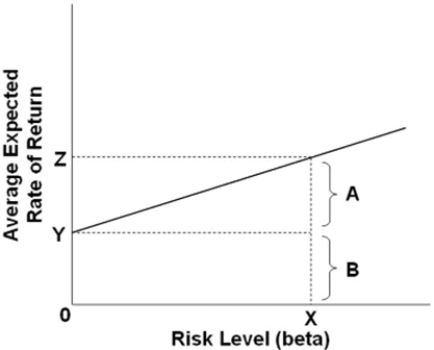 In the accompanying graph, bracket A represents the
The idea that money has "time value" refers to the fact that
(Multiple Choice)
4.8/5 (78)
(78) Arbitrage refers to the buying and selling activities that cause an equalization of the rates of return on assets that have substantially different characteristics.
(True/False)
4.8/5 (74)
(74) Karen holds a $100 bond that pays $10 per year in interest.The minimum price Karen would have to be offered before she would sell the bond
(Multiple Choice)
4.8/5 (86)
(86) An investor wants to invest in the oil industry but does not know which major companies will produce the greatest return.As a result, the investor buys shares in several oil companies.By buying several companies to reduce risk, the investor is seeking to reduce
(Multiple Choice)
4.9/5 (71)
(71) Compound interest describes increases in value when interest is paid, or compounded, on
(Multiple Choice)
4.8/5 (77)
(77) 
Filters
- Essay(0)
- Multiple Choice(0)
- Short Answer(0)
- True False(0)
- Matching(0)