



 Chat with AI
Exam 17: C: Financial Economics

Exam 1: B: Limits, Alternatives, and Choices265 Questions
Exam 1: A: - Limits, Alternatives, and Choices60 Questions
Exam 2: B: The Market System and the Circular Flow119 Questions
Exam 2: A: - The Market System and the Circular Flow42 Questions
Exam 3: B: Demand, Supply, and Market Equilibrium291 Questions
Exam 3: A: - Demand, Supply, and Market Equilibrium51 Questions
Exam 4: B: Market Failures: Public Goods and Externalities133 Questions
Exam 4: A: - Market Failures: Public Goods and Externalities36 Questions
Exam 5: B: Governments Role and Government Failure121 Questions
Exam 5: A: Governments Role and Government Failure1 Questions
Exam 6: B: an Introduction to Macroeconomics65 Questions
Exam 6: A: an Introduction to Macroeconomics31 Questions
Exam 7: B: Measuring the Economys Output191 Questions
Exam 7: A: Measuring the Economys Output30 Questions
Exam 8: B: Economic Growth122 Questions
Exam 8: A: Economic Growth35 Questions
Exam 9: B: Business Cycles, Unemployment, and Inflation193 Questions
Exam 9: A: Business Cycles, Unemployment, and Inflation40 Questions
Exam 10: B: Basic Macroeconomic Relationships200 Questions
Exam 10: A: Basic Macroeconomic Relationships26 Questions
Exam 11: B: The Aggregate Expenditures Model238 Questions
Exam 11: A: The Aggregate Expenditures Model47 Questions
Exam 12: B: Aggregate Demand and Aggregate Supply203 Questions
Exam 12: A: Aggregate Demand and Aggregate Supply35 Questions
Exam 13: B: Fiscal Policy, Deficits, Surpluses, and Debt234 Questions
Exam 13: A: Fiscal Policy, Deficits, Surpluses, and Debt53 Questions
Exam 14: B: Money, Banking, and Money Creation206 Questions
Exam 14: A: Money, Banking, and Money Creation56 Questions
Exam 15: B: Interest Rates and Monetary Policy239 Questions
Exam 15: A: Interest Rates and Monetary Policy47 Questions
Exam 17: C: Financial Economics323 Questions
Exam 16: A: Long-Run Macroeconomic Adjustments28 Questions
Exam 16: B: Long-Run Macroeconomic Adjustments122 Questions
Exam 17: A: International Trade40 Questions
Exam 17: B: International Trade188 Questions
Exam 18: A: The Balance of Payments and Exchange Rates30 Questions
Exam 18: B: The Balance of Payments and Exchange Rates133 Questions
Exam 22: The Economics of Developing Countries254 Questions
Select questions type


Bonds issued by the Federal government are riskier than bonds issued by corporations.
(True/False)
4.9/5  (77)
(77) The compensation for bearing more risk in owning an asset is a higher rate of return for the asset.
(True/False)
4.8/5 (81)
(81) You estimate that a piece of real estate for investment will be worth $700,000 in five years.The current interest rate is 3 percent.What is the present value of this investment?
(Multiple Choice)
4.7/5 (83)
(83) Tracy won a $100 million jackpot. She can receive the jackpot as a $5 million payment each year for 20 years, or she can ask to receive the present value of all those payments all at once now. Assume an annual interest rate of 5 percent. If she decides to take the present value payment, about how much will she receive?
(Multiple Choice)
4.8/5 (74)
(74) The Security Market Line is a straight line that plots how the average expected rates of return on assets and portfolios in an economy vary with their respective levels of nondiversifiable risk as measured by beta.
(True/False)
4.8/5 (75)
(75) The beta for the market portfolio's level of nondiversifiable risk is
(Multiple Choice)
4.8/5 (82)
(82) The concept of time preference in financial investing rests on the belief that people
(Multiple Choice)
4.8/5 (76)
(76) 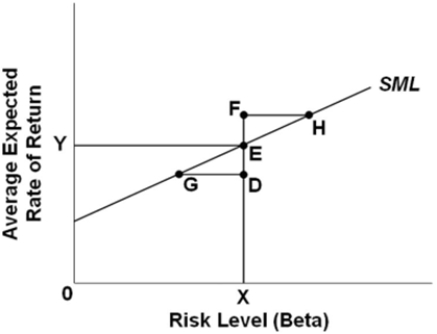 Refer to the graph.Each labeled point represents a different asset.For which of these assets would we expect arbitrage to cause movement to a different point?
 (Multiple Choice)
4.9/5 (78)
(78) Rupert recently purchased a nonmaturing bond for $10,000 that pays $350 semiannual coupons.His expected rate of return per year on the bond is
(Multiple Choice)
5.0/5 (81)
(81) 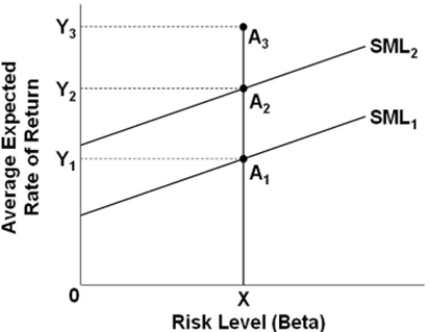 Refer to the graph. A movement of the Security Market Line from SML2 to SML1 and of the highlighted asset from A2 to A1 would be caused by
 (Multiple Choice)
4.8/5 (73)
(73) The decision of the Federal Reserve to reduce the short-term interest rate will shift the Security Market Line upward.
(True/False)
4.8/5 (96)
(96) Arbitrage causes an equalization of the when assets are identical or nearly identical.
(Multiple Choice)
4.8/5 (79)
(79) A bond that is currently selling at $1,000 offers to pay $50 annually.What is the percentage rate of return on the bond?
(Multiple Choice)
4.9/5 (92)
(92) (Consider This) According to critics, growth in the popularity of mutual funds has
(Multiple Choice)
4.7/5 (82)
(82) 
Filters
- Essay(0)
- Multiple Choice(0)
- Short Answer(0)
- True False(0)
- Matching(0)