



 Chat with AI
Exam 17: C: Financial Economics

Exam 1: B: Limits, Alternatives, and Choices265 Questions
Exam 1: A: - Limits, Alternatives, and Choices60 Questions
Exam 2: B: The Market System and the Circular Flow119 Questions
Exam 2: A: - The Market System and the Circular Flow42 Questions
Exam 3: B: Demand, Supply, and Market Equilibrium291 Questions
Exam 3: A: - Demand, Supply, and Market Equilibrium51 Questions
Exam 4: B: Market Failures: Public Goods and Externalities133 Questions
Exam 4: A: - Market Failures: Public Goods and Externalities36 Questions
Exam 5: B: Governments Role and Government Failure121 Questions
Exam 5: A: Governments Role and Government Failure1 Questions
Exam 6: B: an Introduction to Macroeconomics65 Questions
Exam 6: A: an Introduction to Macroeconomics31 Questions
Exam 7: B: Measuring the Economys Output191 Questions
Exam 7: A: Measuring the Economys Output30 Questions
Exam 8: B: Economic Growth122 Questions
Exam 8: A: Economic Growth35 Questions
Exam 9: B: Business Cycles, Unemployment, and Inflation193 Questions
Exam 9: A: Business Cycles, Unemployment, and Inflation40 Questions
Exam 10: B: Basic Macroeconomic Relationships200 Questions
Exam 10: A: Basic Macroeconomic Relationships26 Questions
Exam 11: B: The Aggregate Expenditures Model238 Questions
Exam 11: A: The Aggregate Expenditures Model47 Questions
Exam 12: B: Aggregate Demand and Aggregate Supply203 Questions
Exam 12: A: Aggregate Demand and Aggregate Supply35 Questions
Exam 13: B: Fiscal Policy, Deficits, Surpluses, and Debt234 Questions
Exam 13: A: Fiscal Policy, Deficits, Surpluses, and Debt53 Questions
Exam 14: B: Money, Banking, and Money Creation206 Questions
Exam 14: A: Money, Banking, and Money Creation56 Questions
Exam 15: B: Interest Rates and Monetary Policy239 Questions
Exam 15: A: Interest Rates and Monetary Policy47 Questions
Exam 17: C: Financial Economics323 Questions
Exam 16: A: Long-Run Macroeconomic Adjustments28 Questions
Exam 16: B: Long-Run Macroeconomic Adjustments122 Questions
Exam 17: A: International Trade40 Questions
Exam 17: B: International Trade188 Questions
Exam 18: A: The Balance of Payments and Exchange Rates30 Questions
Exam 18: B: The Balance of Payments and Exchange Rates133 Questions
Exam 22: The Economics of Developing Countries254 Questions
Select questions type


The so-called market portfolio used as a benchmark in financial economics is
(Multiple Choice)
4.9/5  (78)
(78) A recession in an economy would be an example of a diversifiable risk.
(True/False)
4.7/5 (78)
(78) 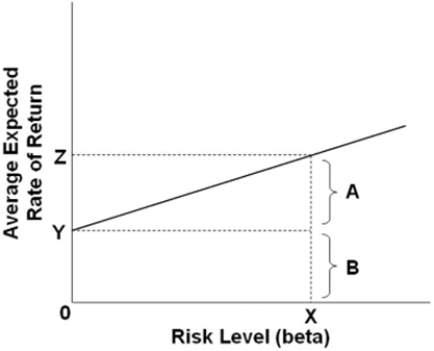 In the accompanying graph, point Y represents the
Stockholders of a company can benefit from either capital gains or dividends when the company is profitable.
(True/False)
4.8/5 (78)
(78) Which of the following statements is true about buying an old factory?
(Multiple Choice)
4.7/5 (77)
(77) Lottery winners who take the lump-sum payouts instead of payments spread out over many years
(Multiple Choice)
4.9/5 (83)
(83) If an asset has a risk-return combination that is below the Security Market Line (SML), then this indicates that the asset's
(Multiple Choice)
4.9/5 (79)
(79) Jacob is holding an investment he bought for $1,000 that has a 60 percent chance of gaining $200 in value and a 40 percent chance of losing $40.Jacob's average expected rate of return on this investment is
(Multiple Choice)
4.8/5 (80)
(80) Katie buys a house for $200,000 and rents it for $1,000 per month.Katie's annual rate of return
(Multiple Choice)
5.0/5 (84)
(84) The present value of a future amount of money will be greater the
(Multiple Choice)
4.8/5 (82)
(82) The vertical intercept of the Security Market Line is determined by the
(Multiple Choice)
4.8/5 (85)
(85) The process by which investors seek to profit by simultaneously selling an asset with a lower rate of return and buying an otherwise identical asset with a higher rate of return is known as
(Multiple Choice)
4.8/5 (76)
(76) Which of the following statements is true about investing in stocks and bonds?
(Multiple Choice)
4.8/5 (94)
(94) 
Filters
- Essay(0)
- Multiple Choice(0)
- Short Answer(0)
- True False(0)
- Matching(0)