



 Chat with AI
Exam 17: C: Financial Economics

Exam 1: B: Limits, Alternatives, and Choices265 Questions
Exam 1: A: - Limits, Alternatives, and Choices60 Questions
Exam 2: B: The Market System and the Circular Flow119 Questions
Exam 2: A: - The Market System and the Circular Flow42 Questions
Exam 3: B: Demand, Supply, and Market Equilibrium291 Questions
Exam 3: A: - Demand, Supply, and Market Equilibrium51 Questions
Exam 4: B: Market Failures: Public Goods and Externalities133 Questions
Exam 4: A: - Market Failures: Public Goods and Externalities36 Questions
Exam 5: B: Governments Role and Government Failure121 Questions
Exam 5: A: Governments Role and Government Failure1 Questions
Exam 6: B: an Introduction to Macroeconomics65 Questions
Exam 6: A: an Introduction to Macroeconomics31 Questions
Exam 7: B: Measuring the Economys Output191 Questions
Exam 7: A: Measuring the Economys Output30 Questions
Exam 8: B: Economic Growth122 Questions
Exam 8: A: Economic Growth35 Questions
Exam 9: B: Business Cycles, Unemployment, and Inflation193 Questions
Exam 9: A: Business Cycles, Unemployment, and Inflation40 Questions
Exam 10: B: Basic Macroeconomic Relationships200 Questions
Exam 10: A: Basic Macroeconomic Relationships26 Questions
Exam 11: B: The Aggregate Expenditures Model238 Questions
Exam 11: A: The Aggregate Expenditures Model47 Questions
Exam 12: B: Aggregate Demand and Aggregate Supply203 Questions
Exam 12: A: Aggregate Demand and Aggregate Supply35 Questions
Exam 13: B: Fiscal Policy, Deficits, Surpluses, and Debt234 Questions
Exam 13: A: Fiscal Policy, Deficits, Surpluses, and Debt53 Questions
Exam 14: B: Money, Banking, and Money Creation206 Questions
Exam 14: A: Money, Banking, and Money Creation56 Questions
Exam 15: B: Interest Rates and Monetary Policy239 Questions
Exam 15: A: Interest Rates and Monetary Policy47 Questions
Exam 17: C: Financial Economics323 Questions
Exam 16: A: Long-Run Macroeconomic Adjustments28 Questions
Exam 16: B: Long-Run Macroeconomic Adjustments122 Questions
Exam 17: A: International Trade40 Questions
Exam 17: B: International Trade188 Questions
Exam 18: A: The Balance of Payments and Exchange Rates30 Questions
Exam 18: B: The Balance of Payments and Exchange Rates133 Questions
Exam 22: The Economics of Developing Countries254 Questions
Select questions type


Joseph is considering purchasing a condo. He has the option of buying one in Midtown with a present value of $150,000 or one in downtown with a future value of $200,000. If the current market interest rate is 5 percent and he wants to buy the home with the highest future value in 5 years, he should buy the condo in downtown.
(True/False)
4.8/5  (71)
(71) The Security Market line (SML) shows how the average expected rates of return on assets vary with
(Multiple Choice)
4.7/5 (85)
(85) During the financial crisis of 2007-2008, investors demanded much higher risk premiums in their investments.This caused the SML to
(Multiple Choice)
4.8/5 (75)
(75) The key difference between bonds and stocks is that stocks' income streams are more predictable than those of bonds.
(True/False)
4.9/5 (79)
(79) Assume that two firms (Firm A and Firm B) are similar in all respects, but Firm A's stock has a higher rate of return than Firm B's stock.Arbitrage will occur as investors
(Multiple Choice)
5.0/5 (92)
(92) (Advanced analysis) Susie has $500 invested in a financial asset earning an annually compounded interest rate of 8 percent.If Susie plans to cash in the asset when it is worth $700, about how long will she have to wait?
(Multiple Choice)
4.8/5 (64)
(64) 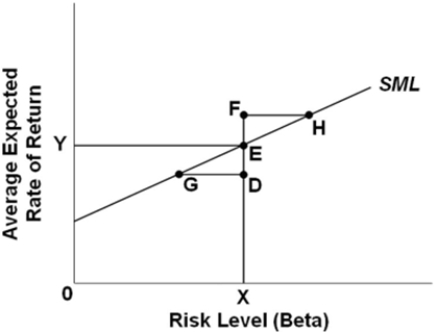 Refer to the graph.Each labeled point represents a different asset.For which of these assets would we not expect arbitrage to change the average expected rate of return?
 (Multiple Choice)
4.9/5 (72)
(72) Which of the following is a difference between stocks and bonds?
(Multiple Choice)
4.8/5 (74)
(74) Hermione is considering an investment that has a ¾ chance of paying a 10 percent rate of return and a ¼ chance of paying 2 percent.What is the average expected rate of return on the investment?
(Multiple Choice)
4.9/5 (80)
(80) Alyssa is saving money for a vacation she wants to take five years from now.If the trip will cost $1,000 and she puts her money into a savings account paying 4 percent interest, compounded annually, how much would Alyssa need to deposit today to reach her goal without making further deposits?
(Multiple Choice)
4.7/5 (90)
(90) Roger has the opportunity to invest $100,000 in two different assets. The investment in Asset #1 will have a present value of $120,000. The investment in Asset #2 is expected to have a future value of $140,000 in four years. If the market interest rate is 5 percent a year, which one would be the better investment?
(Multiple Choice)
4.9/5 (77)
(77) The present value of a stream of lottery payments is less than the size of the stated jackpot.
(True/False)
4.8/5 (84)
(84) What is the present value of $5,000 to be received 10 years from now if the interest rate is 10 percent?
(Multiple Choice)
4.9/5 (73)
(73) An expansionary monetary policy will shift the Security Market Line down.
(True/False)
4.8/5 (87)
(87) A bank makes an auto loan for $10,000 at an annual rate of 6 percent.Assuming no repayment is made during the period, after two years the borrower will owe
(Multiple Choice)
4.9/5 (90)
(90) 
Filters
- Essay(0)
- Multiple Choice(0)
- Short Answer(0)
- True False(0)
- Matching(0)