



 Chat with AI
Exam 17: C: Financial Economics

Exam 1: B: Limits, Alternatives, and Choices265 Questions
Exam 1: A: - Limits, Alternatives, and Choices60 Questions
Exam 2: B: The Market System and the Circular Flow119 Questions
Exam 2: A: - The Market System and the Circular Flow42 Questions
Exam 3: B: Demand, Supply, and Market Equilibrium291 Questions
Exam 3: A: - Demand, Supply, and Market Equilibrium51 Questions
Exam 4: B: Market Failures: Public Goods and Externalities133 Questions
Exam 4: A: - Market Failures: Public Goods and Externalities36 Questions
Exam 5: B: Governments Role and Government Failure121 Questions
Exam 5: A: Governments Role and Government Failure1 Questions
Exam 6: B: an Introduction to Macroeconomics65 Questions
Exam 6: A: an Introduction to Macroeconomics31 Questions
Exam 7: B: Measuring the Economys Output191 Questions
Exam 7: A: Measuring the Economys Output30 Questions
Exam 8: B: Economic Growth122 Questions
Exam 8: A: Economic Growth35 Questions
Exam 9: B: Business Cycles, Unemployment, and Inflation193 Questions
Exam 9: A: Business Cycles, Unemployment, and Inflation40 Questions
Exam 10: B: Basic Macroeconomic Relationships200 Questions
Exam 10: A: Basic Macroeconomic Relationships26 Questions
Exam 11: B: The Aggregate Expenditures Model238 Questions
Exam 11: A: The Aggregate Expenditures Model47 Questions
Exam 12: B: Aggregate Demand and Aggregate Supply203 Questions
Exam 12: A: Aggregate Demand and Aggregate Supply35 Questions
Exam 13: B: Fiscal Policy, Deficits, Surpluses, and Debt234 Questions
Exam 13: A: Fiscal Policy, Deficits, Surpluses, and Debt53 Questions
Exam 14: B: Money, Banking, and Money Creation206 Questions
Exam 14: A: Money, Banking, and Money Creation56 Questions
Exam 15: B: Interest Rates and Monetary Policy239 Questions
Exam 15: A: Interest Rates and Monetary Policy47 Questions
Exam 17: C: Financial Economics323 Questions
Exam 16: A: Long-Run Macroeconomic Adjustments28 Questions
Exam 16: B: Long-Run Macroeconomic Adjustments122 Questions
Exam 17: A: International Trade40 Questions
Exam 17: B: International Trade188 Questions
Exam 18: A: The Balance of Payments and Exchange Rates30 Questions
Exam 18: B: The Balance of Payments and Exchange Rates133 Questions
Exam 22: The Economics of Developing Countries254 Questions
Select questions type


One asset has a beta of 1.5 and another asset has a beta of 0.75.The difference in beta means that the asset with a beta of 0.75 has
(Multiple Choice)
4.8/5  (72)
(72) Calculate the present value of an asset worth $2,000 four years from now if the interest rate is 6 percent.
(Multiple Choice)
4.8/5 (80)
(80) The U.S.federal government is unlikely to default on its bonds because
(Multiple Choice)
4.9/5 (77)
(77) Which of the following statements best reflects the concept of present value?
(Multiple Choice)
4.9/5 (66)
(66) (Advanced analysis) Kara has $2,000 to invest today that she wants to grow to $3,000 in five years.What annually compounded rate of interest would she have to earn to reach her goal?
(Multiple Choice)
4.8/5 (89)
(89) Investments that are designed to match exactly the performance of a group of stocks like the Dow Jones Industrial Average or the S&P 500 are called
(Multiple Choice)
4.8/5 (73)
(73) An investor with a diversified portfolio is generally less concerned about
(Multiple Choice)
4.8/5 (58)
(58) Suppose stock A sells for $30 per share and pays dividends of $1 per share per year.Stock B sells for $40 per share and pays dividends of $2 per share per year.Through the process of arbitrage, we would expect the price of
(Multiple Choice)
4.9/5 (63)
(63) 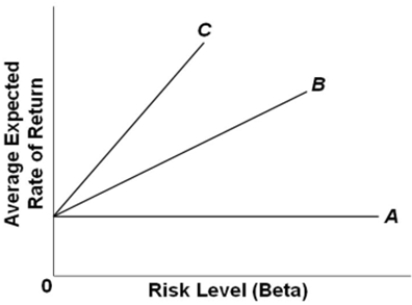 Refer to the graph.The intercept of the three Security Market Lines is determined by
 (Multiple Choice)
4.8/5 (69)
(69) Arbitrage activities will make the price of the asset with the higher initial return increase, while the price of the asset with the lower return will decrease.
(True/False)
4.9/5 (87)
(87) $500 invested at an annual interest rate of 8 percent will be worth how much at the end of one year?
(Multiple Choice)
4.8/5 (83)
(83) When the Security Market Line shifts up, the average expected rate of return on investment assets with given risk levels is increasing.
(True/False)
4.8/5 (82)
(82) 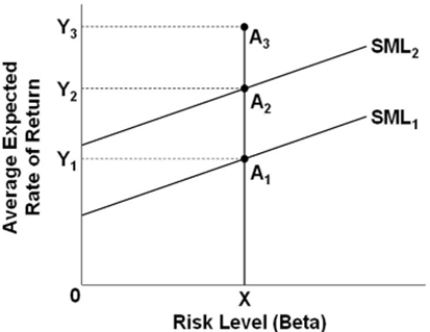 Refer to the graph. An increase in the Security Market Line from SML1 to SML2 and an increase in the average expected rate of return of asset A from Y1 to Y2 would be explained by
 (Multiple Choice)
4.8/5 (73)
(73) Maria is looking to buy one of two houses to rent out for additional income.She determines that the first house, priced at $200,000, could rent for $1,500 per month.If the second house is priced at $280,000, how much rent would Maria have to charge to get an equivalent yearly rate of return?
(Multiple Choice)
4.7/5 (76)
(76) Alex wants to borrow $1,000 from Kara.If he repays the loan in one year, Kara will require him to pay 5 percent interest on the loan.If Alex wants to repay the loan over three years, but Kara strongly prefers present to future consumption, we would expect the interest rate on a three-year loan to be
(Multiple Choice)
4.8/5 (92)
(92) 
Filters
- Essay(0)
- Multiple Choice(0)
- Short Answer(0)
- True False(0)
- Matching(0)