



 Chat with AI
Exam 13: B: Fiscal Policy, Deficits, Surpluses, and Debt

Exam 1: B: Limits, Alternatives, and Choices265 Questions
Exam 1: A: - Limits, Alternatives, and Choices60 Questions
Exam 2: B: The Market System and the Circular Flow119 Questions
Exam 2: A: - The Market System and the Circular Flow42 Questions
Exam 3: B: Demand, Supply, and Market Equilibrium291 Questions
Exam 3: A: - Demand, Supply, and Market Equilibrium51 Questions
Exam 4: B: Market Failures: Public Goods and Externalities133 Questions
Exam 4: A: - Market Failures: Public Goods and Externalities36 Questions
Exam 5: B: Governments Role and Government Failure121 Questions
Exam 5: A: Governments Role and Government Failure1 Questions
Exam 6: B: an Introduction to Macroeconomics65 Questions
Exam 6: A: an Introduction to Macroeconomics31 Questions
Exam 7: B: Measuring the Economys Output191 Questions
Exam 7: A: Measuring the Economys Output30 Questions
Exam 8: B: Economic Growth122 Questions
Exam 8: A: Economic Growth35 Questions
Exam 9: B: Business Cycles, Unemployment, and Inflation193 Questions
Exam 9: A: Business Cycles, Unemployment, and Inflation40 Questions
Exam 10: B: Basic Macroeconomic Relationships200 Questions
Exam 10: A: Basic Macroeconomic Relationships26 Questions
Exam 11: B: The Aggregate Expenditures Model238 Questions
Exam 11: A: The Aggregate Expenditures Model47 Questions
Exam 12: B: Aggregate Demand and Aggregate Supply203 Questions
Exam 12: A: Aggregate Demand and Aggregate Supply35 Questions
Exam 13: B: Fiscal Policy, Deficits, Surpluses, and Debt234 Questions
Exam 13: A: Fiscal Policy, Deficits, Surpluses, and Debt53 Questions
Exam 14: B: Money, Banking, and Money Creation206 Questions
Exam 14: A: Money, Banking, and Money Creation56 Questions
Exam 15: B: Interest Rates and Monetary Policy239 Questions
Exam 15: A: Interest Rates and Monetary Policy47 Questions
Exam 17: C: Financial Economics323 Questions
Exam 16: A: Long-Run Macroeconomic Adjustments28 Questions
Exam 16: B: Long-Run Macroeconomic Adjustments122 Questions
Exam 17: A: International Trade40 Questions
Exam 17: B: International Trade188 Questions
Exam 18: A: The Balance of Payments and Exchange Rates30 Questions
Exam 18: B: The Balance of Payments and Exchange Rates133 Questions
Exam 22: The Economics of Developing Countries254 Questions
Select questions type


One reason the public debt will not bankrupt the Federal government is that the:
(Multiple Choice)
4.9/5  (86)
(86) 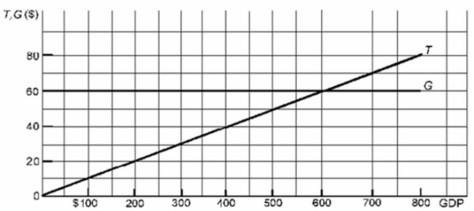 Refer to the above diagram where T is tax revenues and G is government expenditures.All figures are in billions of dollars.If the full-employment GDP is $400 billion while the actual GDP is $200 billion, the full-employment or cyclically adjusted deficit is:
 (Multiple Choice)
4.8/5 (82)
(82) 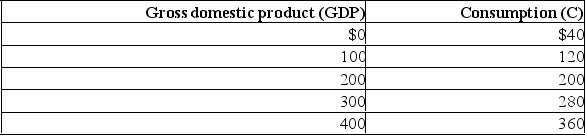 Refer to the above data.If a 10 percent proportional tax on income is imposed, the consumption schedule will now be:
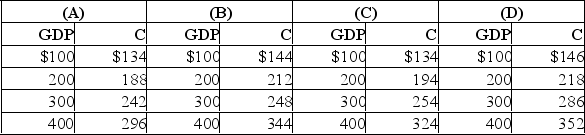
Refer to the above data.If a 10 percent proportional tax on income is imposed, the consumption schedule will now be: (Multiple Choice)
4.9/5 (82)
(82) Who among the following owned the smallest percentage of Canada's public debt in 2016, using Figure 13-7?
(Multiple Choice)
4.7/5 (80)
(80) 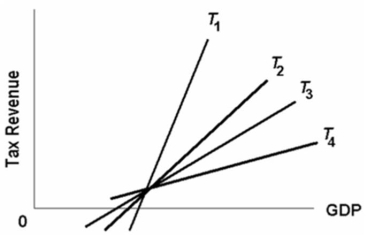 Refer to the above diagram.Which tax system has the least built-in stability?
 (Multiple Choice)
4.9/5 (92)
(92) 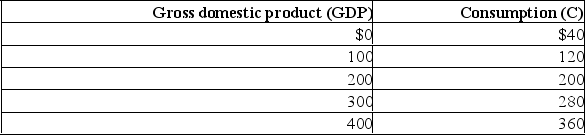 Refer to the above data.If a lump-sum tax (the same tax amount at each level of GDP) of $40 is imposed in this economy, the marginal propensity to consume is:
 (Multiple Choice)
4.8/5 (91)
(91) The greater the progressiveness of the tax system, the less is the built-in stability of the economy.
(True/False)
4.8/5 (68)
(68) Other things equal, the stock of capital inherited by future generations is likely to be smaller when government spending:
(Multiple Choice)
4.9/5 (81)
(81) 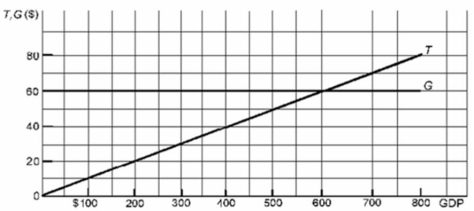 Refer to the above diagram where T is tax revenues and G is government expenditures.All figures are in billions of dollars.If the full-employment GDP is $400 billion while the actual GDP is $200 billion, the actual budget deficit is:
 (Multiple Choice)
4.9/5 (82)
(82) With a regressive tax system, as the level of income increases in an economy, the average tax rate will:
(Multiple Choice)
4.8/5 (84)
(84) 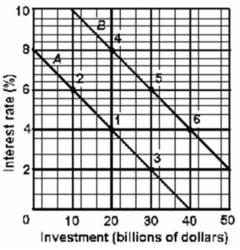 Refer to the above graph.If interest rates increased by 2 percentage points, what event would most likely counteract the crowding-out effect?
 (Multiple Choice)
4.9/5 (73)
(73) The net export effect may partially counteract an expansionary fiscal policy.
(True/False)
4.8/5 (96)
(96) If fiscal policy leads to higher interest rates, the dollar may appreciate and net exports fall.
(True/False)
4.8/5 (80)
(80) An appropriate fiscal policy for severe demand-pull inflation is:
(Multiple Choice)
5.0/5 (76)
(76) If government increases the size of its full-employment surplus, we can:
(Multiple Choice)
4.7/5 (84)
(84) (1) The composite index of leading indicators turns downward for three consecutive months; (2) Economists reach agreement that the economy is moving into a recession; (3) A tax cut is proposed in Parliament; (4) The tax cut is passed by Parliament; (5) Consumption spending begins to rise, aggregate demand increases, and the economy begins to recover.Refer to the above information.The recognition lag of fiscal policy is reflected in events:
(Multiple Choice)
4.9/5 (83)
(83) A major reason that a public debt cannot bankrupt the Federal government is because:
(Multiple Choice)
4.7/5 (83)
(83) 
Filters
- Essay(0)
- Multiple Choice(0)
- Short Answer(0)
- True False(0)
- Matching(0)