



 Chat with AI
Exam 13: B: Fiscal Policy, Deficits, Surpluses, and Debt

Exam 1: B: Limits, Alternatives, and Choices265 Questions
Exam 1: A: - Limits, Alternatives, and Choices60 Questions
Exam 2: B: The Market System and the Circular Flow119 Questions
Exam 2: A: - The Market System and the Circular Flow42 Questions
Exam 3: B: Demand, Supply, and Market Equilibrium291 Questions
Exam 3: A: - Demand, Supply, and Market Equilibrium51 Questions
Exam 4: B: Market Failures: Public Goods and Externalities133 Questions
Exam 4: A: - Market Failures: Public Goods and Externalities36 Questions
Exam 5: B: Governments Role and Government Failure121 Questions
Exam 5: A: Governments Role and Government Failure1 Questions
Exam 6: B: an Introduction to Macroeconomics65 Questions
Exam 6: A: an Introduction to Macroeconomics31 Questions
Exam 7: B: Measuring the Economys Output191 Questions
Exam 7: A: Measuring the Economys Output30 Questions
Exam 8: B: Economic Growth122 Questions
Exam 8: A: Economic Growth35 Questions
Exam 9: B: Business Cycles, Unemployment, and Inflation193 Questions
Exam 9: A: Business Cycles, Unemployment, and Inflation40 Questions
Exam 10: B: Basic Macroeconomic Relationships200 Questions
Exam 10: A: Basic Macroeconomic Relationships26 Questions
Exam 11: B: The Aggregate Expenditures Model238 Questions
Exam 11: A: The Aggregate Expenditures Model47 Questions
Exam 12: B: Aggregate Demand and Aggregate Supply203 Questions
Exam 12: A: Aggregate Demand and Aggregate Supply35 Questions
Exam 13: B: Fiscal Policy, Deficits, Surpluses, and Debt234 Questions
Exam 13: A: Fiscal Policy, Deficits, Surpluses, and Debt53 Questions
Exam 14: B: Money, Banking, and Money Creation206 Questions
Exam 14: A: Money, Banking, and Money Creation56 Questions
Exam 15: B: Interest Rates and Monetary Policy239 Questions
Exam 15: A: Interest Rates and Monetary Policy47 Questions
Exam 17: C: Financial Economics323 Questions
Exam 16: A: Long-Run Macroeconomic Adjustments28 Questions
Exam 16: B: Long-Run Macroeconomic Adjustments122 Questions
Exam 17: A: International Trade40 Questions
Exam 17: B: International Trade188 Questions
Exam 18: A: The Balance of Payments and Exchange Rates30 Questions
Exam 18: B: The Balance of Payments and Exchange Rates133 Questions
Exam 22: The Economics of Developing Countries254 Questions
Select questions type


Some economists believe the budget deficit is directly linked to the trade deficit through real interest rates and the international value of the dollar.
(True/False)
4.9/5  (69)
(69) Using Image 13.2 Global Perspective, which of the following countries had the lowest public debt as a percentage of GDP in 2015?
(Multiple Choice)
4.8/5 (69)
(69) The crowding-out of investment may be avoided if a budget deficit is financed by issuing new money.
(True/False)
4.9/5 (86)
(86) In Year 1, the actual budget deficit was $150 billion and the cyclically adjusted deficit was $125 billion.In Year 2, the actual budget deficit was $125 billion and the cyclically adjusted deficit was $100 billion.It can be concluded that fiscal policy from Year 1 to Year 2 was:
(Multiple Choice)
4.7/5 (80)
(80) If you are told that the government had an actual budget deficit of $50 billion, then you would:
(Multiple Choice)
4.9/5 (81)
(81) 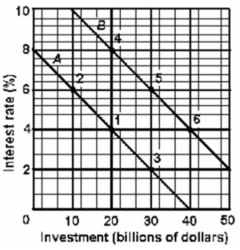 Refer to the above graph.The crowding-out effect would be illustrated by a:
 (Multiple Choice)
4.9/5 (86)
(86) Actions by the Federal government that decrease the progressiveness of the tax system:
(Multiple Choice)
4.9/5 (86)
(86) Contractionary fiscal policy will do what to the government budget, assuming that was balanced at the start?
(Multiple Choice)
4.8/5 (73)
(73) Which of the following is the best example of public investment?
(Multiple Choice)
4.9/5 (62)
(62) Which of the following phases of a business cycle generates cyclical deficit (a movement from a surplus to a deficit) as a by-product?
(Multiple Choice)
4.9/5 (86)
(86) An example of a built-in automatic stabilizer for the Canadian economy is:
(Multiple Choice)
4.7/5 (56)
(56) Which one of the following might offset a crowding-out effect of an increase in government spending financed through expansion of the public debt?
(Multiple Choice)
4.8/5 (83)
(83) 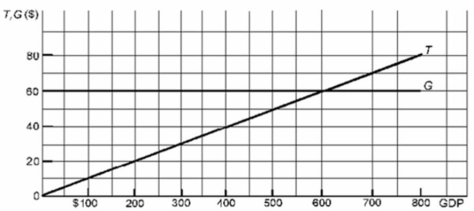 Refer to the above diagram where T is tax revenues and G is government expenditures.All figures are in billions of dollars.If the full-employment GDP is $400 billion while the actual GDP is $200 billion, the cyclical deficit is:
 (Multiple Choice)
4.8/5 (80)
(80) Suppose that in an economy with a MPC of .5 the government wanted to shift the aggregate demand curve rightward by $80 billion at each price level to expand real GDP.It could:
(Multiple Choice)
4.9/5 (90)
(90) Assume the economy is in the midst of a severe recession.Which of the following policies would be consistent with discretionary fiscal policy?
(Multiple Choice)
4.9/5 (71)
(71) A cyclical surplus (movement from a deficit to a surplus) is a by-product of what stage of the business cycle?
(Multiple Choice)
4.9/5 (71)
(71) In an aggregate demand and aggregate supply graph, an expansionary fiscal policy can be illustrated by a:
(Multiple Choice)
4.8/5 (83)
(83) Economists refer to a budget deficit which exists when the economy is achieving full employment as a:
(Multiple Choice)
4.8/5 (67)
(67) 
Filters
- Essay(0)
- Multiple Choice(0)
- Short Answer(0)
- True False(0)
- Matching(0)