



 Chat with AI
Exam 13: B: Fiscal Policy, Deficits, Surpluses, and Debt

Exam 1: B: Limits, Alternatives, and Choices265 Questions
Exam 1: A: - Limits, Alternatives, and Choices60 Questions
Exam 2: B: The Market System and the Circular Flow119 Questions
Exam 2: A: - The Market System and the Circular Flow42 Questions
Exam 3: B: Demand, Supply, and Market Equilibrium291 Questions
Exam 3: A: - Demand, Supply, and Market Equilibrium51 Questions
Exam 4: B: Market Failures: Public Goods and Externalities133 Questions
Exam 4: A: - Market Failures: Public Goods and Externalities36 Questions
Exam 5: B: Governments Role and Government Failure121 Questions
Exam 5: A: Governments Role and Government Failure1 Questions
Exam 6: B: an Introduction to Macroeconomics65 Questions
Exam 6: A: an Introduction to Macroeconomics31 Questions
Exam 7: B: Measuring the Economys Output191 Questions
Exam 7: A: Measuring the Economys Output30 Questions
Exam 8: B: Economic Growth122 Questions
Exam 8: A: Economic Growth35 Questions
Exam 9: B: Business Cycles, Unemployment, and Inflation193 Questions
Exam 9: A: Business Cycles, Unemployment, and Inflation40 Questions
Exam 10: B: Basic Macroeconomic Relationships200 Questions
Exam 10: A: Basic Macroeconomic Relationships26 Questions
Exam 11: B: The Aggregate Expenditures Model238 Questions
Exam 11: A: The Aggregate Expenditures Model47 Questions
Exam 12: B: Aggregate Demand and Aggregate Supply203 Questions
Exam 12: A: Aggregate Demand and Aggregate Supply35 Questions
Exam 13: B: Fiscal Policy, Deficits, Surpluses, and Debt234 Questions
Exam 13: A: Fiscal Policy, Deficits, Surpluses, and Debt53 Questions
Exam 14: B: Money, Banking, and Money Creation206 Questions
Exam 14: A: Money, Banking, and Money Creation56 Questions
Exam 15: B: Interest Rates and Monetary Policy239 Questions
Exam 15: A: Interest Rates and Monetary Policy47 Questions
Exam 17: C: Financial Economics323 Questions
Exam 16: A: Long-Run Macroeconomic Adjustments28 Questions
Exam 16: B: Long-Run Macroeconomic Adjustments122 Questions
Exam 17: A: International Trade40 Questions
Exam 17: B: International Trade188 Questions
Exam 18: A: The Balance of Payments and Exchange Rates30 Questions
Exam 18: B: The Balance of Payments and Exchange Rates133 Questions
Exam 22: The Economics of Developing Countries254 Questions
Select questions type


If the government increases its spending during recession to assist the economy, the funds for such expenditures must come from some source.Which of the following sources would be the most expansionary?
(Multiple Choice)
4.8/5  (78)
(78) 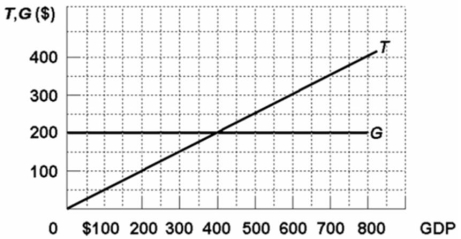 Refer to the above diagram wherein T is tax revenues and G is government expenditures.All figures are in billions.The equilibrium level of GDP in this economy:
 (Multiple Choice)
4.8/5 (79)
(79) Expansionary fiscal policy will do what to the government budget, assuming that was balanced at the start?
(Multiple Choice)
4.8/5 (75)
(75) In Year 1, the actual budget deficit was $200 billion and the cyclically adjusted deficit was $150 billion.In Year 2, the actual budget deficit was $225 billion and the cyclically adjusted deficit was $175 billion.It can be concluded that fiscal policy from Year 1 to Year 2 was:
(Multiple Choice)
4.8/5 (76)
(76) Using Image 13.2 Global Perspective, which of the following countries had the highest publicly held debt as a percentage of GDP in 2015?
(Multiple Choice)
4.8/5 (81)
(81) 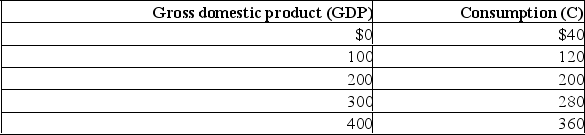 Refer to the above data.If a lump-sum tax (the same tax amount at each level of GDP) of $40 is now imposed in this economy, the consumption schedule will be:
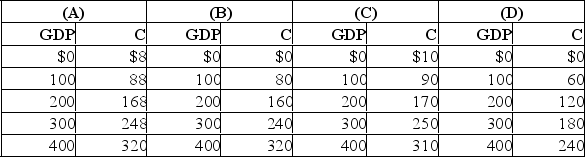
Refer to the above data.If a lump-sum tax (the same tax amount at each level of GDP) of $40 is now imposed in this economy, the consumption schedule will be: (Multiple Choice)
4.9/5 (69)
(69) In a certain year the aggregate amount demanded at the existing price level consists of $100 billion of consumption, $40 billion of investment, $10 billion of net exports, and $20 billion of government purchases.Full-employment GDP is $120 billion.To obtain price level stability under these conditions the government should:
(Multiple Choice)
4.8/5 (74)
(74) Incurring an internal debt to finance a war does not pass the cost of the war on to future generations because:
(Multiple Choice)
4.9/5 (73)
(73) International flows of financial capital in response to interest rate changes in Canada:
(Multiple Choice)
4.8/5 (83)
(83) If the cyclically adjusted budget deficit increases from $200 billion to $250 billion and GDP remains constant over the two years:
(Multiple Choice)
4.8/5 (86)
(86) Refer to the data below.If year 1 is the first year of this nation's existence and year 4 is the present year, the public debt as a percentage of GDP in year 4 is: The following budget information is for a hypothetical economy.All data are in billions of dollars. 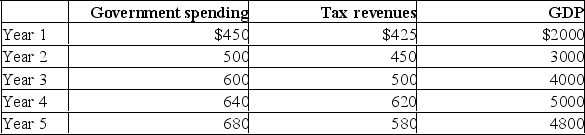
(Multiple Choice)
4.9/5 (71)
(71) Which combination of fiscal policy actions would most likely be offsetting?
(Multiple Choice)
4.8/5 (97)
(97) 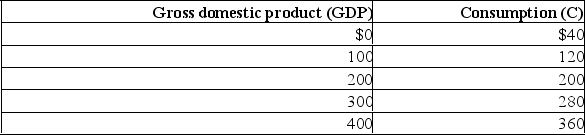 Refer to the above data.If a lump-sum tax (the same tax amount at each level of GDP) of $40 is imposed in this economy, we can conclude that the tax:
 (Multiple Choice)
4.8/5 (80)
(80) The actual and full-employment budgets will be equal when the economy is at full-employment.
(True/False)
4.7/5 (77)
(77) In an aggregate demand-aggregate supply diagram, equal decreases in government spending and taxes will:
(Multiple Choice)
4.9/5 (70)
(70) The direction of discretionary fiscal policy cannot be examined by a simple look at the changes in the actual budget deficits or surpluses.This is because:
(Multiple Choice)
4.9/5 (79)
(79) Other things equal, which of the policies will have the most expansionary effect on the economy?
(Multiple Choice)
4.9/5 (79)
(79) 
Filters
- Essay(0)
- Multiple Choice(0)
- Short Answer(0)
- True False(0)
- Matching(0)