



 Chat with AI
Exam 13: B: Fiscal Policy, Deficits, Surpluses, and Debt

Exam 1: B: Limits, Alternatives, and Choices265 Questions
Exam 1: A: - Limits, Alternatives, and Choices60 Questions
Exam 2: B: The Market System and the Circular Flow119 Questions
Exam 2: A: - The Market System and the Circular Flow42 Questions
Exam 3: B: Demand, Supply, and Market Equilibrium291 Questions
Exam 3: A: - Demand, Supply, and Market Equilibrium51 Questions
Exam 4: B: Market Failures: Public Goods and Externalities133 Questions
Exam 4: A: - Market Failures: Public Goods and Externalities36 Questions
Exam 5: B: Governments Role and Government Failure121 Questions
Exam 5: A: Governments Role and Government Failure1 Questions
Exam 6: B: an Introduction to Macroeconomics65 Questions
Exam 6: A: an Introduction to Macroeconomics31 Questions
Exam 7: B: Measuring the Economys Output191 Questions
Exam 7: A: Measuring the Economys Output30 Questions
Exam 8: B: Economic Growth122 Questions
Exam 8: A: Economic Growth35 Questions
Exam 9: B: Business Cycles, Unemployment, and Inflation193 Questions
Exam 9: A: Business Cycles, Unemployment, and Inflation40 Questions
Exam 10: B: Basic Macroeconomic Relationships200 Questions
Exam 10: A: Basic Macroeconomic Relationships26 Questions
Exam 11: B: The Aggregate Expenditures Model238 Questions
Exam 11: A: The Aggregate Expenditures Model47 Questions
Exam 12: B: Aggregate Demand and Aggregate Supply203 Questions
Exam 12: A: Aggregate Demand and Aggregate Supply35 Questions
Exam 13: B: Fiscal Policy, Deficits, Surpluses, and Debt234 Questions
Exam 13: A: Fiscal Policy, Deficits, Surpluses, and Debt53 Questions
Exam 14: B: Money, Banking, and Money Creation206 Questions
Exam 14: A: Money, Banking, and Money Creation56 Questions
Exam 15: B: Interest Rates and Monetary Policy239 Questions
Exam 15: A: Interest Rates and Monetary Policy47 Questions
Exam 17: C: Financial Economics323 Questions
Exam 16: A: Long-Run Macroeconomic Adjustments28 Questions
Exam 16: B: Long-Run Macroeconomic Adjustments122 Questions
Exam 17: A: International Trade40 Questions
Exam 17: B: International Trade188 Questions
Exam 18: A: The Balance of Payments and Exchange Rates30 Questions
Exam 18: B: The Balance of Payments and Exchange Rates133 Questions
Exam 22: The Economics of Developing Countries254 Questions
Select questions type


Refer to the diagram below.Which tax system will generate the largest cyclical deficits? 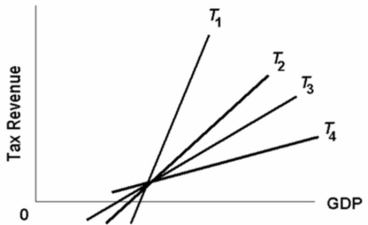
(Multiple Choice)
4.7/5  (87)
(87) Which is regarded as an automatic stabilizer in the economy?
(Multiple Choice)
4.8/5 (77)
(77) Assume the government incurs a budget deficit which is financed by borrowing.As a result, interest rates rise and the volume of private investment spending declines.This illustrates:
(Multiple Choice)
4.9/5 (76)
(76) 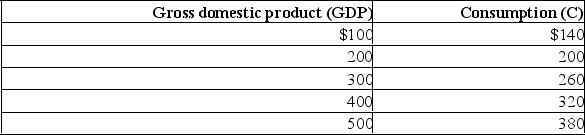 Refer to the above data.The 10 percent proportional tax on income would:
 (Multiple Choice)
4.8/5 (82)
(82) If the MPC in an economy is .75, government could shift the aggregate demand curve leftward by $60 billion at each price level by:
(Multiple Choice)
4.7/5 (62)
(62) If the government wishes to increase the level of real GDP, it might reduce:
(Multiple Choice)
4.9/5 (87)
(87) An economist who advocates discretionary fiscal policy would recommend:
(Multiple Choice)
4.9/5 (79)
(79) A major advantage of the built-in or automatic stabilizers is that they:
(Multiple Choice)
4.8/5 (93)
(93) Automatic stabilizers will reduce tax revenues during recessions and increase tax revenues during periods of strong economic growth.
(True/False)
4.8/5 (71)
(71) If the MPC in an economy is .8, government could shift the aggregate demand curve rightward by $100 billion at each price level by:
(Multiple Choice)
4.8/5 (70)
(70) Who among the following owned the largest percentage of Canada's public debt in 2016, using Figure 13-7?
(Multiple Choice)
4.9/5 (70)
(70) An increase in taxes and a decrease in government spending would be characteristic of a contractionary fiscal policy.
(True/False)
4.7/5 (85)
(85) If the full-employment surplus as a percentage of GDP is zero in one year, and 2 percent of GDP the next year, it can be concluded that:
(Multiple Choice)
5.0/5 (102)
(102) 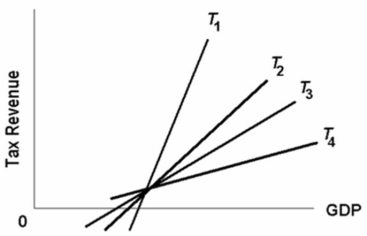 Refer to the above diagram.Which tax system has the most built-in stability?
 (Multiple Choice)
4.9/5 (89)
(89) 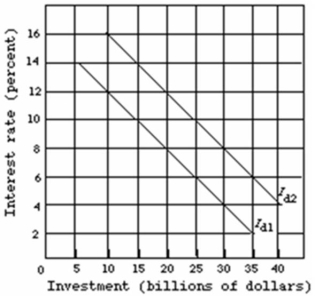 Refer to the above diagram.Initially assume that the investment demand curve is Id1.Which of the following effects of a budget deficit might shift the investment demand curve from Id1 to Id2, wholly offsetting any crowding-out effect?
 (Multiple Choice)
4.8/5 (69)
(69) 
Filters
- Essay(0)
- Multiple Choice(0)
- Short Answer(0)
- True False(0)
- Matching(0)