



 Chat with AI
Exam 13: B: Fiscal Policy, Deficits, Surpluses, and Debt

Exam 1: B: Limits, Alternatives, and Choices265 Questions
Exam 1: A: - Limits, Alternatives, and Choices60 Questions
Exam 2: B: The Market System and the Circular Flow119 Questions
Exam 2: A: - The Market System and the Circular Flow42 Questions
Exam 3: B: Demand, Supply, and Market Equilibrium291 Questions
Exam 3: A: - Demand, Supply, and Market Equilibrium51 Questions
Exam 4: B: Market Failures: Public Goods and Externalities133 Questions
Exam 4: A: - Market Failures: Public Goods and Externalities36 Questions
Exam 5: B: Governments Role and Government Failure121 Questions
Exam 5: A: Governments Role and Government Failure1 Questions
Exam 6: B: an Introduction to Macroeconomics65 Questions
Exam 6: A: an Introduction to Macroeconomics31 Questions
Exam 7: B: Measuring the Economys Output191 Questions
Exam 7: A: Measuring the Economys Output30 Questions
Exam 8: B: Economic Growth122 Questions
Exam 8: A: Economic Growth35 Questions
Exam 9: B: Business Cycles, Unemployment, and Inflation193 Questions
Exam 9: A: Business Cycles, Unemployment, and Inflation40 Questions
Exam 10: B: Basic Macroeconomic Relationships200 Questions
Exam 10: A: Basic Macroeconomic Relationships26 Questions
Exam 11: B: The Aggregate Expenditures Model238 Questions
Exam 11: A: The Aggregate Expenditures Model47 Questions
Exam 12: B: Aggregate Demand and Aggregate Supply203 Questions
Exam 12: A: Aggregate Demand and Aggregate Supply35 Questions
Exam 13: B: Fiscal Policy, Deficits, Surpluses, and Debt234 Questions
Exam 13: A: Fiscal Policy, Deficits, Surpluses, and Debt53 Questions
Exam 14: B: Money, Banking, and Money Creation206 Questions
Exam 14: A: Money, Banking, and Money Creation56 Questions
Exam 15: B: Interest Rates and Monetary Policy239 Questions
Exam 15: A: Interest Rates and Monetary Policy47 Questions
Exam 17: C: Financial Economics323 Questions
Exam 16: A: Long-Run Macroeconomic Adjustments28 Questions
Exam 16: B: Long-Run Macroeconomic Adjustments122 Questions
Exam 17: A: International Trade40 Questions
Exam 17: B: International Trade188 Questions
Exam 18: A: The Balance of Payments and Exchange Rates30 Questions
Exam 18: B: The Balance of Payments and Exchange Rates133 Questions
Exam 22: The Economics of Developing Countries254 Questions
Select questions type


A decrease in government spending is one of the options that can be used to pursue a contractionary fiscal policy.
(True/False)
4.8/5  (78)
(78) If the Federal government wants to finance a budget deficit in the least expansionary way, which of the following actions would be most appropriate?
(Multiple Choice)
4.9/5 (82)
(82) Foreign individuals and institutions hold about what percentage of the public debt?
(Multiple Choice)
4.8/5 (80)
(80) Which of the following represents the most expansionary fiscal policy?
(Multiple Choice)
4.9/5 (80)
(80) In an economy, the government wants to increase aggregate demand by $48 billion at each price level to increase real GDP and reduce unemployment.If the MPC is .75, then it could:
(Multiple Choice)
4.9/5 (82)
(82) A contractionary fiscal policy shifts the aggregate demand curve leftward and may or may not reduce real GDP.
(True/False)
4.8/5 (82)
(82) An expansionary fiscal policy can be partially offset by a(n):
(Multiple Choice)
4.9/5 (66)
(66) The crowding-out effect of an expansionary fiscal policy is likely to be fully or partially offset during a recession.
(True/False)
4.7/5 (91)
(91) The payment of interest on the public debt probably decreases income inequality.
(True/False)
4.8/5 (83)
(83) Proponents of the notion of a "political business cycle" suggest that:
(Multiple Choice)
4.9/5 (76)
(76) The average tax rate required to service the public debt is roughly measured by:
(Multiple Choice)
4.8/5 (76)
(76) 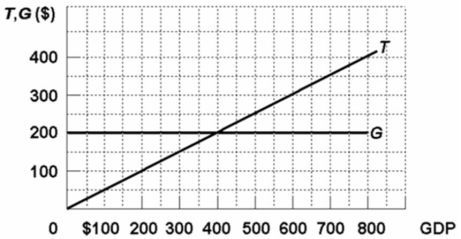 Refer to the above diagram wherein T is tax revenues and G is government expenditures.All figures are in billions.The tax system of this economy is such that:
 (Multiple Choice)
4.8/5 (72)
(72) An expansionary fiscal policy in Canada which drives up Canadian interest rates is most likely to:
(Multiple Choice)
4.8/5 (68)
(68) The crowding-out effect from government borrowing to finance the public debt is reduced when:
(Multiple Choice)
4.7/5 (73)
(73) With a progressive tax system, as the level of income increases in an economy, the average tax rate will:
(Multiple Choice)
4.8/5 (89)
(89) If the economy is to have automatic stabilizers, when real GDP rises:
(Multiple Choice)
4.7/5 (63)
(63) 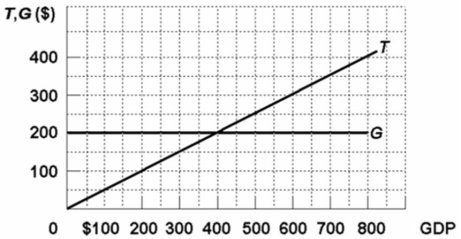 Refer to the above diagram wherein T is tax revenues and G is government expenditures.All figures are in billions.This diagram portrays the notion of:
 (Multiple Choice)
4.7/5 (80)
(80) 
Filters
- Essay(0)
- Multiple Choice(0)
- Short Answer(0)
- True False(0)
- Matching(0)