



 Chat with AI
Exam 13: B: Fiscal Policy, Deficits, Surpluses, and Debt

Exam 1: B: Limits, Alternatives, and Choices265 Questions
Exam 1: A: - Limits, Alternatives, and Choices60 Questions
Exam 2: B: The Market System and the Circular Flow119 Questions
Exam 2: A: - The Market System and the Circular Flow42 Questions
Exam 3: B: Demand, Supply, and Market Equilibrium291 Questions
Exam 3: A: - Demand, Supply, and Market Equilibrium51 Questions
Exam 4: B: Market Failures: Public Goods and Externalities133 Questions
Exam 4: A: - Market Failures: Public Goods and Externalities36 Questions
Exam 5: B: Governments Role and Government Failure121 Questions
Exam 5: A: Governments Role and Government Failure1 Questions
Exam 6: B: an Introduction to Macroeconomics65 Questions
Exam 6: A: an Introduction to Macroeconomics31 Questions
Exam 7: B: Measuring the Economys Output191 Questions
Exam 7: A: Measuring the Economys Output30 Questions
Exam 8: B: Economic Growth122 Questions
Exam 8: A: Economic Growth35 Questions
Exam 9: B: Business Cycles, Unemployment, and Inflation193 Questions
Exam 9: A: Business Cycles, Unemployment, and Inflation40 Questions
Exam 10: B: Basic Macroeconomic Relationships200 Questions
Exam 10: A: Basic Macroeconomic Relationships26 Questions
Exam 11: B: The Aggregate Expenditures Model238 Questions
Exam 11: A: The Aggregate Expenditures Model47 Questions
Exam 12: B: Aggregate Demand and Aggregate Supply203 Questions
Exam 12: A: Aggregate Demand and Aggregate Supply35 Questions
Exam 13: B: Fiscal Policy, Deficits, Surpluses, and Debt234 Questions
Exam 13: A: Fiscal Policy, Deficits, Surpluses, and Debt53 Questions
Exam 14: B: Money, Banking, and Money Creation206 Questions
Exam 14: A: Money, Banking, and Money Creation56 Questions
Exam 15: B: Interest Rates and Monetary Policy239 Questions
Exam 15: A: Interest Rates and Monetary Policy47 Questions
Exam 17: C: Financial Economics323 Questions
Exam 16: A: Long-Run Macroeconomic Adjustments28 Questions
Exam 16: B: Long-Run Macroeconomic Adjustments122 Questions
Exam 17: A: International Trade40 Questions
Exam 17: B: International Trade188 Questions
Exam 18: A: The Balance of Payments and Exchange Rates30 Questions
Exam 18: B: The Balance of Payments and Exchange Rates133 Questions
Exam 22: The Economics of Developing Countries254 Questions
Select questions type


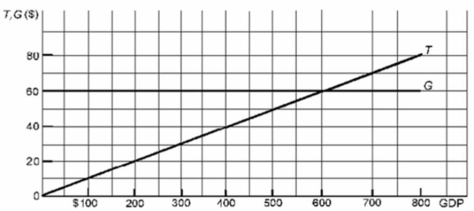 Refer to the above diagram where T is tax revenues and G is government expenditures.All figures are in billions of dollars.If the full-employment and actual GDP are each $400 billion, government can balance its budget by:
 (Multiple Choice)
4.8/5  (86)
(86) The key to assessing the direction of discretionary fiscal policy is to observe changes in the full-employment deficit.
(True/False)
4.7/5 (74)
(74) 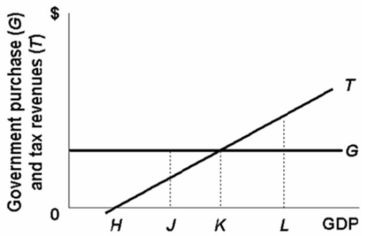 In the above diagram, tax revenues vary:
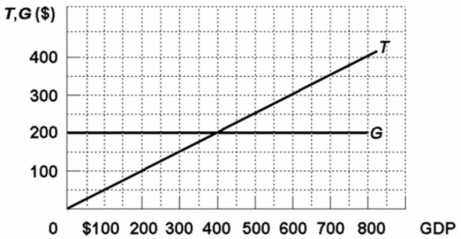 Refer to the above diagram wherein T is tax revenues and G is government expenditures.All figures are in billions.The budget will entail a deficit:
 (Multiple Choice)
4.7/5 (103)
(103) (1) The composite index of leading indicators turns downward for three consecutive months; (2) Economists reach agreement that the economy is moving into a recession; (3) A tax cut is proposed in Parliament; (4) The tax cut is passed by Parliament; (5) Consumption spending begins to rise, aggregate demand increases, and the economy begins to recover.Refer to the above information.The operational lag of fiscal policy is reflected in events:
(Multiple Choice)
4.7/5 (83)
(83) In a certain year the aggregate demand at the existing price level consists of $100 billion of consumption, $40 billion of investment, $10 billion of net exports, and $20 billion of government purchases.Full-employment GDP is $200 billion.To obtain full employment under these conditions the government should:
(Multiple Choice)
4.7/5 (77)
(77) In 2011, the level of taxation (the average tax rate) required to pay interest on the public debt was about:
(Multiple Choice)
4.8/5 (85)
(85) The impact of an expansionary fiscal policy may be strengthened if it crowds out some private investment spending.
(True/False)
4.9/5 (73)
(73) The public debt is the accumulation of all deficits and surpluses which have occurred through time.
(True/False)
4.8/5 (61)
(61) 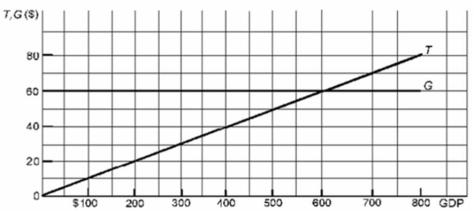 Refer to the above diagram where T is tax revenues and G is government expenditures.All figures are in billions of dollars.If the full-employment GDP and actual GDP are each $400 billion, this economy will realize a:
 (Multiple Choice)
4.8/5 (74)
(74) The full-employment budget measures what the Federal budget deficit or surplus would be at full employment output with existing tax and spending decisions.
(True/False)
4.7/5 (74)
(74) In an economy, the government wants to decrease aggregate demand by $48 billion at each price level to decrease real GDP and control demand-pull inflation.If the MPS is .25, then it could:
(Multiple Choice)
4.8/5 (88)
(88) A net export effect may partially reinforce an expansionary fiscal policy.
(True/False)
4.9/5 (76)
(76) 
Filters
- Essay(0)
- Multiple Choice(0)
- Short Answer(0)
- True False(0)
- Matching(0)