



 Chat with AI
Exam 8: Consumer Choice

Exam 1: Economics: The World Around You90 Questions
Exam 2: Choice, Opportunity Costs, and Specialization94 Questions
Exam 3: Markets, Demand and Supply, and the Price System97 Questions
Exam 5: The Market System and the Private and Public Sector97 Questions
Exam 4: Elasticity: Demand and Supply126 Questions
Exam 6: National Income Accounting104 Questions
Exam 7: an Introduction to the Foreign Exchange Market and the Balance of Payments90 Questions
Exam 8: Consumer Choice132 Questions
Exam 9: Supply: The Costs of Doing Business106 Questions
Exam 10: Unemployment and Inflation129 Questions
Exam 11: Macroeconomic Equilibrium: Aggregate Demand and Supply122 Questions
Exam 12: Profit Maximization122 Questions
Exam 13: Aggregate Expenditures115 Questions
Exam 14: Perfect Competition135 Questions
Exam 15: Income and Expenditures Equilibrium134 Questions
Exam 16: Monopoly118 Questions
Exam 17: Fiscal Policy93 Questions
Exam 18: Monopolistic Competition and Oligopoly111 Questions
Exam 19: Antitrust and Regulation100 Questions
Exam 10: Money and Banking125 Questions
Exam 21: Market Failures, Government Failures, and Rent Seeking121 Questions
Exam 22: Monetary Policy141 Questions
Exam 23: Macroeconomic Policy: Tradeoffs, Expectations, Credibility, and Sources of Business Cycles112 Questions
Exam 24: Resource Markets112 Questions
Exam 25: Macroeconomic Viewpoints: New Keynesian, Monetarist, and New Classical99 Questions
Exam 26: The Labor Market114 Questions
Exam 27: Capital Markets100 Questions
Exam 28: Economic Growth99 Questions
Exam 29: Development Economics104 Questions
Exam 30: the Land Market and Natural Resources55 Questions
Exam 31: Aging, Social Security and Health Care88 Questions
Exam 32: Globalization84 Questions
Exam 33: Elasticity: Demand and Supply126 Questions
Exam 34: Income Distribution, Poverty and Government Policy115 Questions
Exam 35: World Trade Equilibrium112 Questions
Exam 36: Consumer Choice132 Questions
Exam 37: International Trade Restrictions109 Questions
Exam 38: World Trade Equilibrium112 Questions
Exam 39: Exchange Rates and Financial Links Between Countries132 Questions
Exam 40: International Trade Restrictions109 Questions
Exam 41: Supply: the Costs of Doing Business106 Questions
Exam 42: Exchange Rates and Financial Links Between Countries132 Questions
Exam 43: Profit Maximization122 Questions
Exam 44: Perfect Competition135 Questions
Exam 45: Monopoly118 Questions
Exam 46: Monopolistic Competition and Oligopoly111 Questions
Exam 47: Antitrust and Regulation100 Questions
Exam 48: Market Failures, Government Failures, and Rent Seeking121 Questions
Exam 49: Resource Markets112 Questions
Exam 50: The Labor Market114 Questions
Exam 51: Capital Markets100 Questions
Exam 52: The Land Market and Natural Resources55 Questions
Exam 53: Aging, Social Security and Health Care87 Questions
Exam 54: Income Distribution, Poverty and Government Policy115 Questions
Exam 55: World Trade Equilibrium112 Questions
Exam 56: International Trade Restrictions109 Questions
Exam 57: Exchange Rates and Financial Links Between Countries132 Questions
Select questions type


Assume MUX = 30 utils, MUY = 15 utils, PX = $2 and PY = $0.50.This consumer:
(Multiple Choice)
5.0/5  (84)
(84) According to Table 6.2, marginal utility is negative _____.
(Multiple Choice)
4.8/5 (85)
(85) If all consumers had identical preferences, then their marginal utility schedules would be the same.
(True/False)
4.9/5 (76)
(76) The law of diminishing marginal utility does not hold good when the good is free or priced at zero dollars.
(True/False)
4.9/5 (76)
(76) Suppose a budget line is drawn with X on the horizontal axis and Y on the vertical axis.A decrease in the price of X will cause:
(Multiple Choice)
5.0/5 (78)
(78) Other things equal, if there is a price increase of a good measured on the vertical axis, the budget constraint will shift outward.
(True/False)
4.8/5 (79)
(79) _____ is the lack of satisfaction yielded after consuming too much of the same product.
(Multiple Choice)
4.7/5 (79)
(79) The study of decision making that assumes people are rational in a broad sense, even if they do not have complete and perfect information is called _____.
(Multiple Choice)
4.8/5 (78)
(78) The law of diminishing marginal utility states that as additional units are consumed, satisfaction per unit will decline.
(True/False)
4.8/5 (78)
(78) When attempting to explain why a consumer purchases a Ford automobile instead of a Honda automobile or a Compaq computer instead of an IBM computer, an economist would assert:
(Multiple Choice)
4.8/5 (83)
(83) Neuroeconomics suggests that the frontal lobe carries out most decision making and strategic thinking takes place in the prefrontal cortex.
(True/False)
4.9/5 (69)
(69) Suppose that there are five bottles of lemonade, each of which gives the consumer the same level of utility.According to the law of diminishing marginal utility, how can one receive the highest utility?
(Multiple Choice)
4.7/5 (80)
(80) If total utility increases by smaller and smaller amounts as more units of a product are consumed, then marginal utility is:
(Multiple Choice)
4.9/5 (79)
(79) The shorter the period of time being considered, the less rapidly will diminishing marginal utility set in.
(True/False)
4.8/5 (82)
(82) The below indifference map shows the various combinations of hours of music and apples that yield different levels of utility. Figure 6.1 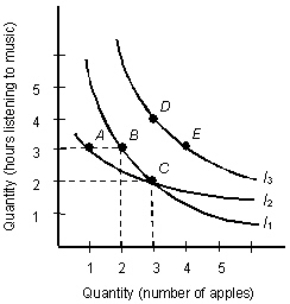 According to Figure 6.1, which of the following is incorrect?
 (Multiple Choice)
4.9/5 (85)
(85) According to Table 6.1, which of the following units of the good yields disutility?
(Multiple Choice)
4.8/5 (76)
(76) Jason is trying to decide whether to buy a bagel or a muffin for breakfast.The bagel costs $.50 and has a marginal utility of 5.The muffin costs $1 and has a marginal utility of 20.Which should he buy, and why?
(Multiple Choice)
4.7/5 (81)
(81) 
Filters
- Essay(0)
- Multiple Choice(0)
- Short Answer(0)
- True False(0)
- Matching(0)