



 Chat with AI
Exam 17: Fiscal Policy

Exam 1: Economics: The World Around You90 Questions
Exam 2: Choice, Opportunity Costs, and Specialization94 Questions
Exam 3: Markets, Demand and Supply, and the Price System97 Questions
Exam 5: The Market System and the Private and Public Sector97 Questions
Exam 4: Elasticity: Demand and Supply126 Questions
Exam 6: National Income Accounting104 Questions
Exam 7: an Introduction to the Foreign Exchange Market and the Balance of Payments90 Questions
Exam 8: Consumer Choice132 Questions
Exam 9: Supply: The Costs of Doing Business106 Questions
Exam 10: Unemployment and Inflation129 Questions
Exam 11: Macroeconomic Equilibrium: Aggregate Demand and Supply122 Questions
Exam 12: Profit Maximization122 Questions
Exam 13: Aggregate Expenditures115 Questions
Exam 14: Perfect Competition135 Questions
Exam 15: Income and Expenditures Equilibrium134 Questions
Exam 16: Monopoly118 Questions
Exam 17: Fiscal Policy93 Questions
Exam 18: Monopolistic Competition and Oligopoly111 Questions
Exam 19: Antitrust and Regulation100 Questions
Exam 10: Money and Banking125 Questions
Exam 21: Market Failures, Government Failures, and Rent Seeking121 Questions
Exam 22: Monetary Policy141 Questions
Exam 23: Macroeconomic Policy: Tradeoffs, Expectations, Credibility, and Sources of Business Cycles112 Questions
Exam 24: Resource Markets112 Questions
Exam 25: Macroeconomic Viewpoints: New Keynesian, Monetarist, and New Classical99 Questions
Exam 26: The Labor Market114 Questions
Exam 27: Capital Markets100 Questions
Exam 28: Economic Growth99 Questions
Exam 29: Development Economics104 Questions
Exam 30: the Land Market and Natural Resources55 Questions
Exam 31: Aging, Social Security and Health Care88 Questions
Exam 32: Globalization84 Questions
Exam 33: Elasticity: Demand and Supply126 Questions
Exam 34: Income Distribution, Poverty and Government Policy115 Questions
Exam 35: World Trade Equilibrium112 Questions
Exam 36: Consumer Choice132 Questions
Exam 37: International Trade Restrictions109 Questions
Exam 38: World Trade Equilibrium112 Questions
Exam 39: Exchange Rates and Financial Links Between Countries132 Questions
Exam 40: International Trade Restrictions109 Questions
Exam 41: Supply: the Costs of Doing Business106 Questions
Exam 42: Exchange Rates and Financial Links Between Countries132 Questions
Exam 43: Profit Maximization122 Questions
Exam 44: Perfect Competition135 Questions
Exam 45: Monopoly118 Questions
Exam 46: Monopolistic Competition and Oligopoly111 Questions
Exam 47: Antitrust and Regulation100 Questions
Exam 48: Market Failures, Government Failures, and Rent Seeking121 Questions
Exam 49: Resource Markets112 Questions
Exam 50: The Labor Market114 Questions
Exam 51: Capital Markets100 Questions
Exam 52: The Land Market and Natural Resources55 Questions
Exam 53: Aging, Social Security and Health Care87 Questions
Exam 54: Income Distribution, Poverty and Government Policy115 Questions
Exam 55: World Trade Equilibrium112 Questions
Exam 56: International Trade Restrictions109 Questions
Exam 57: Exchange Rates and Financial Links Between Countries132 Questions
Select questions type


Which of the following can be categorized under fiscal policy?

Free
(Multiple Choice)
4.8/5  (93)
(93) Correct Answer: Verified
E
_____ are elements of fiscal policy that automatically change in value as national income changes.
Free
(Multiple Choice)
4.8/5 (79)
(79) Correct Answer:Verified
VerifiedD
A progressive tax system is one in which the tax rate actually increases as income rises.
Free
(True/False)
4.8/5 (81)
(81) Correct Answer:Verified
VerifiedTrue
Empirical evidence suggests that the United States ran close to a balanced budget during the World War II.
(True/False)
4.8/5 (85)
(85) Assume an economy has automatic stabilizers in place that include a progressive tax structure and a transfer payment system.Then in a period of high economic growth and high inflation, we would expect:
(Multiple Choice)
4.9/5 (86)
(86) Increased domestic imports and higher international trade deficits are possible results of government surpluses.
(True/False)
4.9/5 (80)
(80) Which of the following trends has been observed in federal revenues and expenditures over time?
(Multiple Choice)
4.8/5 (85)
(85) If crowding out exists, contractionary fiscal policy will cause the aggregate demand curve to shift in by more than indicated by the government spending multiplier.
(True/False)
4.7/5 (67)
(67) Which of the following taxes are more easier to collect in industrial countries than in developing countries?
(Multiple Choice)
4.9/5 (79)
(79) Higher taxes affect real GDP indirectly through both the consumption channel and the output supply channel.
(True/False)
4.9/5 (80)
(80) A(n)_____ is an indirect tax imposed on each sale at each stage of production.
(Multiple Choice)
4.8/5 (92)
(92) Suppose the real interest rate in the economy is 3% and the nominal interest rate is 6%, what is the current inflation rate?
(Multiple Choice)
4.9/5 (80)
(80) A decrease in federal income tax rates is an example of fiscal policy that affects GDP through consumption adjustments.
(True/False)
4.8/5 (84)
(84) The figure given below depicts the tax revenue for different tax rates applied by the government. Figure 11.2 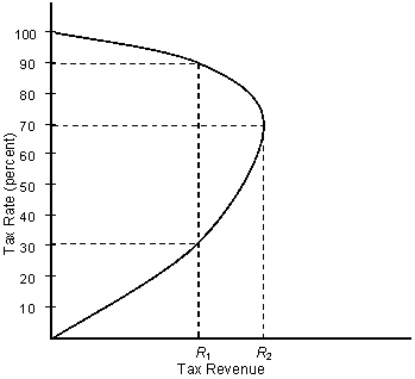 Which of the following is depicted in Figure 11.2?
 (Multiple Choice)
4.8/5 (91)
(91) Ceteris paribus, if the U.S.federal government reduces fiscal spending which of the following will be observed?
(Multiple Choice)
4.8/5 (92)
(92) Which of the following is an example of a transfer payment by the government?
(Multiple Choice)
4.9/5 (83)
(83) Critics of the supply-side tax cuts proposed by the Reagan administration argued that lower taxes would:
(Multiple Choice)
4.9/5 (87)
(87) A drop in consumption or investment spending caused by increased government spending is referred to as:
(Multiple Choice)
4.9/5 (76)
(76) 
Filters
- Essay(0)
- Multiple Choice(0)
- Short Answer(0)
- True False(0)
- Matching(0)