



 Chat with AI
Exam 31: Aging, Social Security and Health Care

Exam 1: Economics: The World Around You90 Questions
Exam 2: Choice, Opportunity Costs, and Specialization94 Questions
Exam 3: Markets, Demand and Supply, and the Price System97 Questions
Exam 5: The Market System and the Private and Public Sector97 Questions
Exam 4: Elasticity: Demand and Supply126 Questions
Exam 6: National Income Accounting104 Questions
Exam 7: an Introduction to the Foreign Exchange Market and the Balance of Payments90 Questions
Exam 8: Consumer Choice132 Questions
Exam 9: Supply: The Costs of Doing Business106 Questions
Exam 10: Unemployment and Inflation129 Questions
Exam 11: Macroeconomic Equilibrium: Aggregate Demand and Supply122 Questions
Exam 12: Profit Maximization122 Questions
Exam 13: Aggregate Expenditures115 Questions
Exam 14: Perfect Competition135 Questions
Exam 15: Income and Expenditures Equilibrium134 Questions
Exam 16: Monopoly118 Questions
Exam 17: Fiscal Policy93 Questions
Exam 18: Monopolistic Competition and Oligopoly111 Questions
Exam 19: Antitrust and Regulation100 Questions
Exam 10: Money and Banking125 Questions
Exam 21: Market Failures, Government Failures, and Rent Seeking121 Questions
Exam 22: Monetary Policy141 Questions
Exam 23: Macroeconomic Policy: Tradeoffs, Expectations, Credibility, and Sources of Business Cycles112 Questions
Exam 24: Resource Markets112 Questions
Exam 25: Macroeconomic Viewpoints: New Keynesian, Monetarist, and New Classical99 Questions
Exam 26: The Labor Market114 Questions
Exam 27: Capital Markets100 Questions
Exam 28: Economic Growth99 Questions
Exam 29: Development Economics104 Questions
Exam 30: the Land Market and Natural Resources55 Questions
Exam 31: Aging, Social Security and Health Care88 Questions
Exam 32: Globalization84 Questions
Exam 33: Elasticity: Demand and Supply126 Questions
Exam 34: Income Distribution, Poverty and Government Policy115 Questions
Exam 35: World Trade Equilibrium112 Questions
Exam 36: Consumer Choice132 Questions
Exam 37: International Trade Restrictions109 Questions
Exam 38: World Trade Equilibrium112 Questions
Exam 39: Exchange Rates and Financial Links Between Countries132 Questions
Exam 40: International Trade Restrictions109 Questions
Exam 41: Supply: the Costs of Doing Business106 Questions
Exam 42: Exchange Rates and Financial Links Between Countries132 Questions
Exam 43: Profit Maximization122 Questions
Exam 44: Perfect Competition135 Questions
Exam 45: Monopoly118 Questions
Exam 46: Monopolistic Competition and Oligopoly111 Questions
Exam 47: Antitrust and Regulation100 Questions
Exam 48: Market Failures, Government Failures, and Rent Seeking121 Questions
Exam 49: Resource Markets112 Questions
Exam 50: The Labor Market114 Questions
Exam 51: Capital Markets100 Questions
Exam 52: The Land Market and Natural Resources55 Questions
Exam 53: Aging, Social Security and Health Care87 Questions
Exam 54: Income Distribution, Poverty and Government Policy115 Questions
Exam 55: World Trade Equilibrium112 Questions
Exam 56: International Trade Restrictions109 Questions
Exam 57: Exchange Rates and Financial Links Between Countries132 Questions
Select questions type


The demand curve for medical care is positively sloped.Thus irrespective of the high price of medical care its demand is always high.

Free
(True/False)
4.7/5  (63)
(63) Correct Answer: Verified
False
The ratio of workers to social security beneficiaries has declined from 16.5 in 1950 to about 3 in 2010 and is expected to decline to 2 by 2030.This trend indicates that:
Free
(Multiple Choice)
4.7/5 (82)
(82) Correct Answer:Verified
VerifiedC
Which of the following can increase the price of medical care even if the demand for medical care remains constant?
Free
(Multiple Choice)
4.8/5 (82)
(82) Correct Answer:Verified
VerifiedC
The figure below shows the demand (AD)and supply (SS1)curves of medical care. Figure 18.4 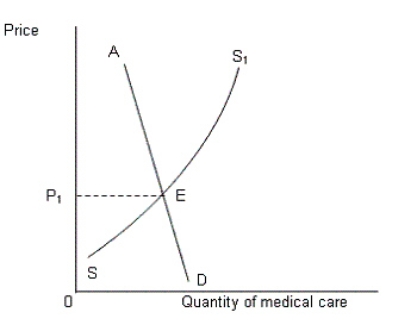 Refer to Figure 18.4.If the third-party system now induces those people to avail medical care who were earlier not willing to avail it, the demand curve AD would:
 (Multiple Choice)
5.0/5 (85)
(85) The U.S.government spends more on social security than it spends on national defense.
(True/False)
4.9/5 (91)
(91) Privatization of the social security system would lead to which of the following adverse outcomes?
(Multiple Choice)
5.0/5 (82)
(82) The increase in physicians' fees in the U.S.is most likely to have resulted from a(n):
(Multiple Choice)
4.9/5 (83)
(83) If the ratio of those working to those retired increases it implies that "The World is Aging."
(True/False)
4.8/5 (77)
(77) Direct payments for medical care consist of out-of-pocket payments made by individuals, copayments, and deductibles required by many third-party payers.
(True/False)
4.8/5 (84)
(84) Which of the following provides the best description of the Social Security System in the United States?
(Multiple Choice)
4.9/5 (81)
(81) Government programs like Medicaid and Medicare have been created as per the belief that everyone has an inalienable right to medical care.
(True/False)
4.9/5 (82)
(82) Many doctors, lawyers, and economists opine that an existence of a legal market for human organs will help cure their chronic shortage that is gripping transplant medicine.
(True/False)
4.9/5 (67)
(67) One proposal for solving the social security problem is privatization.This means:
(Multiple Choice)
4.8/5 (96)
(96) The following figure shows the demand (D)and supply (S)curves of human organs Figure 18.5 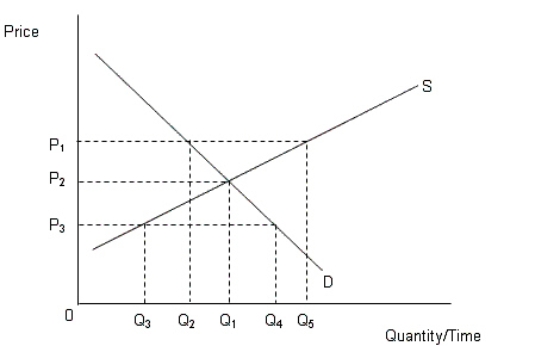 In Figure 18.5, if the price for human organs falls to P3:
 (Multiple Choice)
4.9/5 (78)
(78) It has been pointed out that there is a unidirectional flow of human organs- from poor to rich, from the Third World to the First World.
(True/False)
5.0/5 (82)
(82) The social security tax proceeds are often used to purchase government bonds.
(True/False)
4.9/5 (70)
(70) The bulk of the cost of hospital care is borne by third-parties.Such third-parties are:
(Multiple Choice)
4.8/5 (88)
(88) As three-quarters of the world's population resides in the developing countries, these areas contain around 80 percent of the world's elderly population.
(True/False)
4.9/5 (78)
(78) The system of adjusting social security benefits annually as the cost of living increases in the United States has been a result of intellectual foresight by the American economists.
(True/False)
4.8/5 (73)
(73) A physician who prescribes unnecessary tests to her patients is most likely defending:
(Multiple Choice)
4.8/5 (79)
(79) 
Filters
- Essay(0)
- Multiple Choice(0)
- Short Answer(0)
- True False(0)
- Matching(0)