



 Chat with AI
Exam 27: Capital Markets

Exam 1: Economics: The World Around You90 Questions
Exam 2: Choice, Opportunity Costs, and Specialization94 Questions
Exam 3: Markets, Demand and Supply, and the Price System97 Questions
Exam 5: The Market System and the Private and Public Sector97 Questions
Exam 4: Elasticity: Demand and Supply126 Questions
Exam 6: National Income Accounting104 Questions
Exam 7: an Introduction to the Foreign Exchange Market and the Balance of Payments90 Questions
Exam 8: Consumer Choice132 Questions
Exam 9: Supply: The Costs of Doing Business106 Questions
Exam 10: Unemployment and Inflation129 Questions
Exam 11: Macroeconomic Equilibrium: Aggregate Demand and Supply122 Questions
Exam 12: Profit Maximization122 Questions
Exam 13: Aggregate Expenditures115 Questions
Exam 14: Perfect Competition135 Questions
Exam 15: Income and Expenditures Equilibrium134 Questions
Exam 16: Monopoly118 Questions
Exam 17: Fiscal Policy93 Questions
Exam 18: Monopolistic Competition and Oligopoly111 Questions
Exam 19: Antitrust and Regulation100 Questions
Exam 10: Money and Banking125 Questions
Exam 21: Market Failures, Government Failures, and Rent Seeking121 Questions
Exam 22: Monetary Policy141 Questions
Exam 23: Macroeconomic Policy: Tradeoffs, Expectations, Credibility, and Sources of Business Cycles112 Questions
Exam 24: Resource Markets112 Questions
Exam 25: Macroeconomic Viewpoints: New Keynesian, Monetarist, and New Classical99 Questions
Exam 26: The Labor Market114 Questions
Exam 27: Capital Markets100 Questions
Exam 28: Economic Growth99 Questions
Exam 29: Development Economics104 Questions
Exam 30: the Land Market and Natural Resources55 Questions
Exam 31: Aging, Social Security and Health Care88 Questions
Exam 32: Globalization84 Questions
Exam 33: Elasticity: Demand and Supply126 Questions
Exam 34: Income Distribution, Poverty and Government Policy115 Questions
Exam 35: World Trade Equilibrium112 Questions
Exam 36: Consumer Choice132 Questions
Exam 37: International Trade Restrictions109 Questions
Exam 38: World Trade Equilibrium112 Questions
Exam 39: Exchange Rates and Financial Links Between Countries132 Questions
Exam 40: International Trade Restrictions109 Questions
Exam 41: Supply: the Costs of Doing Business106 Questions
Exam 42: Exchange Rates and Financial Links Between Countries132 Questions
Exam 43: Profit Maximization122 Questions
Exam 44: Perfect Competition135 Questions
Exam 45: Monopoly118 Questions
Exam 46: Monopolistic Competition and Oligopoly111 Questions
Exam 47: Antitrust and Regulation100 Questions
Exam 48: Market Failures, Government Failures, and Rent Seeking121 Questions
Exam 49: Resource Markets112 Questions
Exam 50: The Labor Market114 Questions
Exam 51: Capital Markets100 Questions
Exam 52: The Land Market and Natural Resources55 Questions
Exam 53: Aging, Social Security and Health Care87 Questions
Exam 54: Income Distribution, Poverty and Government Policy115 Questions
Exam 55: World Trade Equilibrium112 Questions
Exam 56: International Trade Restrictions109 Questions
Exam 57: Exchange Rates and Financial Links Between Countries132 Questions
Select questions type


The demand curve for the shares of a company's stock slopes upward, since the higher the price of the stock, everything else the same, the higher the quantity of stock demanded.

Free
(True/False)
4.7/5  (72)
(72) Correct Answer: Verified
False
If the earnings of Chopo Co.are lower than expected, the forecasts will be revised downward and the price of the company's stock will decline.
Free
(True/False)
4.8/5 (81)
(81) Correct Answer:Verified
VerifiedTrue
The unique alphabetic name that identifies a listed stock is known as the:
(Multiple Choice)
4.9/5 (76)
(76) In order to induce risk averse people to invest in risky ventures, an additional sum of money is often paid to them along with the return.
(True/False)
4.9/5 (69)
(69) The equity market is said to be an efficient market because it is difficult for an investor to continually earn above-normal profits.
(True/False)
4.9/5 (89)
(89) According to the ratings given by Moody's and Standard and Poor's, _____ bonds are corporate bonds that carry the lowest risk and offer a lower yield.
(Multiple Choice)
4.9/5 (83)
(83) The figure given below shows the demand curves [D1 and D2] and the supply curve [S1] of capital. Figure 16.1 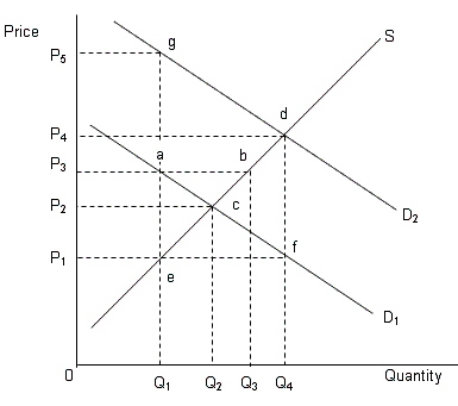 In Figure 16.1, if the demand curve for capital shifts to D2, the equilibrium price and quantity of capital are:
 (Multiple Choice)
4.8/5 (74)
(74) When a new generation of computers that are faster and more powerful than the previous generation are introduced into the resource market:
(Multiple Choice)
4.7/5 (67)
(67) A bubble or panic generally occurs in the stock market because of:
(Multiple Choice)
4.9/5 (75)
(75) The amount that a risk averse person requires to take on risk is called:
(Multiple Choice)
4.7/5 (78)
(78) During the stock market bubbles, the price/earnings [P/E] ratio:
(Multiple Choice)
4.9/5 (79)
(79) A primary market refers to a market in which outstanding shares are bought and sold.
(True/False)
4.7/5 (79)
(79) If the par value of a bond is $200, and the bid price of the bond is $90, it implies:
(Multiple Choice)
4.8/5 (65)
(65) If $30 is paid for a share of stock and the earning per share is $3, how long will it take for the firm's earnings to add up to the purchase price?
(Multiple Choice)
4.8/5 (77)
(77) Consider a mutual fund with a 6 percent back-end load that decreases to 0 percent in the seventh year.How much of the load will an investor have to bear if she sells it off in the second year?
(Multiple Choice)
4.9/5 (90)
(90) Bonds and stocks act as complementary goods such that a rise in the price of one raises the demand for the other.
(True/False)
4.8/5 (79)
(79) Stock prices often fail to correctly reflect complete information about a company in the long run.
(True/False)
4.8/5 (83)
(83) A low P/E ratio of a stock means that the company issuing the stock is headed to trouble in near future.
(True/False)
4.7/5 (67)
(67) 
Filters
- Essay(0)
- Multiple Choice(0)
- Short Answer(0)
- True False(0)
- Matching(0)