



 Chat with AI
Exam 38: World Trade Equilibrium

Exam 1: Economics: The World Around You90 Questions
Exam 2: Choice, Opportunity Costs, and Specialization94 Questions
Exam 3: Markets, Demand and Supply, and the Price System97 Questions
Exam 5: The Market System and the Private and Public Sector97 Questions
Exam 4: Elasticity: Demand and Supply126 Questions
Exam 6: National Income Accounting104 Questions
Exam 7: an Introduction to the Foreign Exchange Market and the Balance of Payments90 Questions
Exam 8: Consumer Choice132 Questions
Exam 9: Supply: The Costs of Doing Business106 Questions
Exam 10: Unemployment and Inflation129 Questions
Exam 11: Macroeconomic Equilibrium: Aggregate Demand and Supply122 Questions
Exam 12: Profit Maximization122 Questions
Exam 13: Aggregate Expenditures115 Questions
Exam 14: Perfect Competition135 Questions
Exam 15: Income and Expenditures Equilibrium134 Questions
Exam 16: Monopoly118 Questions
Exam 17: Fiscal Policy93 Questions
Exam 18: Monopolistic Competition and Oligopoly111 Questions
Exam 19: Antitrust and Regulation100 Questions
Exam 10: Money and Banking125 Questions
Exam 21: Market Failures, Government Failures, and Rent Seeking121 Questions
Exam 22: Monetary Policy141 Questions
Exam 23: Macroeconomic Policy: Tradeoffs, Expectations, Credibility, and Sources of Business Cycles112 Questions
Exam 24: Resource Markets112 Questions
Exam 25: Macroeconomic Viewpoints: New Keynesian, Monetarist, and New Classical99 Questions
Exam 26: The Labor Market114 Questions
Exam 27: Capital Markets100 Questions
Exam 28: Economic Growth99 Questions
Exam 29: Development Economics104 Questions
Exam 30: the Land Market and Natural Resources55 Questions
Exam 31: Aging, Social Security and Health Care88 Questions
Exam 32: Globalization84 Questions
Exam 33: Elasticity: Demand and Supply126 Questions
Exam 34: Income Distribution, Poverty and Government Policy115 Questions
Exam 35: World Trade Equilibrium112 Questions
Exam 36: Consumer Choice132 Questions
Exam 37: International Trade Restrictions109 Questions
Exam 38: World Trade Equilibrium112 Questions
Exam 39: Exchange Rates and Financial Links Between Countries132 Questions
Exam 40: International Trade Restrictions109 Questions
Exam 41: Supply: the Costs of Doing Business106 Questions
Exam 42: Exchange Rates and Financial Links Between Countries132 Questions
Exam 43: Profit Maximization122 Questions
Exam 44: Perfect Competition135 Questions
Exam 45: Monopoly118 Questions
Exam 46: Monopolistic Competition and Oligopoly111 Questions
Exam 47: Antitrust and Regulation100 Questions
Exam 48: Market Failures, Government Failures, and Rent Seeking121 Questions
Exam 49: Resource Markets112 Questions
Exam 50: The Labor Market114 Questions
Exam 51: Capital Markets100 Questions
Exam 52: The Land Market and Natural Resources55 Questions
Exam 53: Aging, Social Security and Health Care87 Questions
Exam 54: Income Distribution, Poverty and Government Policy115 Questions
Exam 55: World Trade Equilibrium112 Questions
Exam 56: International Trade Restrictions109 Questions
Exam 57: Exchange Rates and Financial Links Between Countries132 Questions
Select questions type


Nations trade what they produce in excess of their own consumption to:

Free
(Multiple Choice)
4.8/5  (87)
(87) Correct Answer: Verified
D
We know that industrial countries tend to trade with other industrial countries.This pattern counters the:
Free
(Multiple Choice)
4.7/5 (70)
(70) Correct Answer:Verified
VerifiedB
According to the Ricardian model, the source of comparative advantage is:
Free
(Multiple Choice)
4.9/5 (77)
(77) Correct Answer:Verified
VerifiedA
It seems self evident that countries would have an advantage in producing those goods that use relatively large amounts of their most abundant factor of production.
(True/False)
4.8/5 (88)
(88) Which of the following looks at the demand side of the market to explain some of the observed international trade patterns?
(Multiple Choice)
4.8/5 (73)
(73) Scenario 20.2 Suppose labor productivity differences are the only determinants of comparative advantage, and both Egypt and produce only corn and cocoa.In Egypt, 10 bushels of corn or 15 pounds of cocoa can be produced in a day.In Ghana, one day of labor can be used to produce either 2 bushels of corn or 8 pounds of cocoa.
Based on Scenario 20.2, which of the following terms of trade would benefit both countries?
(Multiple Choice)
4.9/5 (77)
(77) The import demand curve shows the amount of the home country's:
(Multiple Choice)
4.8/5 (91)
(91) The human skills theory is similar to the factor abundance theory of explaining the source of comparative advantage, except that the former concentrates only on different aspects of labor.
(True/False)
4.9/5 (81)
(81) The higher the world price above the domestic no-trade equilibrium, the lesser the quantity of a good exported by a country.
(True/False)
4.9/5 (82)
(82) According to Table 20.1, the opportunity cost of producing cloth in the U.S.equals:
(Multiple Choice)
4.9/5 (82)
(82) The export supply curve is the portion of the domestic supply curve below the no-trade equilibrium price.
(True/False)
4.7/5 (74)
(74) Scenario 20.1 Suppose labor productivity differences are the only determinants of comparative advantage, and Brazil and Chile both produce only coffee and sugar.In Chile, either 5 units of coffee or 2 units of sugar can be produced in one day.In Brazil, a day of labor produces either 2 units of coffee or 1 unit of sugar.
Refer to Scenario 20.1.What is the opportunity cost of producing coffee in Chile?
(Multiple Choice)
5.0/5 (71)
(71) "Most textiles worn by American consumers are produced in Asian and South American countries where the opportunity costs of production are lower." This observation refers to the:
(Multiple Choice)
4.9/5 (88)
(88) Scenario 20.2 Suppose labor productivity differences are the only determinants of comparative advantage, and both Egypt and produce only corn and cocoa.In Egypt, 10 bushels of corn or 15 pounds of cocoa can be produced in a day.In Ghana, one day of labor can be used to produce either 2 bushels of corn or 8 pounds of cocoa.
Refer to Scenario 20.2.Egypt will be willing to trade corn for cocoa if in the international market 1 bushel of corn can be exchanged for:
(Multiple Choice)
4.7/5 (87)
(87) The data in the table below assumes that with the same quantity of resources, both Australia and Philippines produces food and computers.Australia can make 1, 000 computers or 2, 000 units of food in a day, and the Philippines can make 200 computers or 1, 200 units of food in a day. Table 20.2 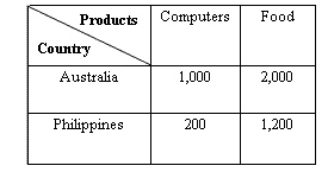 According to Table 20.2, Australia has an:
 (Multiple Choice)
4.9/5 (71)
(71) Which of the following countries receives the largest share of U.S.exports?
(Multiple Choice)
4.9/5 (87)
(87) International equilibrium occurs if the quantity of imports demanded by one country is equal to the quantity of exports supplied by the other country.
(True/False)
4.8/5 (84)
(84) According to Table 20.1, the opportunity cost of producing wheat in the U.S.equals:
(Multiple Choice)
4.9/5 (84)
(84) 
Filters
- Essay(0)
- Multiple Choice(0)
- Short Answer(0)
- True False(0)
- Matching(0)