



 Chat with AI
Exam 43: Profit Maximization

Exam 1: Economics: The World Around You90 Questions
Exam 2: Choice, Opportunity Costs, and Specialization94 Questions
Exam 3: Markets, Demand and Supply, and the Price System97 Questions
Exam 5: The Market System and the Private and Public Sector97 Questions
Exam 4: Elasticity: Demand and Supply126 Questions
Exam 6: National Income Accounting104 Questions
Exam 7: an Introduction to the Foreign Exchange Market and the Balance of Payments90 Questions
Exam 8: Consumer Choice132 Questions
Exam 9: Supply: The Costs of Doing Business106 Questions
Exam 10: Unemployment and Inflation129 Questions
Exam 11: Macroeconomic Equilibrium: Aggregate Demand and Supply122 Questions
Exam 12: Profit Maximization122 Questions
Exam 13: Aggregate Expenditures115 Questions
Exam 14: Perfect Competition135 Questions
Exam 15: Income and Expenditures Equilibrium134 Questions
Exam 16: Monopoly118 Questions
Exam 17: Fiscal Policy93 Questions
Exam 18: Monopolistic Competition and Oligopoly111 Questions
Exam 19: Antitrust and Regulation100 Questions
Exam 10: Money and Banking125 Questions
Exam 21: Market Failures, Government Failures, and Rent Seeking121 Questions
Exam 22: Monetary Policy141 Questions
Exam 23: Macroeconomic Policy: Tradeoffs, Expectations, Credibility, and Sources of Business Cycles112 Questions
Exam 24: Resource Markets112 Questions
Exam 25: Macroeconomic Viewpoints: New Keynesian, Monetarist, and New Classical99 Questions
Exam 26: The Labor Market114 Questions
Exam 27: Capital Markets100 Questions
Exam 28: Economic Growth99 Questions
Exam 29: Development Economics104 Questions
Exam 30: the Land Market and Natural Resources55 Questions
Exam 31: Aging, Social Security and Health Care88 Questions
Exam 32: Globalization84 Questions
Exam 33: Elasticity: Demand and Supply126 Questions
Exam 34: Income Distribution, Poverty and Government Policy115 Questions
Exam 35: World Trade Equilibrium112 Questions
Exam 36: Consumer Choice132 Questions
Exam 37: International Trade Restrictions109 Questions
Exam 38: World Trade Equilibrium112 Questions
Exam 39: Exchange Rates and Financial Links Between Countries132 Questions
Exam 40: International Trade Restrictions109 Questions
Exam 41: Supply: the Costs of Doing Business106 Questions
Exam 42: Exchange Rates and Financial Links Between Countries132 Questions
Exam 43: Profit Maximization122 Questions
Exam 44: Perfect Competition135 Questions
Exam 45: Monopoly118 Questions
Exam 46: Monopolistic Competition and Oligopoly111 Questions
Exam 47: Antitrust and Regulation100 Questions
Exam 48: Market Failures, Government Failures, and Rent Seeking121 Questions
Exam 49: Resource Markets112 Questions
Exam 50: The Labor Market114 Questions
Exam 51: Capital Markets100 Questions
Exam 52: The Land Market and Natural Resources55 Questions
Exam 53: Aging, Social Security and Health Care87 Questions
Exam 54: Income Distribution, Poverty and Government Policy115 Questions
Exam 55: World Trade Equilibrium112 Questions
Exam 56: International Trade Restrictions109 Questions
Exam 57: Exchange Rates and Financial Links Between Countries132 Questions
Select questions type


The only decision that a perfectly competitive firm makes is:

Free
(Multiple Choice)
4.8/5  (95)
(95) Correct Answer: Verified
B
A zero economic profit is not a bad thing because:
Free
(Multiple Choice)
4.8/5 (76)
(76) Correct Answer:Verified
VerifiedA
Economic profit includes all opportunity costs.
Free
(True/False)
4.9/5 (68)
(68) Correct Answer:Verified
VerifiedTrue
Irrespective of the market structure, a firm maximizes profit where the price of its product equals its marginal cost.
(True/False)
4.8/5 (79)
(79) The table given below reports the marginal revenue and marginal cost of Holmes Detective Agency for each client. Table 22.2
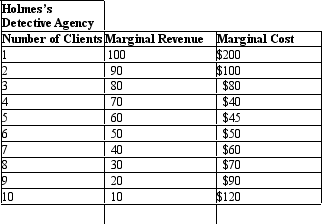 According to Table 22.2, what will be the total number of clients that will maximize profits for the Holmes Detective Agency?
 (Multiple Choice)
4.9/5 (90)
(90) Each firm under perfect competition charges different prices for their products.
(True/False)
4.9/5 (78)
(78) The following graph shows the demand and cost curves of an imperfectly competitive firm.MC and ATC represent the marginal cost curve and the average cost curve respectively. Figure 22.1 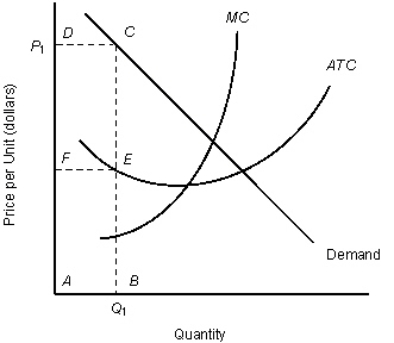 In Table 22.1, in order to maximize profits, the firm should increase output until the ____ unit of output.
 (Multiple Choice)
4.9/5 (92)
(92) The ordering of market structures from most market power to least market power (where market power is the ability to set its own price)is:
(Multiple Choice)
4.8/5 (95)
(95) Under oligopoly market structure, the rival firms take complete independent decisions.
(True/False)
4.8/5 (93)
(93) The table given below reports the marginal revenue and marginal cost of Holmes Detective Agency for each client. Table 22.2
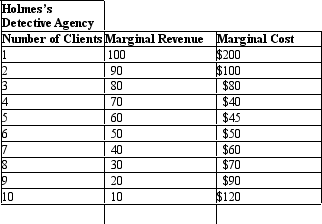 Refer to Table 22.1.If we assume that Holmes is currently serving 8 clients, then Holmes Agency:
 (Multiple Choice)
4.8/5 (75)
(75) When the average cost curve lies below the average revenue curve at the profit maximizing level of output, it implies that the firm is suffering losses.
(True/False)
4.7/5 (87)
(87) Suppose that Cheapo Industries, a perfectly competitive firm, currently produces 500 units of imitation ham spread for a total cost of $1, 500.The marginal cost of the 500th unit is $20, and the marginal revenue of the 500th unit is $15.To maximize profits, Cheapo Industries should:
(Multiple Choice)
4.9/5 (90)
(90) The table given below shows the total revenue and total cost of producing a commodity. Table 22.1
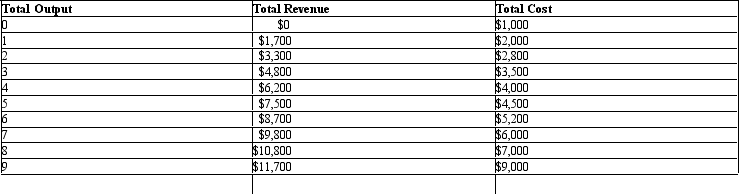 In Table 22.1, marginal revenue exceeds marginal cost:
 (Multiple Choice)
4.9/5 (75)
(75) The figure given below shows the cost curves of a firm. Figure 22.3 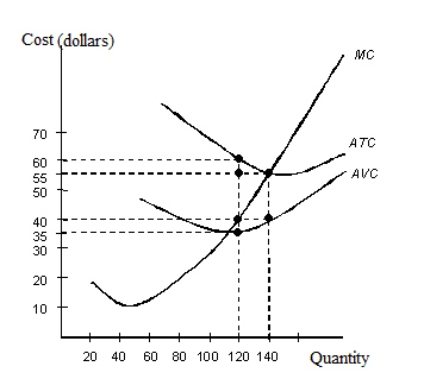 ATC: Average Total Cost
AVC: Average Variable Cost
MC: Marginal Cost
In Figure 22.3, if the marginal revenue of the firm is constant at $55, calculate the profit earned by the firm?
ATC: Average Total Cost
AVC: Average Variable Cost
MC: Marginal Cost
In Figure 22.3, if the marginal revenue of the firm is constant at $55, calculate the profit earned by the firm? (Multiple Choice)
4.8/5 (78)
(78) 
Filters
- Essay(0)
- Multiple Choice(0)
- Short Answer(0)
- True False(0)
- Matching(0)