



 Chat with AI
Exam 2: Choice, Opportunity Costs, and Specialization

Exam 1: Economics: The World Around You90 Questions
Exam 2: Choice, Opportunity Costs, and Specialization94 Questions
Exam 3: Markets, Demand and Supply, and the Price System97 Questions
Exam 5: The Market System and the Private and Public Sector97 Questions
Exam 4: Elasticity: Demand and Supply126 Questions
Exam 6: National Income Accounting104 Questions
Exam 7: an Introduction to the Foreign Exchange Market and the Balance of Payments90 Questions
Exam 8: Consumer Choice132 Questions
Exam 9: Supply: The Costs of Doing Business106 Questions
Exam 10: Unemployment and Inflation129 Questions
Exam 11: Macroeconomic Equilibrium: Aggregate Demand and Supply122 Questions
Exam 12: Profit Maximization122 Questions
Exam 13: Aggregate Expenditures115 Questions
Exam 14: Perfect Competition135 Questions
Exam 15: Income and Expenditures Equilibrium134 Questions
Exam 16: Monopoly118 Questions
Exam 17: Fiscal Policy93 Questions
Exam 18: Monopolistic Competition and Oligopoly111 Questions
Exam 19: Antitrust and Regulation100 Questions
Exam 10: Money and Banking125 Questions
Exam 21: Market Failures, Government Failures, and Rent Seeking121 Questions
Exam 22: Monetary Policy141 Questions
Exam 23: Macroeconomic Policy: Tradeoffs, Expectations, Credibility, and Sources of Business Cycles112 Questions
Exam 24: Resource Markets112 Questions
Exam 25: Macroeconomic Viewpoints: New Keynesian, Monetarist, and New Classical99 Questions
Exam 26: The Labor Market114 Questions
Exam 27: Capital Markets100 Questions
Exam 28: Economic Growth99 Questions
Exam 29: Development Economics104 Questions
Exam 30: the Land Market and Natural Resources55 Questions
Exam 31: Aging, Social Security and Health Care88 Questions
Exam 32: Globalization84 Questions
Exam 33: Elasticity: Demand and Supply126 Questions
Exam 34: Income Distribution, Poverty and Government Policy115 Questions
Exam 35: World Trade Equilibrium112 Questions
Exam 36: Consumer Choice132 Questions
Exam 37: International Trade Restrictions109 Questions
Exam 38: World Trade Equilibrium112 Questions
Exam 39: Exchange Rates and Financial Links Between Countries132 Questions
Exam 40: International Trade Restrictions109 Questions
Exam 41: Supply: the Costs of Doing Business106 Questions
Exam 42: Exchange Rates and Financial Links Between Countries132 Questions
Exam 43: Profit Maximization122 Questions
Exam 44: Perfect Competition135 Questions
Exam 45: Monopoly118 Questions
Exam 46: Monopolistic Competition and Oligopoly111 Questions
Exam 47: Antitrust and Regulation100 Questions
Exam 48: Market Failures, Government Failures, and Rent Seeking121 Questions
Exam 49: Resource Markets112 Questions
Exam 50: The Labor Market114 Questions
Exam 51: Capital Markets100 Questions
Exam 52: The Land Market and Natural Resources55 Questions
Exam 53: Aging, Social Security and Health Care87 Questions
Exam 54: Income Distribution, Poverty and Government Policy115 Questions
Exam 55: World Trade Equilibrium112 Questions
Exam 56: International Trade Restrictions109 Questions
Exam 57: Exchange Rates and Financial Links Between Countries132 Questions
Select questions type


Refer to Figure 2.4.What would be the marginal opportunity cost of producing one unit of food in Korea assuming the economy is at point B?

Free
(Multiple Choice)
4.8/5  (82)
(82) Correct Answer: Verified
B
Which of the following is an example of opportunity cost?
Free
(Multiple Choice)
4.9/5 (81)
(81) Correct Answer:Verified
VerifiedA
Given a production possibilities curve for defense goods and nondefense goods, which of the following is not true?
(Multiple Choice)
4.7/5 (75)
(75) Economists refer to the ability of one person or nation to do something with a lower opportunity cost than another as _____.
(Multiple Choice)
4.8/5 (76)
(76) The table given below represents the output per hour of cookies and chilies in Ohio and Iowa. Table 2.4
 Refer to Table 2.4.If trade were to occur, what would be the most Ohio would be willing to pay for 1 chili?
 (Multiple Choice)
4.8/5 (80)
(80) Which of the following is related to the concept of trade-off used in economics?
(Multiple Choice)
4.9/5 (75)
(75) The table given below represents butter and ham production by two countries Norway and Sweden. Table 2.5
 Refer to Table 2.5 and identify the correct statement.
 (Multiple Choice)
4.7/5 (70)
(70) Jane wins $100, 000 in the lottery and immediately uses her winnings to open up a donut shop.Her direct costs are $50, 000, and she puts the remaining money in a savings account earning 10 percent annual interest.Alternatively, Jane could have placed all her lottery winnings in the 10 percent savings account.Jane's total cost is:
(Multiple Choice)
4.8/5 (82)
(82) Given below is the production possibilities schedule for a small island nation in South Pacific that produces capital and consumer goods. Table 2.2
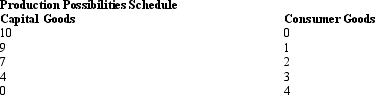 Refer to Table 2.2.Identify the correct statement.
 (Multiple Choice)
4.9/5 (95)
(95) Gains from trade can be realized if each country specializes in its comparative advantage good.
(True/False)
4.9/5 (89)
(89) The figure given below represents the PPC in two nations - Germany and Korea, producing only two goods cars and food. Figure 2.4 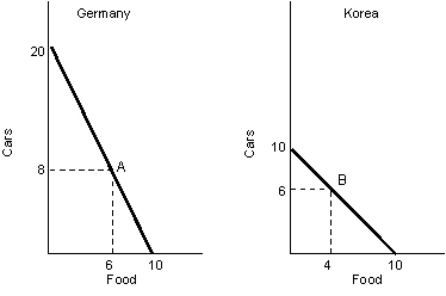 Refer to Figure 2.4 and identify the correct statement.
 (Multiple Choice)
4.7/5 (81)
(81) Given below is the production possibilities schedule for capital goods and consumer goods. Table 2.3
 If the nation depicted in Figure 2.3 is producing at combination E, the opportunity cost of producing the tenth unit of consumer good is:
 (Multiple Choice)
4.7/5 (76)
(76) Bob and Bill can make 16 toys each if they devote 8 working hours in a day.Further, Bob can repair 4 cars and Bill can repair 2 cars, if they devote 8 working hours in a day.What is the opportunity cost of repairing one car to Bill?
(Multiple Choice)
4.9/5 (84)
(84) An economy's PPC illustrates the extent to which the economy consumes what it produces.
(True/False)
4.8/5 (63)
(63) Nicky makes $25, 000 a year as a sales clerk.He then decides to quit his job to enter an MBA program full-time (assume Nicky doesn't work in the summer or hold any part-time jobs).His tuition, books, living expenses, and fees total $15, 000 a year.Given this information, the annual total cost of Nicky's MBA studies is:
(Multiple Choice)
4.9/5 (74)
(74) Consider a PPC with automobiles on the vertical axis and cotton on the horizontal axis.The discovery of a new fertilizer that improves crop yield will shift:
(Multiple Choice)
4.9/5 (63)
(63) The table given below represents the output per hour of cookies and chilies in Ohio and Iowa. Table 2.4
 Refer to Table 2.4.The opportunity cost of a chili in Ohio is:
 (Multiple Choice)
4.9/5 (70)
(70) While constructing a production possibilities frontier [PPF], we assume:
(Multiple Choice)
4.8/5 (72)
(72) Which economic concept is the closest parallel to the saying "There's no free lunch"?
(Multiple Choice)
4.8/5 (79)
(79) 
Filters
- Essay(0)
- Multiple Choice(0)
- Short Answer(0)
- True False(0)
- Matching(0)