



 Chat with AI
Exam 49: Resource Markets

Exam 1: Economics: The World Around You90 Questions
Exam 2: Choice, Opportunity Costs, and Specialization94 Questions
Exam 3: Markets, Demand and Supply, and the Price System97 Questions
Exam 5: The Market System and the Private and Public Sector97 Questions
Exam 4: Elasticity: Demand and Supply126 Questions
Exam 6: National Income Accounting104 Questions
Exam 7: an Introduction to the Foreign Exchange Market and the Balance of Payments90 Questions
Exam 8: Consumer Choice132 Questions
Exam 9: Supply: The Costs of Doing Business106 Questions
Exam 10: Unemployment and Inflation129 Questions
Exam 11: Macroeconomic Equilibrium: Aggregate Demand and Supply122 Questions
Exam 12: Profit Maximization122 Questions
Exam 13: Aggregate Expenditures115 Questions
Exam 14: Perfect Competition135 Questions
Exam 15: Income and Expenditures Equilibrium134 Questions
Exam 16: Monopoly118 Questions
Exam 17: Fiscal Policy93 Questions
Exam 18: Monopolistic Competition and Oligopoly111 Questions
Exam 19: Antitrust and Regulation100 Questions
Exam 10: Money and Banking125 Questions
Exam 21: Market Failures, Government Failures, and Rent Seeking121 Questions
Exam 22: Monetary Policy141 Questions
Exam 23: Macroeconomic Policy: Tradeoffs, Expectations, Credibility, and Sources of Business Cycles112 Questions
Exam 24: Resource Markets112 Questions
Exam 25: Macroeconomic Viewpoints: New Keynesian, Monetarist, and New Classical99 Questions
Exam 26: The Labor Market114 Questions
Exam 27: Capital Markets100 Questions
Exam 28: Economic Growth99 Questions
Exam 29: Development Economics104 Questions
Exam 30: the Land Market and Natural Resources55 Questions
Exam 31: Aging, Social Security and Health Care88 Questions
Exam 32: Globalization84 Questions
Exam 33: Elasticity: Demand and Supply126 Questions
Exam 34: Income Distribution, Poverty and Government Policy115 Questions
Exam 35: World Trade Equilibrium112 Questions
Exam 36: Consumer Choice132 Questions
Exam 37: International Trade Restrictions109 Questions
Exam 38: World Trade Equilibrium112 Questions
Exam 39: Exchange Rates and Financial Links Between Countries132 Questions
Exam 40: International Trade Restrictions109 Questions
Exam 41: Supply: the Costs of Doing Business106 Questions
Exam 42: Exchange Rates and Financial Links Between Countries132 Questions
Exam 43: Profit Maximization122 Questions
Exam 44: Perfect Competition135 Questions
Exam 45: Monopoly118 Questions
Exam 46: Monopolistic Competition and Oligopoly111 Questions
Exam 47: Antitrust and Regulation100 Questions
Exam 48: Market Failures, Government Failures, and Rent Seeking121 Questions
Exam 49: Resource Markets112 Questions
Exam 50: The Labor Market114 Questions
Exam 51: Capital Markets100 Questions
Exam 52: The Land Market and Natural Resources55 Questions
Exam 53: Aging, Social Security and Health Care87 Questions
Exam 54: Income Distribution, Poverty and Government Policy115 Questions
Exam 55: World Trade Equilibrium112 Questions
Exam 56: International Trade Restrictions109 Questions
Exam 57: Exchange Rates and Financial Links Between Countries132 Questions
Select questions type


The figure given below represents equilibrium in the labor market with the demand and supply curves of labor. Figure 28.6 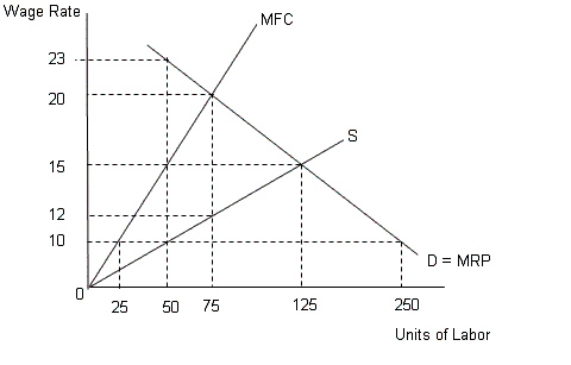 In the figure,
D = MRP implies demand for labor = Marginal Revenue Product
MFC represents Marginal Factor Cost curve
S represents the supply curve of labor
According to Figure 28.6, if the government imposes a minimum wage of $15, what quantity of labor will a competitive firm and a monopsonist, respectively, hire?
In the figure,
D = MRP implies demand for labor = Marginal Revenue Product
MFC represents Marginal Factor Cost curve
S represents the supply curve of labor
According to Figure 28.6, if the government imposes a minimum wage of $15, what quantity of labor will a competitive firm and a monopsonist, respectively, hire?
Free
(Multiple Choice)
4.9/5  (67)
(67) Correct Answer: Verified
E
If a person is earning $80, 000 per year as a dentist and could earn at most $45, 000 per year doing something else, his transfer earnings are ____, whereas his economic rent is ____.
Free
(Multiple Choice)
4.8/5 (81)
(81) Correct Answer:Verified
VerifiedA
Burger King has a direct demand for the cheese which it uses in its burgers.
Free
(True/False)
4.8/5 (64)
(64) Correct Answer:Verified
VerifiedFalse
The figure given below represents the marginal revenue product (MRP)and the marginal factor cost (MFC)of a resource in the resource market. Figure 28.3 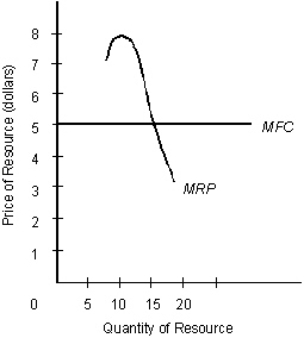 Consider the resource market shown in Figure 28.3.Given that the resource market is perfectly competitive, determine the equilibrium price of the resource.
 (Multiple Choice)
4.8/5 (76)
(76) If there is imperfect competition in the product market, the marginal revenue product of a factor will be greater than the value of its marginal product.
(True/False)
4.8/5 (95)
(95) The following table shows output per hour produced by the different units of labor. Table 28.1
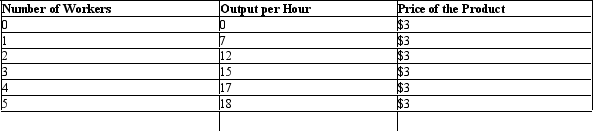 The marginal revenue product of a resource is equal to the product of the marginal product of an input and marginal revenue.
The structure of the product market as described by Table 28.1 is:
The marginal revenue product of a resource is equal to the product of the marginal product of an input and marginal revenue.
The structure of the product market as described by Table 28.1 is: (Multiple Choice)
4.9/5 (77)
(77) Households' expenditure on goods and services are sources of revenue for the firms.
(True/False)
5.0/5 (78)
(78) Consider a perfectly competitive firm that produces computers.Each additional worker at this firm can produce four computers.Calculate the marginal factor cost if the computers are sold for $1, 000 each, and the firm is maximizing profit.(Assume that marginal revenue product is the product of marginal product of the input and the marginal revenue of the firm. )
(Multiple Choice)
5.0/5 (82)
(82) Because of their derived nature, resource markets are completely different from any other type of market studied by economists.
(True/False)
4.7/5 (78)
(78) If the labor market is perfectly competitive the wage rate will be less than the marginal revenue product of labor.
(True/False)
4.8/5 (80)
(80) Which of the following statements brings out the relationship between the value of marginal product (VMP)and the marginal revenue product (MRP)?
(Multiple Choice)
4.8/5 (71)
(71) Intel microchips are an input into a computer.What happens to the demand for the microchips if the demand for computers decline?
(Multiple Choice)
4.7/5 (77)
(77) If the price of a product increases, the demand for the resource used in producing that product decreases.
(True/False)
4.9/5 (82)
(82) The following table shows output per hour produced by the different units of labor. Table 28.1
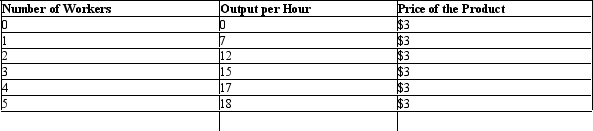 The marginal revenue product of a resource is equal to the product of the marginal product of an input and marginal revenue.
Refer to Table 28.1.If both the wage rate and the price of the good falls to $2, how many workers would the firm hire?
The marginal revenue product of a resource is equal to the product of the marginal product of an input and marginal revenue.
Refer to Table 28.1.If both the wage rate and the price of the good falls to $2, how many workers would the firm hire? (Multiple Choice)
4.9/5 (82)
(82) Monopsonists tend to exploit the resources as they are the sole employers of the resources.
(True/False)
5.0/5 (94)
(94) If a resource is purchased and sold in a perfectly competitive market:
(Multiple Choice)
4.8/5 (71)
(71) The figure given below shows the marginal revenue product (MRP)of accountants in a firm. Figure 28.2 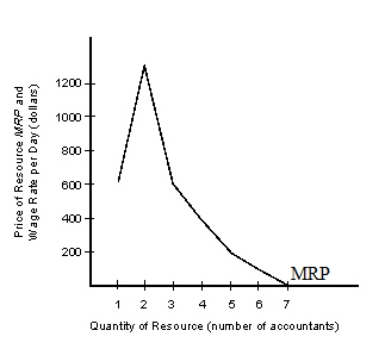 MRP = MP ´ MR
According to Figure 28.2, if the marginal cost of the resource is $600:
MRP = MP ´ MR
According to Figure 28.2, if the marginal cost of the resource is $600: (Multiple Choice)
4.8/5 (78)
(78) For a perfectly competitive firm, the marginal-revenue product is equal to the marginal product multiplied by the output price.
(True/False)
4.8/5 (78)
(78) The figure given below represents equilibrium in the labor market with the demand and supply curves of labor. Figure 28.6 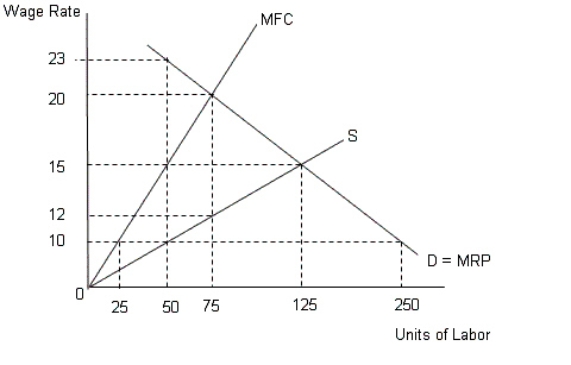 In the figure,
D = MRP implies demand for labor = Marginal Revenue Product
MFC represents Marginal Factor Cost curve
S represents the supply curve of labor
According to Figure 28.6, what is the wage paid by a monopsonist?
In the figure,
D = MRP implies demand for labor = Marginal Revenue Product
MFC represents Marginal Factor Cost curve
S represents the supply curve of labor
According to Figure 28.6, what is the wage paid by a monopsonist? (Multiple Choice)
4.9/5 (70)
(70) 
Filters
- Essay(0)
- Multiple Choice(0)
- Short Answer(0)
- True False(0)
- Matching(0)