



 Chat with AI
Exam 49: Resource Markets

Exam 1: Economics: The World Around You90 Questions
Exam 2: Choice, Opportunity Costs, and Specialization94 Questions
Exam 3: Markets, Demand and Supply, and the Price System97 Questions
Exam 5: The Market System and the Private and Public Sector97 Questions
Exam 4: Elasticity: Demand and Supply126 Questions
Exam 6: National Income Accounting104 Questions
Exam 7: an Introduction to the Foreign Exchange Market and the Balance of Payments90 Questions
Exam 8: Consumer Choice132 Questions
Exam 9: Supply: The Costs of Doing Business106 Questions
Exam 10: Unemployment and Inflation129 Questions
Exam 11: Macroeconomic Equilibrium: Aggregate Demand and Supply122 Questions
Exam 12: Profit Maximization122 Questions
Exam 13: Aggregate Expenditures115 Questions
Exam 14: Perfect Competition135 Questions
Exam 15: Income and Expenditures Equilibrium134 Questions
Exam 16: Monopoly118 Questions
Exam 17: Fiscal Policy93 Questions
Exam 18: Monopolistic Competition and Oligopoly111 Questions
Exam 19: Antitrust and Regulation100 Questions
Exam 10: Money and Banking125 Questions
Exam 21: Market Failures, Government Failures, and Rent Seeking121 Questions
Exam 22: Monetary Policy141 Questions
Exam 23: Macroeconomic Policy: Tradeoffs, Expectations, Credibility, and Sources of Business Cycles112 Questions
Exam 24: Resource Markets112 Questions
Exam 25: Macroeconomic Viewpoints: New Keynesian, Monetarist, and New Classical99 Questions
Exam 26: The Labor Market114 Questions
Exam 27: Capital Markets100 Questions
Exam 28: Economic Growth99 Questions
Exam 29: Development Economics104 Questions
Exam 30: the Land Market and Natural Resources55 Questions
Exam 31: Aging, Social Security and Health Care88 Questions
Exam 32: Globalization84 Questions
Exam 33: Elasticity: Demand and Supply126 Questions
Exam 34: Income Distribution, Poverty and Government Policy115 Questions
Exam 35: World Trade Equilibrium112 Questions
Exam 36: Consumer Choice132 Questions
Exam 37: International Trade Restrictions109 Questions
Exam 38: World Trade Equilibrium112 Questions
Exam 39: Exchange Rates and Financial Links Between Countries132 Questions
Exam 40: International Trade Restrictions109 Questions
Exam 41: Supply: the Costs of Doing Business106 Questions
Exam 42: Exchange Rates and Financial Links Between Countries132 Questions
Exam 43: Profit Maximization122 Questions
Exam 44: Perfect Competition135 Questions
Exam 45: Monopoly118 Questions
Exam 46: Monopolistic Competition and Oligopoly111 Questions
Exam 47: Antitrust and Regulation100 Questions
Exam 48: Market Failures, Government Failures, and Rent Seeking121 Questions
Exam 49: Resource Markets112 Questions
Exam 50: The Labor Market114 Questions
Exam 51: Capital Markets100 Questions
Exam 52: The Land Market and Natural Resources55 Questions
Exam 53: Aging, Social Security and Health Care87 Questions
Exam 54: Income Distribution, Poverty and Government Policy115 Questions
Exam 55: World Trade Equilibrium112 Questions
Exam 56: International Trade Restrictions109 Questions
Exam 57: Exchange Rates and Financial Links Between Countries132 Questions
Select questions type


If a particular factor has a specific use its transfer earning is very high.
(True/False)
4.8/5  (69)
(69) The following figure shows the marginal revenue product of a resource [MRP]: Figure 28.1 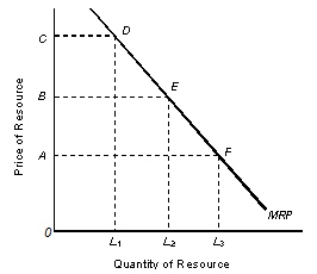 In Figure 28.1, if the price of the resource is equal to 0C and the resource market is perfectly competitive, the quantity employed of the resource would be:
 (Multiple Choice)
5.0/5 (80)
(80) The figure given below represents equilibrium in the labor market with the demand and supply curves of labor. Figure 28.6 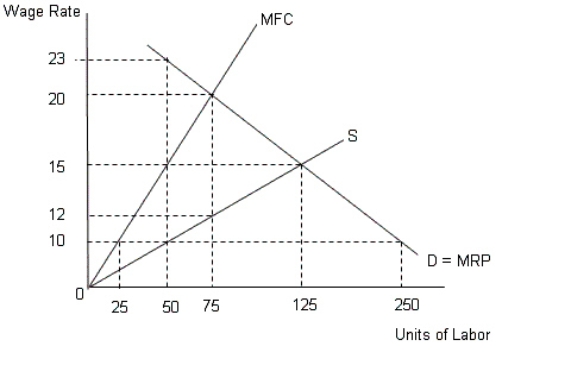 In the figure,
D = MRP implies demand for labor = Marginal Revenue Product
MFC represents Marginal Factor Cost curve
S represents the supply curve of labor
According to Figure 28.6, what is the wage and quantity of labor hired by a competitive firm?
In the figure,
D = MRP implies demand for labor = Marginal Revenue Product
MFC represents Marginal Factor Cost curve
S represents the supply curve of labor
According to Figure 28.6, what is the wage and quantity of labor hired by a competitive firm? (Multiple Choice)
4.8/5 (84)
(84) If the marginal factor cost is greater than the marginal revenue product of a resource, the producer can increase profits by laying off some units of the resource.
(True/False)
4.9/5 (78)
(78) If the elasticity of supply of a resource is greater than zero but less than infinity, its income will comprise of:
(Multiple Choice)
4.8/5 (70)
(70) The following table shows output per hour produced by the different units of labor. Table 28.1
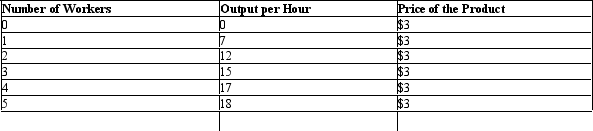 The marginal revenue product of a resource is equal to the product of the marginal product of an input and marginal revenue.
According to Table 28.1, the marginal-revenue product of the:
The marginal revenue product of a resource is equal to the product of the marginal product of an input and marginal revenue.
According to Table 28.1, the marginal-revenue product of the: (Multiple Choice)
4.9/5 (76)
(76) A perfectly competitive firm hires more resources than a monopolist firm.
(True/False)
4.9/5 (83)
(83) The following table shows output per hour produced by the different units of labor. Table 28.1
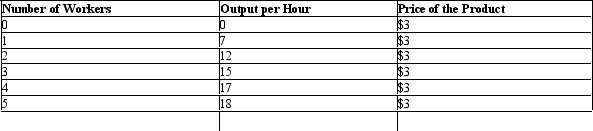 The marginal revenue product of a resource is equal to the product of the marginal product of an input and marginal revenue.
According to Table 28.1, if the wage rate is $6 per hour, how many workers should this firm hire?
The marginal revenue product of a resource is equal to the product of the marginal product of an input and marginal revenue.
According to Table 28.1, if the wage rate is $6 per hour, how many workers should this firm hire? (Multiple Choice)
4.8/5 (72)
(72) The following table shows the marginal productivity of different units of labor for producing a product. Table 28.4
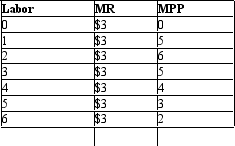 In the table,
MR: Marginal Revenue
MPP: Marginal Physical Product
According to Table 28.4, how many laborers should be hired if the wage rate is $18? (Marginal revenue product = MPP ´ MR)
In the table,
MR: Marginal Revenue
MPP: Marginal Physical Product
According to Table 28.4, how many laborers should be hired if the wage rate is $18? (Marginal revenue product = MPP ´ MR) (Multiple Choice)
4.9/5 (84)
(84) The following table shows the total output produced by different units of a resource.Assume that the resource and output markets are both perfectly competitive.The equilibrium price of the resource is $15.00, and the equilibrium price of the product is $0.50. Table 28.2
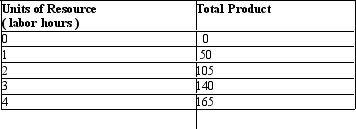 Marginal revenue product (MRP)of a resource is the product of the marginal product of the resource and the marginal revenue.
Refer to Table 28.2.How many units of the resource will a profit-maximizing firm hire?
Marginal revenue product (MRP)of a resource is the product of the marginal product of the resource and the marginal revenue.
Refer to Table 28.2.How many units of the resource will a profit-maximizing firm hire? (Multiple Choice)
4.7/5 (82)
(82) The following table shows the marginal revenue of a firm and the marginal physical product of different units of labor in a perfectly competitive labor market. Table 28.5
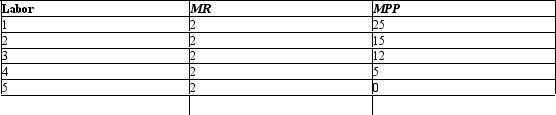 Note: Marginal revenue product of a resource is the product of MPP and MR.
In Table 28.5, if the wage rate is $10, how many workers will be employed by a profit-maximizing firm ?
Note: Marginal revenue product of a resource is the product of MPP and MR.
In Table 28.5, if the wage rate is $10, how many workers will be employed by a profit-maximizing firm ? (Multiple Choice)
4.8/5 (100)
(100) If a firm hires its fourth worker for $5 and its fifth worker for $8, then
(Multiple Choice)
4.8/5 (83)
(83) The greater the elasticity of supply of a resource the greater is its economic rent.
(True/False)
4.9/5 (81)
(81) A market is classified as a monopsony will arise when there is only one seller of the product.
(True/False)
4.7/5 (87)
(87) Assume that labor is the only variable input and that an additional input of labor increases total output from 72 to 78 units.If the product sells for $6 per unit in a perfectly competitive market, then the MRPof this additional worker is:
(Multiple Choice)
4.9/5 (81)
(81) If the government sets a minimum wage which is more than the equilibrium wage, the firms tend to demand more labor.
(True/False)
4.9/5 (83)
(83) When studying the market for resources, it is important to understand that:
(Multiple Choice)
4.9/5 (64)
(64) 
Filters
- Essay(0)
- Multiple Choice(0)
- Short Answer(0)
- True False(0)
- Matching(0)