



 Chat with AI
Exam 49: Resource Markets

Exam 1: Economics: The World Around You90 Questions
Exam 2: Choice, Opportunity Costs, and Specialization94 Questions
Exam 3: Markets, Demand and Supply, and the Price System97 Questions
Exam 5: The Market System and the Private and Public Sector97 Questions
Exam 4: Elasticity: Demand and Supply126 Questions
Exam 6: National Income Accounting104 Questions
Exam 7: an Introduction to the Foreign Exchange Market and the Balance of Payments90 Questions
Exam 8: Consumer Choice132 Questions
Exam 9: Supply: The Costs of Doing Business106 Questions
Exam 10: Unemployment and Inflation129 Questions
Exam 11: Macroeconomic Equilibrium: Aggregate Demand and Supply122 Questions
Exam 12: Profit Maximization122 Questions
Exam 13: Aggregate Expenditures115 Questions
Exam 14: Perfect Competition135 Questions
Exam 15: Income and Expenditures Equilibrium134 Questions
Exam 16: Monopoly118 Questions
Exam 17: Fiscal Policy93 Questions
Exam 18: Monopolistic Competition and Oligopoly111 Questions
Exam 19: Antitrust and Regulation100 Questions
Exam 10: Money and Banking125 Questions
Exam 21: Market Failures, Government Failures, and Rent Seeking121 Questions
Exam 22: Monetary Policy141 Questions
Exam 23: Macroeconomic Policy: Tradeoffs, Expectations, Credibility, and Sources of Business Cycles112 Questions
Exam 24: Resource Markets112 Questions
Exam 25: Macroeconomic Viewpoints: New Keynesian, Monetarist, and New Classical99 Questions
Exam 26: The Labor Market114 Questions
Exam 27: Capital Markets100 Questions
Exam 28: Economic Growth99 Questions
Exam 29: Development Economics104 Questions
Exam 30: the Land Market and Natural Resources55 Questions
Exam 31: Aging, Social Security and Health Care88 Questions
Exam 32: Globalization84 Questions
Exam 33: Elasticity: Demand and Supply126 Questions
Exam 34: Income Distribution, Poverty and Government Policy115 Questions
Exam 35: World Trade Equilibrium112 Questions
Exam 36: Consumer Choice132 Questions
Exam 37: International Trade Restrictions109 Questions
Exam 38: World Trade Equilibrium112 Questions
Exam 39: Exchange Rates and Financial Links Between Countries132 Questions
Exam 40: International Trade Restrictions109 Questions
Exam 41: Supply: the Costs of Doing Business106 Questions
Exam 42: Exchange Rates and Financial Links Between Countries132 Questions
Exam 43: Profit Maximization122 Questions
Exam 44: Perfect Competition135 Questions
Exam 45: Monopoly118 Questions
Exam 46: Monopolistic Competition and Oligopoly111 Questions
Exam 47: Antitrust and Regulation100 Questions
Exam 48: Market Failures, Government Failures, and Rent Seeking121 Questions
Exam 49: Resource Markets112 Questions
Exam 50: The Labor Market114 Questions
Exam 51: Capital Markets100 Questions
Exam 52: The Land Market and Natural Resources55 Questions
Exam 53: Aging, Social Security and Health Care87 Questions
Exam 54: Income Distribution, Poverty and Government Policy115 Questions
Exam 55: World Trade Equilibrium112 Questions
Exam 56: International Trade Restrictions109 Questions
Exam 57: Exchange Rates and Financial Links Between Countries132 Questions
Select questions type


Why is the value of marginal product equal to the marginal revenue product under perfect competition in the product market?
(Multiple Choice)
4.8/5  (84)
(84) The resource market comprises of the households and firms where the firms sell their resources to the households.
(True/False)
4.8/5 (87)
(87) The resource market is the same as the product market except that, in the resource market:
(Multiple Choice)
4.9/5 (68)
(68) If the resource market is perfectly competitive, the marginal factor cost is equal to the price of the resource.
(True/False)
4.8/5 (74)
(74) Which of the following goods is likely to have a derived demand?
(Multiple Choice)
4.7/5 (78)
(78) The following table shows total output produced by different units of capital. Table 28.3
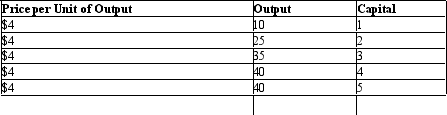 The marginal revenue product of a resource is the product of the marginal product of the resource and the marginal revenue.
In Table 28.3, how many units of capital will the firm hire if the price per unit of capital is $60?
The marginal revenue product of a resource is the product of the marginal product of the resource and the marginal revenue.
In Table 28.3, how many units of capital will the firm hire if the price per unit of capital is $60? (Multiple Choice)
4.8/5 (85)
(85) Consider a perfectly competitive firm that can raise its output by 2 units by hiring an additional unit of capital.If the cost of hiring this additional unit of capital is $4 and the market price of the good is $1, the firm will certainly hire this unit of capital.[Hint: MRP = MP ´ MR]
(True/False)
4.8/5 (75)
(75) In a perfectly competitive labor market, a profit-maximizing firm that is also perfectly competitive in the product market will:
(Multiple Choice)
4.8/5 (63)
(63) The following figure represents the equilibrium in the labor markets. Figure 28.4 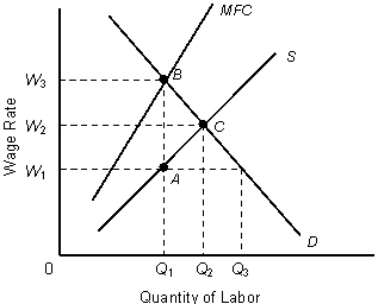 In the figure,
MFC: Marginal Factor Cost curve
D: Demand or the Marginal Revenue Product curve
S: Supply curve
Refer to Figure 28.4.A competitive labor market will pay the wage rate _____ and hire _____ units of labor.
In the figure,
MFC: Marginal Factor Cost curve
D: Demand or the Marginal Revenue Product curve
S: Supply curve
Refer to Figure 28.4.A competitive labor market will pay the wage rate _____ and hire _____ units of labor. (Multiple Choice)
4.9/5 (87)
(87) If an individual thinks about how he purchase goods and services, he will realize that he allocates his expenditures so that the pleasure he gets out of spending one more dollar is the same no matter what he spends that dollar on.For a firm purchasing resources, this is the same as ensuring that:
(Multiple Choice)
4.8/5 (86)
(86) If a resource has perfectly elastic supply curve then its income is termed as:
(Multiple Choice)
4.7/5 (78)
(78) A monopsonist firm faces a negatively sloped marginal factor cost curve.
(True/False)
4.8/5 (89)
(89) An automobile manufacturer uses land, labor, capital, and entrepreneurial ability to produce cars and trucks.If the price of trucks increases, the automobile manufacturer would not _____.
(Multiple Choice)
4.8/5 (74)
(74) The following table shows the marginal productivity of different units of labor for producing a product. Table 28.4
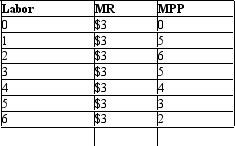 In the table,
MR: Marginal Revenue
MPP: Marginal Physical Product
In Table 28.4, if marginal revenue product is equal to the product of MPP and MR, what wage rate would be consistent with a profit-maximizing firm hiring six laborers?
In the table,
MR: Marginal Revenue
MPP: Marginal Physical Product
In Table 28.4, if marginal revenue product is equal to the product of MPP and MR, what wage rate would be consistent with a profit-maximizing firm hiring six laborers? (Multiple Choice)
4.9/5 (77)
(77) The figure given below represents the marginal revenue product (MRP)and the marginal factor cost (MFC)of a resource in the resource market. Figure 28.3 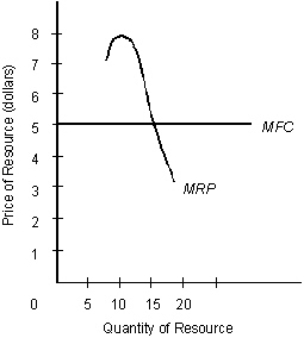 Consider the resource market shown in Figure 28.3.Given that the resource market is perfectly competitive, how many units of the resource will be purchased when the market is in equilibrium?
 (Multiple Choice)
4.8/5 (83)
(83) The following table shows the total output produced by different units of a resource.Assume that the resource and output markets are both perfectly competitive.The equilibrium price of the resource is $15.00, and the equilibrium price of the product is $0.50. Table 28.2
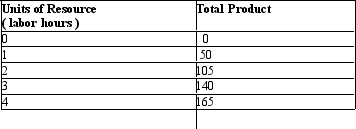 Marginal revenue product (MRP)of a resource is the product of the marginal product of the resource and the marginal revenue.
Refer to Table 28.2.What is the marginal-factor cost for the third unit of the resource?
Marginal revenue product (MRP)of a resource is the product of the marginal product of the resource and the marginal revenue.
Refer to Table 28.2.What is the marginal-factor cost for the third unit of the resource? (Multiple Choice)
4.9/5 (94)
(94) 
Filters
- Essay(0)
- Multiple Choice(0)
- Short Answer(0)
- True False(0)
- Matching(0)