



 Chat with AI
Exam 49: Resource Markets

Exam 1: Economics: The World Around You90 Questions
Exam 2: Choice, Opportunity Costs, and Specialization94 Questions
Exam 3: Markets, Demand and Supply, and the Price System97 Questions
Exam 5: The Market System and the Private and Public Sector97 Questions
Exam 4: Elasticity: Demand and Supply126 Questions
Exam 6: National Income Accounting104 Questions
Exam 7: an Introduction to the Foreign Exchange Market and the Balance of Payments90 Questions
Exam 8: Consumer Choice132 Questions
Exam 9: Supply: The Costs of Doing Business106 Questions
Exam 10: Unemployment and Inflation129 Questions
Exam 11: Macroeconomic Equilibrium: Aggregate Demand and Supply122 Questions
Exam 12: Profit Maximization122 Questions
Exam 13: Aggregate Expenditures115 Questions
Exam 14: Perfect Competition135 Questions
Exam 15: Income and Expenditures Equilibrium134 Questions
Exam 16: Monopoly118 Questions
Exam 17: Fiscal Policy93 Questions
Exam 18: Monopolistic Competition and Oligopoly111 Questions
Exam 19: Antitrust and Regulation100 Questions
Exam 10: Money and Banking125 Questions
Exam 21: Market Failures, Government Failures, and Rent Seeking121 Questions
Exam 22: Monetary Policy141 Questions
Exam 23: Macroeconomic Policy: Tradeoffs, Expectations, Credibility, and Sources of Business Cycles112 Questions
Exam 24: Resource Markets112 Questions
Exam 25: Macroeconomic Viewpoints: New Keynesian, Monetarist, and New Classical99 Questions
Exam 26: The Labor Market114 Questions
Exam 27: Capital Markets100 Questions
Exam 28: Economic Growth99 Questions
Exam 29: Development Economics104 Questions
Exam 30: the Land Market and Natural Resources55 Questions
Exam 31: Aging, Social Security and Health Care88 Questions
Exam 32: Globalization84 Questions
Exam 33: Elasticity: Demand and Supply126 Questions
Exam 34: Income Distribution, Poverty and Government Policy115 Questions
Exam 35: World Trade Equilibrium112 Questions
Exam 36: Consumer Choice132 Questions
Exam 37: International Trade Restrictions109 Questions
Exam 38: World Trade Equilibrium112 Questions
Exam 39: Exchange Rates and Financial Links Between Countries132 Questions
Exam 40: International Trade Restrictions109 Questions
Exam 41: Supply: the Costs of Doing Business106 Questions
Exam 42: Exchange Rates and Financial Links Between Countries132 Questions
Exam 43: Profit Maximization122 Questions
Exam 44: Perfect Competition135 Questions
Exam 45: Monopoly118 Questions
Exam 46: Monopolistic Competition and Oligopoly111 Questions
Exam 47: Antitrust and Regulation100 Questions
Exam 48: Market Failures, Government Failures, and Rent Seeking121 Questions
Exam 49: Resource Markets112 Questions
Exam 50: The Labor Market114 Questions
Exam 51: Capital Markets100 Questions
Exam 52: The Land Market and Natural Resources55 Questions
Exam 53: Aging, Social Security and Health Care87 Questions
Exam 54: Income Distribution, Poverty and Government Policy115 Questions
Exam 55: World Trade Equilibrium112 Questions
Exam 56: International Trade Restrictions109 Questions
Exam 57: Exchange Rates and Financial Links Between Countries132 Questions
Select questions type


The following table shows the total output produced by different units of a resource.Assume that the resource and output markets are both perfectly competitive.The equilibrium price of the resource is $15.00, and the equilibrium price of the product is $0.50. Table 28.2
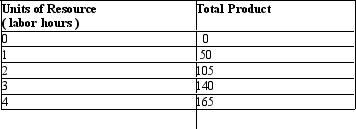 Marginal revenue product (MRP)of a resource is the product of the marginal product of the resource and the marginal revenue.
Refer to Table 28.2.What is the marginal-revenue product of the third unit of the resource?
Marginal revenue product (MRP)of a resource is the product of the marginal product of the resource and the marginal revenue.
Refer to Table 28.2.What is the marginal-revenue product of the third unit of the resource? (Multiple Choice)
4.8/5  (88)
(88) A firm under any market structure maximizes profits at a point where:
(Multiple Choice)
4.7/5 (82)
(82) If the ratio of marginal revenue product to marginal factor cost for labor is greater than that for capital, then:
(Multiple Choice)
4.8/5 (79)
(79) A firm that was initially a monopsonist but has to buy from a competitive resource market all of a sudden will:
(Multiple Choice)
4.8/5 (73)
(73) Transfer earning is the minimum amount that has to be paid to a factor to allocate it in its next best alternative use.
(True/False)
4.8/5 (96)
(96) The following figure represents the equilibrium in the labor markets. Figure 28.4 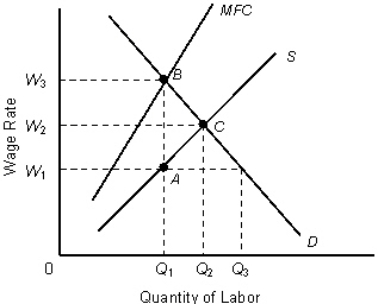 In the figure,
MFC: Marginal Factor Cost curve
D: Demand or the Marginal Revenue Product curve
S: Supply curve
Refer to Figure 28.4.A monopsonist will pay the wage rate _____ and hire _____ units of labor.
In the figure,
MFC: Marginal Factor Cost curve
D: Demand or the Marginal Revenue Product curve
S: Supply curve
Refer to Figure 28.4.A monopsonist will pay the wage rate _____ and hire _____ units of labor. (Multiple Choice)
4.8/5 (83)
(83) Why is the marginal revenue product curve of a factor negatively sloped?
(Multiple Choice)
4.9/5 (73)
(73) If resource A and resource B are substitutes of each other and the price of resource A increases, then:
(Multiple Choice)
4.8/5 (89)
(89) A general study of resource markets shows that the roles of firms and households are:
(Multiple Choice)
4.9/5 (67)
(67) If the market price of the product that employs labor in production increases:
(Multiple Choice)
4.7/5 (74)
(74) The demand for capital, as an input in production, will decrease if:
(Multiple Choice)
5.0/5 (70)
(70) During the recession witnessed in early 2001, many firms laid off their employees and downsized.The reason for this decrease in the demand for employees was:
(Multiple Choice)
4.9/5 (79)
(79) The figure given below represents equilibrium in the labor market. Figure 28.5 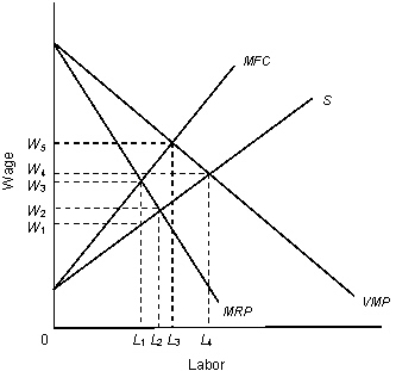 In the figure,
VMP: Value of marginal product curve
MRP: Marginal revenue product curve
MFC: Marginal factor cost
S: Supply curve of labor
Refer to Figure 28.5.What wage rate will this firm pay?
In the figure,
VMP: Value of marginal product curve
MRP: Marginal revenue product curve
MFC: Marginal factor cost
S: Supply curve of labor
Refer to Figure 28.5.What wage rate will this firm pay? (Multiple Choice)
4.9/5 (71)
(71) A perfectly competitive employer of an input will maximize profits from the employment of the input by equating:
(Multiple Choice)
5.0/5 (74)
(74) The figure given below represents equilibrium in the labor market. Figure 28.5 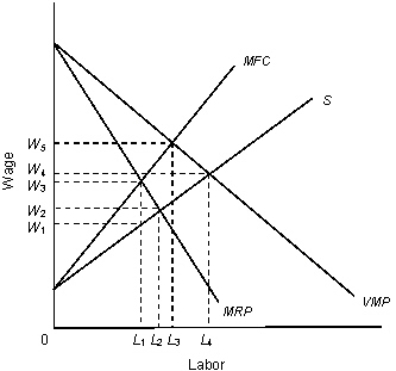 In the figure,
VMP: Value of marginal product curve
MRP: Marginal revenue product curve
MFC: Marginal factor cost
S: Supply curve of labor
In Figure 28.5, the firm is:
In the figure,
VMP: Value of marginal product curve
MRP: Marginal revenue product curve
MFC: Marginal factor cost
S: Supply curve of labor
In Figure 28.5, the firm is: (Multiple Choice)
4.9/5 (86)
(86) The following figure shows the marginal revenue product of a resource [MRP]: Figure 28.1 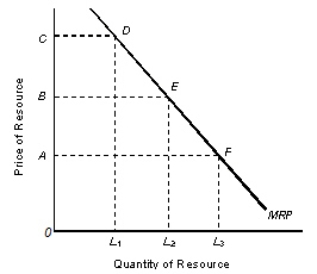 Assume that the resource market shown in Figure 28.1 is perfectly competitive.The MRP curve for the resource is negatively sloped because:
 (Multiple Choice)
4.9/5 (67)
(67) If a resource can be put to a single use and has no alternative uses then:
(Multiple Choice)
4.8/5 (76)
(76) Economic rent is the sum of actual earning and transfer earning.
(True/False)
4.9/5 (80)
(80) The producer can raise the level of profit by hiring more units of a resource if:
(Multiple Choice)
4.7/5 (74)
(74) 
Filters
- Essay(0)
- Multiple Choice(0)
- Short Answer(0)
- True False(0)
- Matching(0)