



 Chat with AI
Exam 53: Aging, Social Security and Health Care

Exam 1: Economics: The World Around You90 Questions
Exam 2: Choice, Opportunity Costs, and Specialization94 Questions
Exam 3: Markets, Demand and Supply, and the Price System97 Questions
Exam 5: The Market System and the Private and Public Sector97 Questions
Exam 4: Elasticity: Demand and Supply126 Questions
Exam 6: National Income Accounting104 Questions
Exam 7: an Introduction to the Foreign Exchange Market and the Balance of Payments90 Questions
Exam 8: Consumer Choice132 Questions
Exam 9: Supply: The Costs of Doing Business106 Questions
Exam 10: Unemployment and Inflation129 Questions
Exam 11: Macroeconomic Equilibrium: Aggregate Demand and Supply122 Questions
Exam 12: Profit Maximization122 Questions
Exam 13: Aggregate Expenditures115 Questions
Exam 14: Perfect Competition135 Questions
Exam 15: Income and Expenditures Equilibrium134 Questions
Exam 16: Monopoly118 Questions
Exam 17: Fiscal Policy93 Questions
Exam 18: Monopolistic Competition and Oligopoly111 Questions
Exam 19: Antitrust and Regulation100 Questions
Exam 10: Money and Banking125 Questions
Exam 21: Market Failures, Government Failures, and Rent Seeking121 Questions
Exam 22: Monetary Policy141 Questions
Exam 23: Macroeconomic Policy: Tradeoffs, Expectations, Credibility, and Sources of Business Cycles112 Questions
Exam 24: Resource Markets112 Questions
Exam 25: Macroeconomic Viewpoints: New Keynesian, Monetarist, and New Classical99 Questions
Exam 26: The Labor Market114 Questions
Exam 27: Capital Markets100 Questions
Exam 28: Economic Growth99 Questions
Exam 29: Development Economics104 Questions
Exam 30: the Land Market and Natural Resources55 Questions
Exam 31: Aging, Social Security and Health Care88 Questions
Exam 32: Globalization84 Questions
Exam 33: Elasticity: Demand and Supply126 Questions
Exam 34: Income Distribution, Poverty and Government Policy115 Questions
Exam 35: World Trade Equilibrium112 Questions
Exam 36: Consumer Choice132 Questions
Exam 37: International Trade Restrictions109 Questions
Exam 38: World Trade Equilibrium112 Questions
Exam 39: Exchange Rates and Financial Links Between Countries132 Questions
Exam 40: International Trade Restrictions109 Questions
Exam 41: Supply: the Costs of Doing Business106 Questions
Exam 42: Exchange Rates and Financial Links Between Countries132 Questions
Exam 43: Profit Maximization122 Questions
Exam 44: Perfect Competition135 Questions
Exam 45: Monopoly118 Questions
Exam 46: Monopolistic Competition and Oligopoly111 Questions
Exam 47: Antitrust and Regulation100 Questions
Exam 48: Market Failures, Government Failures, and Rent Seeking121 Questions
Exam 49: Resource Markets112 Questions
Exam 50: The Labor Market114 Questions
Exam 51: Capital Markets100 Questions
Exam 52: The Land Market and Natural Resources55 Questions
Exam 53: Aging, Social Security and Health Care87 Questions
Exam 54: Income Distribution, Poverty and Government Policy115 Questions
Exam 55: World Trade Equilibrium112 Questions
Exam 56: International Trade Restrictions109 Questions
Exam 57: Exchange Rates and Financial Links Between Countries132 Questions
Select questions type


Why didn't the supply of medical care increase in the United States in spite of increase in its price?

Free
(Multiple Choice)
4.8/5  (86)
(86) Correct Answer: Verified
C
Direct payments for medical care consist of out-of-pocket payments made by individuals, copayments, and deductibles required by many third-party payers.
Free
(True/False)
4.8/5 (76)
(76) Correct Answer:Verified
VerifiedTrue
The system of adjusting social security benefits annually as the cost of living increases in the United States has been a result of intellectual foresight by the American economists.
Free
(True/False)
4.9/5 (94)
(94) Correct Answer:Verified
VerifiedFalse
The results of privatizing the social security system has been negative at large in most of the economies.
(True/False)
4.9/5 (88)
(88) The social security taxes that the working population pays today are used to provide benefits for current retirees.
(True/False)
4.8/5 (86)
(86) People who oppose the establishment of an open market in human organs justify their view on the ground that:
(Multiple Choice)
4.8/5 (74)
(74) Empirical evidences suggest that the expenditure on prescription drugs grew by an annual average of 15 percent since 1995.In the light of this observation which of the following statements is true?
(Multiple Choice)
4.7/5 (78)
(78) Which of the following statements about Medicare is correct?
(Multiple Choice)
4.7/5 (98)
(98) The figure given below represents demand for and supply of hospital beds in Anytown, U.S.A. , as shown by curves D and S1 in the following figure.If the hospital receives permission to expand, its new supply curve will be S2.Price level P1 is the fixed prospective payment reimbursement rate paid by Medicare to the hospital, regardless of actual cost. Figure 32.3 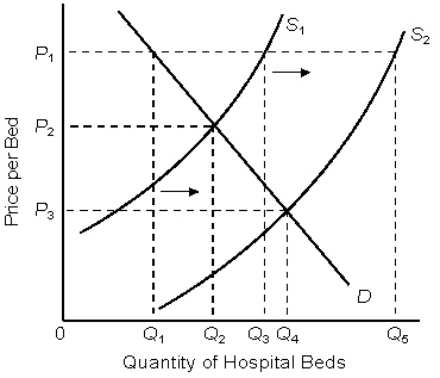 According to Figure 32.3, given the existing demand for its beds, after the hospital completes its expansion it will maximize its occupancy rate by charging a price level:
 (Multiple Choice)
4.8/5 (78)
(78) Which of the following reasons justifies the increase in the expenditure on prescription drugs in the U.S.?
(Multiple Choice)
4.9/5 (78)
(78) A part of the supply to the human organs market comes from the organs harvested from people who die suddenly, such as those killed in accidents.
(True/False)
4.9/5 (81)
(81) Government restrictions prevent the market from allocating resources to where they have the highest value.
(True/False)
4.8/5 (84)
(84) Medical care in the United States is not only expensive but also technologically backward than other nations.
(True/False)
4.9/5 (85)
(85) The aging of the American population has brought to the forefront of the nation the concern that social security is no longer a viable option for future retirees and that the financial viability of the system depends on:
(Multiple Choice)
4.8/5 (66)
(66) _____ account for a majority of the health care expenditure in the United States.
(Multiple Choice)
4.8/5 (73)
(73) The U.S.government spends more on social security than it spends on national defense.
(True/False)
4.9/5 (85)
(85) The increase in physicians' fees in the U.S.is most likely to have resulted from a(n):
(Multiple Choice)
4.8/5 (73)
(73) Which of the following has led to increased cost of health services?
(Multiple Choice)
4.9/5 (72)
(72) The social security system in Chile is partially privatized as a part of the taxes is used to run government expenses and the rest can be invested by the worker.
(True/False)
4.9/5 (85)
(85) Which of the following is a consequence of government programs like Medicare and Medicaid?
(Multiple Choice)
4.9/5 (88)
(88) 
Filters
- Essay(0)
- Multiple Choice(0)
- Short Answer(0)
- True False(0)
- Matching(0)