



 Chat with AI
Exam 53: Aging, Social Security and Health Care

Exam 1: Economics: The World Around You90 Questions
Exam 2: Choice, Opportunity Costs, and Specialization94 Questions
Exam 3: Markets, Demand and Supply, and the Price System97 Questions
Exam 5: The Market System and the Private and Public Sector97 Questions
Exam 4: Elasticity: Demand and Supply126 Questions
Exam 6: National Income Accounting104 Questions
Exam 7: an Introduction to the Foreign Exchange Market and the Balance of Payments90 Questions
Exam 8: Consumer Choice132 Questions
Exam 9: Supply: The Costs of Doing Business106 Questions
Exam 10: Unemployment and Inflation129 Questions
Exam 11: Macroeconomic Equilibrium: Aggregate Demand and Supply122 Questions
Exam 12: Profit Maximization122 Questions
Exam 13: Aggregate Expenditures115 Questions
Exam 14: Perfect Competition135 Questions
Exam 15: Income and Expenditures Equilibrium134 Questions
Exam 16: Monopoly118 Questions
Exam 17: Fiscal Policy93 Questions
Exam 18: Monopolistic Competition and Oligopoly111 Questions
Exam 19: Antitrust and Regulation100 Questions
Exam 10: Money and Banking125 Questions
Exam 21: Market Failures, Government Failures, and Rent Seeking121 Questions
Exam 22: Monetary Policy141 Questions
Exam 23: Macroeconomic Policy: Tradeoffs, Expectations, Credibility, and Sources of Business Cycles112 Questions
Exam 24: Resource Markets112 Questions
Exam 25: Macroeconomic Viewpoints: New Keynesian, Monetarist, and New Classical99 Questions
Exam 26: The Labor Market114 Questions
Exam 27: Capital Markets100 Questions
Exam 28: Economic Growth99 Questions
Exam 29: Development Economics104 Questions
Exam 30: the Land Market and Natural Resources55 Questions
Exam 31: Aging, Social Security and Health Care88 Questions
Exam 32: Globalization84 Questions
Exam 33: Elasticity: Demand and Supply126 Questions
Exam 34: Income Distribution, Poverty and Government Policy115 Questions
Exam 35: World Trade Equilibrium112 Questions
Exam 36: Consumer Choice132 Questions
Exam 37: International Trade Restrictions109 Questions
Exam 38: World Trade Equilibrium112 Questions
Exam 39: Exchange Rates and Financial Links Between Countries132 Questions
Exam 40: International Trade Restrictions109 Questions
Exam 41: Supply: the Costs of Doing Business106 Questions
Exam 42: Exchange Rates and Financial Links Between Countries132 Questions
Exam 43: Profit Maximization122 Questions
Exam 44: Perfect Competition135 Questions
Exam 45: Monopoly118 Questions
Exam 46: Monopolistic Competition and Oligopoly111 Questions
Exam 47: Antitrust and Regulation100 Questions
Exam 48: Market Failures, Government Failures, and Rent Seeking121 Questions
Exam 49: Resource Markets112 Questions
Exam 50: The Labor Market114 Questions
Exam 51: Capital Markets100 Questions
Exam 52: The Land Market and Natural Resources55 Questions
Exam 53: Aging, Social Security and Health Care87 Questions
Exam 54: Income Distribution, Poverty and Government Policy115 Questions
Exam 55: World Trade Equilibrium112 Questions
Exam 56: International Trade Restrictions109 Questions
Exam 57: Exchange Rates and Financial Links Between Countries132 Questions
Select questions type


Many doctors, lawyers, and economists opine that an existence of a legal market for human organs will help cure their chronic shortage that is gripping transplant medicine.
(True/False)
4.9/5  (66)
(66) The figure given below shows the demand (D)and supply (S1 and S2)curves of medical care. Figure 32.2 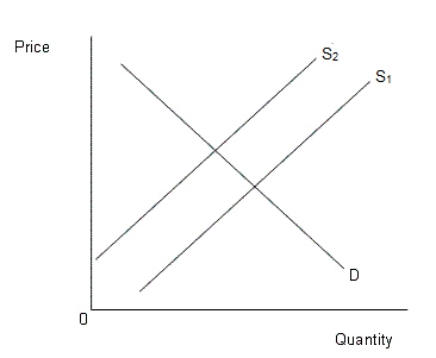 Refer to Figure 32.1.The possible reason behind the shift of the supply curve from S1 to S2 is:
 (Multiple Choice)
4.9/5 (60)
(60) The elderly support ratio recorded by the U.S.Bureau of the Census in 1985 is expected to rise post 2005 because:
(Multiple Choice)
4.8/5 (81)
(81) The social security system in the United States, which covers both social security and hospital insurance is financed by a:
(Multiple Choice)
4.8/5 (98)
(98) The bulk of the cost of hospital care is borne by third-parties.Such third-parties are:
(Multiple Choice)
4.8/5 (71)
(71) Why are black markets for human organs less efficient than free markets?
(Multiple Choice)
4.8/5 (92)
(92) The American Medical Association's payment system is an example of a:
(Multiple Choice)
5.0/5 (75)
(75) One way in which the U.S.government can reduce the deficit in the social security fund is by lowering the social security tax rate.
(True/False)
4.9/5 (86)
(86) "Rising health care costs might be considered a vicious circle.As health care costs rise, people want more, and this drives up demand, which in turn increases health care costs." What is wrong with this statement?
(Multiple Choice)
4.9/5 (78)
(78) In the context of the hospitals in the United States, which of the following statements is correct?
(Multiple Choice)
4.7/5 (76)
(76) Why is health care considered to be an economic good and is subject to the laws of economics?
(Multiple Choice)
4.9/5 (76)
(76) The ratio of workers to social security beneficiaries has declined from 16.5 in 1950 to about 3 in 2010 and is expected to decline to 2 by 2030.This trend indicates that:
(Multiple Choice)
4.8/5 (83)
(83) The figure given below represents demand for and supply of hospital beds in Anytown, U.S.A. , as shown by curves D and S1 in the following figure.If the hospital receives permission to expand, its new supply curve will be S2.Price level P1 is the fixed prospective payment reimbursement rate paid by Medicare to the hospital, regardless of actual cost. Figure 32.3 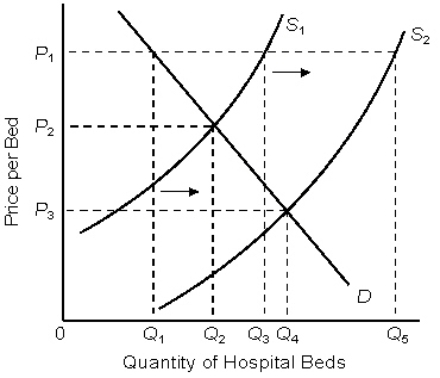 According to Figure 32.3, the surplus of beds caused by the fixed reimbursement rate, after the expansion of the hospital is the difference between _____ and _____.
 (Multiple Choice)
4.8/5 (75)
(75) The existence of new drugs reduces the demand for drugs as they are highly expensive.
(True/False)
4.9/5 (81)
(81) Which of the following can increase the price of medical care even if the demand for medical care remains constant?
(Multiple Choice)
4.9/5 (76)
(76) The following figure shows the demand (D)and supply (S)curves of human organs Figure 32.5 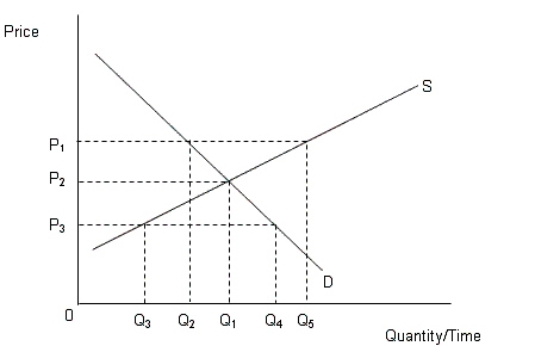 In Figure 32.5, the equilibrium quantity of human organs in the market is:
 (Multiple Choice)
4.9/5 (79)
(79) Why does the demand curve for human organs tend to be relatively price inelastic?
(Multiple Choice)
4.8/5 (66)
(66) The high cost of hospital care in the U.S.is primarily attributable to:
(Multiple Choice)
4.8/5 (74)
(74) 
Filters
- Essay(0)
- Multiple Choice(0)
- Short Answer(0)
- True False(0)
- Matching(0)