



 Chat with AI
Exam 38: World Trade Equilibrium

Exam 1: Economics: The World Around You90 Questions
Exam 2: Choice, Opportunity Costs, and Specialization94 Questions
Exam 3: Markets, Demand and Supply, and the Price System97 Questions
Exam 5: The Market System and the Private and Public Sector97 Questions
Exam 4: Elasticity: Demand and Supply126 Questions
Exam 6: National Income Accounting104 Questions
Exam 7: an Introduction to the Foreign Exchange Market and the Balance of Payments90 Questions
Exam 8: Consumer Choice132 Questions
Exam 9: Supply: The Costs of Doing Business106 Questions
Exam 10: Unemployment and Inflation129 Questions
Exam 11: Macroeconomic Equilibrium: Aggregate Demand and Supply122 Questions
Exam 12: Profit Maximization122 Questions
Exam 13: Aggregate Expenditures115 Questions
Exam 14: Perfect Competition135 Questions
Exam 15: Income and Expenditures Equilibrium134 Questions
Exam 16: Monopoly118 Questions
Exam 17: Fiscal Policy93 Questions
Exam 18: Monopolistic Competition and Oligopoly111 Questions
Exam 19: Antitrust and Regulation100 Questions
Exam 10: Money and Banking125 Questions
Exam 21: Market Failures, Government Failures, and Rent Seeking121 Questions
Exam 22: Monetary Policy141 Questions
Exam 23: Macroeconomic Policy: Tradeoffs, Expectations, Credibility, and Sources of Business Cycles112 Questions
Exam 24: Resource Markets112 Questions
Exam 25: Macroeconomic Viewpoints: New Keynesian, Monetarist, and New Classical99 Questions
Exam 26: The Labor Market114 Questions
Exam 27: Capital Markets100 Questions
Exam 28: Economic Growth99 Questions
Exam 29: Development Economics104 Questions
Exam 30: the Land Market and Natural Resources55 Questions
Exam 31: Aging, Social Security and Health Care88 Questions
Exam 32: Globalization84 Questions
Exam 33: Elasticity: Demand and Supply126 Questions
Exam 34: Income Distribution, Poverty and Government Policy115 Questions
Exam 35: World Trade Equilibrium112 Questions
Exam 36: Consumer Choice132 Questions
Exam 37: International Trade Restrictions109 Questions
Exam 38: World Trade Equilibrium112 Questions
Exam 39: Exchange Rates and Financial Links Between Countries132 Questions
Exam 40: International Trade Restrictions109 Questions
Exam 41: Supply: the Costs of Doing Business106 Questions
Exam 42: Exchange Rates and Financial Links Between Countries132 Questions
Exam 43: Profit Maximization122 Questions
Exam 44: Perfect Competition135 Questions
Exam 45: Monopoly118 Questions
Exam 46: Monopolistic Competition and Oligopoly111 Questions
Exam 47: Antitrust and Regulation100 Questions
Exam 48: Market Failures, Government Failures, and Rent Seeking121 Questions
Exam 49: Resource Markets112 Questions
Exam 50: The Labor Market114 Questions
Exam 51: Capital Markets100 Questions
Exam 52: The Land Market and Natural Resources55 Questions
Exam 53: Aging, Social Security and Health Care87 Questions
Exam 54: Income Distribution, Poverty and Government Policy115 Questions
Exam 55: World Trade Equilibrium112 Questions
Exam 56: International Trade Restrictions109 Questions
Exam 57: Exchange Rates and Financial Links Between Countries132 Questions
Select questions type


The table below shows units of wheat and cloth produced by each worker per day in both the countries. Table 20.1 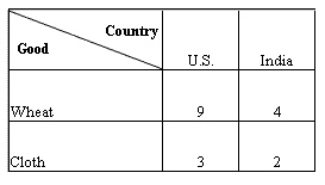 According to Table 20.1, the opportunity cost of producing wheat in India equals:
 (Multiple Choice)
4.9/5  (67)
(67) The first panel in the following figure shows the domestic demand (D)and supply (S)curves of Columbian coffee and the second panel shows the import demand and export supply of Columbian coffee in the international market. Figure 20.1 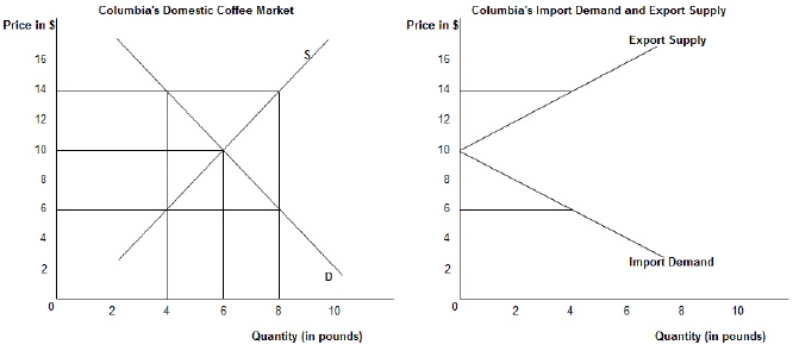 Refer to Figure 20.1.The autarky equilibrium price of coffee in Columbia is:
 (Multiple Choice)
4.8/5 (76)
(76) A country has a comparative advantage when the opportunity cost of producing a good in terms of:
(Multiple Choice)
5.0/5 (76)
(76) The figure given below shows the import demand and export supply curves of corn of the U.S.and Mexico. Figure 20.2 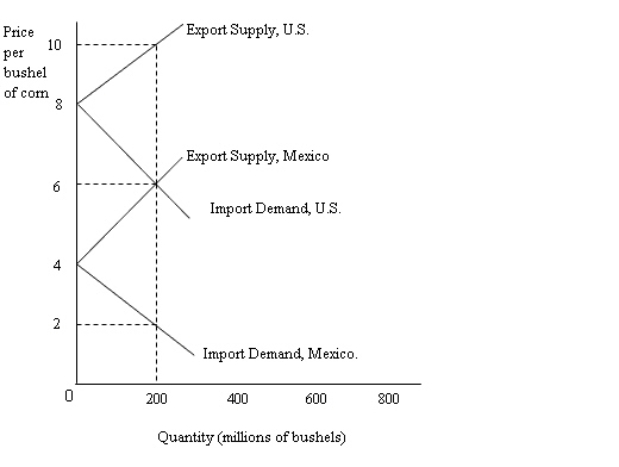 Refer to Figure 20.2.The no-trade equilibrium price of a bushel of corn in Mexico is:
 (Multiple Choice)
4.9/5 (83)
(83) Developing countries can be expected to have a comparative advantage in industries requiring a relatively large amount of skilled labor.
(True/False)
4.8/5 (81)
(81) The comparative advantage in a specific good can shift over time from one country to another, as the other countries can produce it at a cheaper cost after imitating the technology.
(True/False)
4.8/5 (83)
(83) Countries tend to export different goods and services because of:
(Multiple Choice)
4.7/5 (71)
(71) Whether exchange is between individuals, firms, or countries, voluntary trade occurs because:
(Multiple Choice)
4.9/5 (78)
(78) The principle of comparative advantage states that a country should specialize in the production of those goods that have the highest opportunity costs.
(True/False)
4.8/5 (78)
(78) Scenario 20.1 Suppose labor productivity differences are the only determinants of comparative advantage, and Brazil and Chile both produce only coffee and sugar.In Chile, either 5 units of coffee or 2 units of sugar can be produced in one day.In Brazil, a day of labor produces either 2 units of coffee or 1 unit of sugar.
Refer to Scenario 20.1.Which of the following statements is true?
(Multiple Choice)
4.7/5 (77)
(77) The standard interpretation of the Ricardian model is that differences in factor endowments between countries account for differences in labor productivity.
(True/False)
4.8/5 (71)
(71) 
Filters
- Essay(0)
- Multiple Choice(0)
- Short Answer(0)
- True False(0)
- Matching(0)