



 Chat with AI
Exam 27: Capital Markets

Exam 1: Economics: The World Around You90 Questions
Exam 2: Choice, Opportunity Costs, and Specialization94 Questions
Exam 3: Markets, Demand and Supply, and the Price System97 Questions
Exam 5: The Market System and the Private and Public Sector97 Questions
Exam 4: Elasticity: Demand and Supply126 Questions
Exam 6: National Income Accounting104 Questions
Exam 7: an Introduction to the Foreign Exchange Market and the Balance of Payments90 Questions
Exam 8: Consumer Choice132 Questions
Exam 9: Supply: The Costs of Doing Business106 Questions
Exam 10: Unemployment and Inflation129 Questions
Exam 11: Macroeconomic Equilibrium: Aggregate Demand and Supply122 Questions
Exam 12: Profit Maximization122 Questions
Exam 13: Aggregate Expenditures115 Questions
Exam 14: Perfect Competition135 Questions
Exam 15: Income and Expenditures Equilibrium134 Questions
Exam 16: Monopoly118 Questions
Exam 17: Fiscal Policy93 Questions
Exam 18: Monopolistic Competition and Oligopoly111 Questions
Exam 19: Antitrust and Regulation100 Questions
Exam 10: Money and Banking125 Questions
Exam 21: Market Failures, Government Failures, and Rent Seeking121 Questions
Exam 22: Monetary Policy141 Questions
Exam 23: Macroeconomic Policy: Tradeoffs, Expectations, Credibility, and Sources of Business Cycles112 Questions
Exam 24: Resource Markets112 Questions
Exam 25: Macroeconomic Viewpoints: New Keynesian, Monetarist, and New Classical99 Questions
Exam 26: The Labor Market114 Questions
Exam 27: Capital Markets100 Questions
Exam 28: Economic Growth99 Questions
Exam 29: Development Economics104 Questions
Exam 30: the Land Market and Natural Resources55 Questions
Exam 31: Aging, Social Security and Health Care88 Questions
Exam 32: Globalization84 Questions
Exam 33: Elasticity: Demand and Supply126 Questions
Exam 34: Income Distribution, Poverty and Government Policy115 Questions
Exam 35: World Trade Equilibrium112 Questions
Exam 36: Consumer Choice132 Questions
Exam 37: International Trade Restrictions109 Questions
Exam 38: World Trade Equilibrium112 Questions
Exam 39: Exchange Rates and Financial Links Between Countries132 Questions
Exam 40: International Trade Restrictions109 Questions
Exam 41: Supply: the Costs of Doing Business106 Questions
Exam 42: Exchange Rates and Financial Links Between Countries132 Questions
Exam 43: Profit Maximization122 Questions
Exam 44: Perfect Competition135 Questions
Exam 45: Monopoly118 Questions
Exam 46: Monopolistic Competition and Oligopoly111 Questions
Exam 47: Antitrust and Regulation100 Questions
Exam 48: Market Failures, Government Failures, and Rent Seeking121 Questions
Exam 49: Resource Markets112 Questions
Exam 50: The Labor Market114 Questions
Exam 51: Capital Markets100 Questions
Exam 52: The Land Market and Natural Resources55 Questions
Exam 53: Aging, Social Security and Health Care87 Questions
Exam 54: Income Distribution, Poverty and Government Policy115 Questions
Exam 55: World Trade Equilibrium112 Questions
Exam 56: International Trade Restrictions109 Questions
Exam 57: Exchange Rates and Financial Links Between Countries132 Questions
Select questions type


The price of Amazon.com stock was very high in the 1990s although the company never earned an economic profit.This demonstrates that:
(Multiple Choice)
4.9/5  (93)
(93) If the price of company's stock is expected to fall in the future, then people holding such shares will have an incentive to get rid of them.
(True/False)
5.0/5 (80)
(80) The quantity of capital demanded changes when one of the nonprice determinants of demand change.
(True/False)
4.9/5 (65)
(65) The figure given below shows the demand [D and D'] and supply [S and S'] curves of shares of stock. Figure 16.2 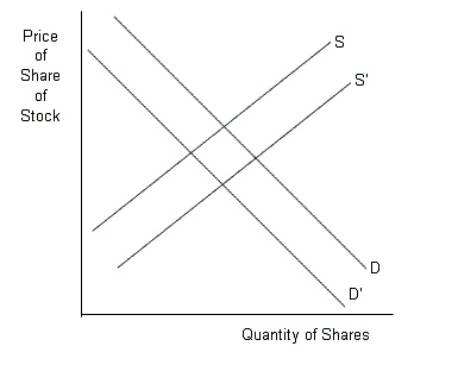 According to Figure 16.2, what sort of change in the market environment would increase the supply of stocks from S to S' and decrease the demand from D to D'?
 (Multiple Choice)
4.9/5 (88)
(88) Which of the following measures the performance of smaller stocks in the United States?
(Multiple Choice)
4.9/5 (74)
(74) Which of the following is sometimes used as a synonym to describe a bond?
(Multiple Choice)
4.8/5 (78)
(78) If the number of people who want to sell of stocks are higher than those who want to buy it, the stock prices move up.
(True/False)
4.9/5 (84)
(84) If people expect the price of a stock to rise in future, the demand curve for the stock:
(Multiple Choice)
4.9/5 (94)
(94) Most stock indexes use which of the following measures to weight the companies that participate in the index?
(Multiple Choice)
4.9/5 (88)
(88) Which of the following factors affects the quantity demanded of a company's stock?
(Multiple Choice)
4.8/5 (81)
(81) If both demand for and supply of capital increases by equal amounts, then the equilibrium price of capital goes up, and the equilibrium quantity of capital increases.
(True/False)
4.9/5 (81)
(81) A decline in the interest rate will lead to an increase in the price of capital, supply of capital remaining constant.
(True/False)
4.9/5 (73)
(73) The capital market is a market in which financial capital is acquired.
(True/False)
4.8/5 (104)
(104) An investor who wants to diversify his portfolio will buy only bonds when both stocks and bonds are expected to yield better returns.
(True/False)
4.7/5 (77)
(77) The phrase, "Google stock soared Friday, continuing Wall Street's love affair with the company, " implies that Google's earnings were much more than it was expected in that quarter.
(True/False)
4.8/5 (82)
(82) The figure given below shows the demand curves [D1 and D2] and the supply curve [S1] of capital. Figure 16.1 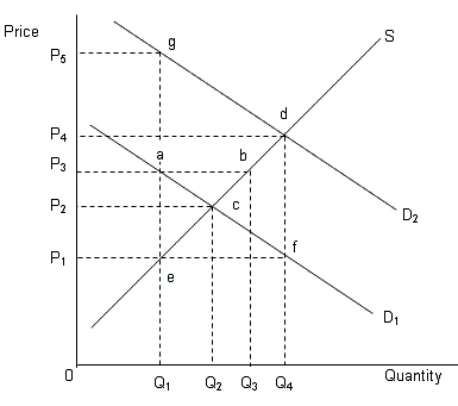 In Figure 16.1, if the initial demand curve is D1, the equilibrium price of capital is:
 (Multiple Choice)
4.9/5 (84)
(84) The S&P 500 index includes the stocks of 500 largest companies in the U.S.
(True/False)
4.7/5 (85)
(85) 
Filters
- Essay(0)
- Multiple Choice(0)
- Short Answer(0)
- True False(0)
- Matching(0)