



 Chat with AI
Exam 31: Aging, Social Security and Health Care

Exam 1: Economics: The World Around You90 Questions
Exam 2: Choice, Opportunity Costs, and Specialization94 Questions
Exam 3: Markets, Demand and Supply, and the Price System97 Questions
Exam 5: The Market System and the Private and Public Sector97 Questions
Exam 4: Elasticity: Demand and Supply126 Questions
Exam 6: National Income Accounting104 Questions
Exam 7: an Introduction to the Foreign Exchange Market and the Balance of Payments90 Questions
Exam 8: Consumer Choice132 Questions
Exam 9: Supply: The Costs of Doing Business106 Questions
Exam 10: Unemployment and Inflation129 Questions
Exam 11: Macroeconomic Equilibrium: Aggregate Demand and Supply122 Questions
Exam 12: Profit Maximization122 Questions
Exam 13: Aggregate Expenditures115 Questions
Exam 14: Perfect Competition135 Questions
Exam 15: Income and Expenditures Equilibrium134 Questions
Exam 16: Monopoly118 Questions
Exam 17: Fiscal Policy93 Questions
Exam 18: Monopolistic Competition and Oligopoly111 Questions
Exam 19: Antitrust and Regulation100 Questions
Exam 10: Money and Banking125 Questions
Exam 21: Market Failures, Government Failures, and Rent Seeking121 Questions
Exam 22: Monetary Policy141 Questions
Exam 23: Macroeconomic Policy: Tradeoffs, Expectations, Credibility, and Sources of Business Cycles112 Questions
Exam 24: Resource Markets112 Questions
Exam 25: Macroeconomic Viewpoints: New Keynesian, Monetarist, and New Classical99 Questions
Exam 26: The Labor Market114 Questions
Exam 27: Capital Markets100 Questions
Exam 28: Economic Growth99 Questions
Exam 29: Development Economics104 Questions
Exam 30: the Land Market and Natural Resources55 Questions
Exam 31: Aging, Social Security and Health Care88 Questions
Exam 32: Globalization84 Questions
Exam 33: Elasticity: Demand and Supply126 Questions
Exam 34: Income Distribution, Poverty and Government Policy115 Questions
Exam 35: World Trade Equilibrium112 Questions
Exam 36: Consumer Choice132 Questions
Exam 37: International Trade Restrictions109 Questions
Exam 38: World Trade Equilibrium112 Questions
Exam 39: Exchange Rates and Financial Links Between Countries132 Questions
Exam 40: International Trade Restrictions109 Questions
Exam 41: Supply: the Costs of Doing Business106 Questions
Exam 42: Exchange Rates and Financial Links Between Countries132 Questions
Exam 43: Profit Maximization122 Questions
Exam 44: Perfect Competition135 Questions
Exam 45: Monopoly118 Questions
Exam 46: Monopolistic Competition and Oligopoly111 Questions
Exam 47: Antitrust and Regulation100 Questions
Exam 48: Market Failures, Government Failures, and Rent Seeking121 Questions
Exam 49: Resource Markets112 Questions
Exam 50: The Labor Market114 Questions
Exam 51: Capital Markets100 Questions
Exam 52: The Land Market and Natural Resources55 Questions
Exam 53: Aging, Social Security and Health Care87 Questions
Exam 54: Income Distribution, Poverty and Government Policy115 Questions
Exam 55: World Trade Equilibrium112 Questions
Exam 56: International Trade Restrictions109 Questions
Exam 57: Exchange Rates and Financial Links Between Countries132 Questions
Select questions type


The ratio of the number of people in the population aged 65 and older to the number of people aged 20 to 64 has risen in most of the developed countries as:
(Multiple Choice)
4.9/5  (73)
(73) Government restrictions prevent the market from allocating resources to where they have the highest value.
(True/False)
5.0/5 (80)
(80) The existence of new drugs reduces the demand for drugs as they are highly expensive.
(True/False)
4.9/5 (87)
(87) The social security system in the United States, which covers both social security and hospital insurance is financed by a:
(Multiple Choice)
4.8/5 (76)
(76) As per the payment system laid down by the American Medical Association the physicians are reimbursed on the basis of their speciality.
(True/False)
4.8/5 (86)
(86) The figure given below represents demand for and supply of hospital beds in Anytown, U.S.A. , as shown by curves D and S1 in the following figure.If the hospital receives permission to expand, its new supply curve will be S2.Price level P1 is the fixed prospective payment reimbursement rate paid by Medicare to the hospital, regardless of actual cost. Figure 18.3 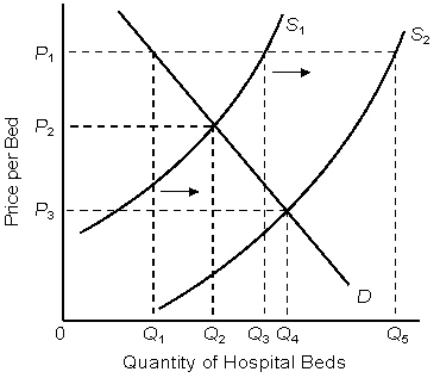 Based on the information given in Figure 18.3, in order to increase its occupancy rate prior to the expansion, this hospital should:
 (Multiple Choice)
5.0/5 (78)
(78) The following figure shows the demand (D)and supply (S)curves of human organs Figure 18.5 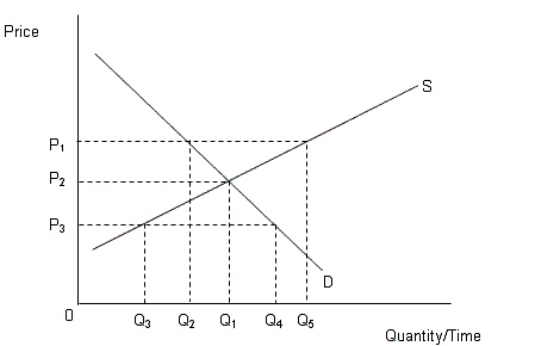 Which of the following factors might have led to a fall in the price of human organs from P2 to P3 in Figure 18.5?
 (Multiple Choice)
4.8/5 (85)
(85) The high cost of hospital care in the U.S.is primarily attributable to:
(Multiple Choice)
4.9/5 (73)
(73) Why are black markets for human organs less efficient than free markets?
(Multiple Choice)
5.0/5 (95)
(95) Which of the following is the most controversial proposal suggested for making the system of social security more efficient?
(Multiple Choice)
4.7/5 (86)
(86) The new technologies developed in the field of medical care are cost-increasing innovations and because costs are not paid by the users, the increased technology increases demand.
(True/False)
4.8/5 (64)
(64) Medical care in the United States is not only expensive but also technologically backward than other nations.
(True/False)
4.9/5 (93)
(93) _____ account for a majority of the health care expenditure in the United States.
(Multiple Choice)
4.7/5 (85)
(85) One way in which the U.S.government can reduce the deficit in the social security fund is by lowering the social security tax rate.
(True/False)
4.9/5 (66)
(66) People who oppose the establishment of an open market in human organs justify their view on the ground that:
(Multiple Choice)
4.9/5 (86)
(86) The figure below shows the demand (AD)and supply (SS1)curves of medical care. Figure 18.4 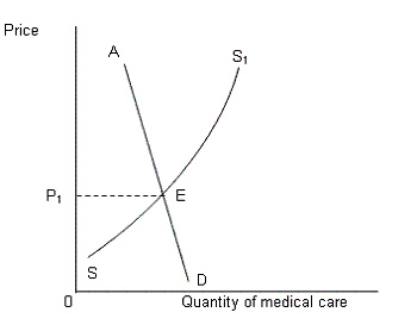 In Figure 18.4, which of the following regions on the graph represents those people who are not willing and able to pay the price P1 for availing medical care?
 (Multiple Choice)
4.8/5 (81)
(81) The American Medical Association encourages the young physicians to advertise to attract more patients.
(True/False)
4.7/5 (72)
(72) Which of the following has resulted from the payment system laid down by the American Medical Association?
(Multiple Choice)
4.9/5 (77)
(77) Which of the following is a joint federal and state health program that pays for the health care of poor families and disabled?
(Multiple Choice)
4.9/5 (83)
(83) 
Filters
- Essay(0)
- Multiple Choice(0)
- Short Answer(0)
- True False(0)
- Matching(0)