



 Chat with AI
Exam 31: Aging, Social Security and Health Care

Exam 1: Economics: The World Around You90 Questions
Exam 2: Choice, Opportunity Costs, and Specialization94 Questions
Exam 3: Markets, Demand and Supply, and the Price System97 Questions
Exam 5: The Market System and the Private and Public Sector97 Questions
Exam 4: Elasticity: Demand and Supply126 Questions
Exam 6: National Income Accounting104 Questions
Exam 7: an Introduction to the Foreign Exchange Market and the Balance of Payments90 Questions
Exam 8: Consumer Choice132 Questions
Exam 9: Supply: The Costs of Doing Business106 Questions
Exam 10: Unemployment and Inflation129 Questions
Exam 11: Macroeconomic Equilibrium: Aggregate Demand and Supply122 Questions
Exam 12: Profit Maximization122 Questions
Exam 13: Aggregate Expenditures115 Questions
Exam 14: Perfect Competition135 Questions
Exam 15: Income and Expenditures Equilibrium134 Questions
Exam 16: Monopoly118 Questions
Exam 17: Fiscal Policy93 Questions
Exam 18: Monopolistic Competition and Oligopoly111 Questions
Exam 19: Antitrust and Regulation100 Questions
Exam 10: Money and Banking125 Questions
Exam 21: Market Failures, Government Failures, and Rent Seeking121 Questions
Exam 22: Monetary Policy141 Questions
Exam 23: Macroeconomic Policy: Tradeoffs, Expectations, Credibility, and Sources of Business Cycles112 Questions
Exam 24: Resource Markets112 Questions
Exam 25: Macroeconomic Viewpoints: New Keynesian, Monetarist, and New Classical99 Questions
Exam 26: The Labor Market114 Questions
Exam 27: Capital Markets100 Questions
Exam 28: Economic Growth99 Questions
Exam 29: Development Economics104 Questions
Exam 30: the Land Market and Natural Resources55 Questions
Exam 31: Aging, Social Security and Health Care88 Questions
Exam 32: Globalization84 Questions
Exam 33: Elasticity: Demand and Supply126 Questions
Exam 34: Income Distribution, Poverty and Government Policy115 Questions
Exam 35: World Trade Equilibrium112 Questions
Exam 36: Consumer Choice132 Questions
Exam 37: International Trade Restrictions109 Questions
Exam 38: World Trade Equilibrium112 Questions
Exam 39: Exchange Rates and Financial Links Between Countries132 Questions
Exam 40: International Trade Restrictions109 Questions
Exam 41: Supply: the Costs of Doing Business106 Questions
Exam 42: Exchange Rates and Financial Links Between Countries132 Questions
Exam 43: Profit Maximization122 Questions
Exam 44: Perfect Competition135 Questions
Exam 45: Monopoly118 Questions
Exam 46: Monopolistic Competition and Oligopoly111 Questions
Exam 47: Antitrust and Regulation100 Questions
Exam 48: Market Failures, Government Failures, and Rent Seeking121 Questions
Exam 49: Resource Markets112 Questions
Exam 50: The Labor Market114 Questions
Exam 51: Capital Markets100 Questions
Exam 52: The Land Market and Natural Resources55 Questions
Exam 53: Aging, Social Security and Health Care87 Questions
Exam 54: Income Distribution, Poverty and Government Policy115 Questions
Exam 55: World Trade Equilibrium112 Questions
Exam 56: International Trade Restrictions109 Questions
Exam 57: Exchange Rates and Financial Links Between Countries132 Questions
Select questions type


Which of the following statements is true of the market for prescription drugs in the U.S.?
(Multiple Choice)
4.9/5  (74)
(74) Which of the following is true of the demand curve for medical care?
(Multiple Choice)
4.9/5 (69)
(69) Medicare helps only the neediest people, including many elderly people whose Medicaid benefits have run out.
(True/False)
4.7/5 (88)
(88) The figure given below represents demand for and supply of hospital beds in Anytown, U.S.A. , as shown by curves D and S1 in the following figure.If the hospital receives permission to expand, its new supply curve will be S2.Price level P1 is the fixed prospective payment reimbursement rate paid by Medicare to the hospital, regardless of actual cost. Figure 18.3 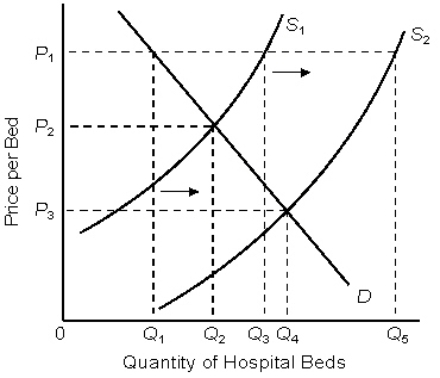 According to Figure 18.3, the surplus of beds caused by the fixed reimbursement rate, after the expansion of the hospital is the difference between _____ and _____.
 (Multiple Choice)
4.7/5 (86)
(86) Demand for medical care remaining constant, if the supply of medical care is decreased, the price of medical care increases.
(True/False)
5.0/5 (84)
(84) Physicians' fees have risen rapidly in the face of an expanding supply of physicians in the last two decades.Which of the following reasons best explains this phenomenon?
(Multiple Choice)
4.9/5 (80)
(80) Why didn't the supply of medical care increase in the United States in spite of increase in its price?
(Multiple Choice)
4.8/5 (75)
(75) Which of the following would not reduce the problem with the social security system?
(Multiple Choice)
4.9/5 (74)
(74) The figure given below represents demand for and supply of hospital beds in Anytown, U.S.A. , as shown by curves D and S1 in the following figure.If the hospital receives permission to expand, its new supply curve will be S2.Price level P1 is the fixed prospective payment reimbursement rate paid by Medicare to the hospital, regardless of actual cost. Figure 18.3 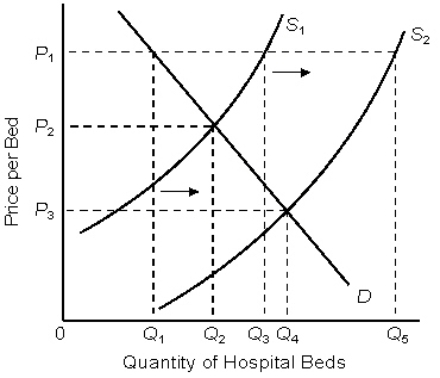 According to Figure 18.3, given the existing demand for its beds, after the hospital completes its expansion it will maximize its occupancy rate by charging a price level:
 (Multiple Choice)
4.9/5 (70)
(70) Which of the following has led to increased cost of health services?
(Multiple Choice)
4.8/5 (79)
(79) A part of the supply to the human organs market comes from the organs harvested from people who die suddenly, such as those killed in accidents.
(True/False)
4.8/5 (83)
(83) Why is health care considered to be an economic good and is subject to the laws of economics?
(Multiple Choice)
4.8/5 (81)
(81) In the context of the hospitals in the United States, which of the following statements is correct?
(Multiple Choice)
4.9/5 (78)
(78) The figure given below shows the demand (D)and supply (S1 and S2)curves of medical care. Figure 18.2 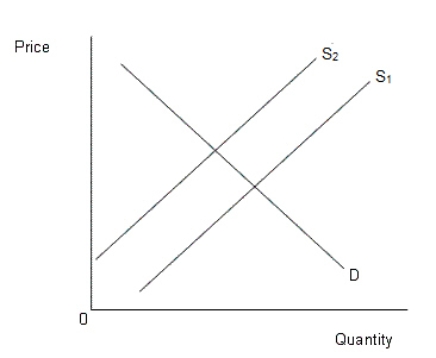 Refer to Figure 18.1.The possible reason behind the shift of the supply curve from S1 to S2 is:
 (Multiple Choice)
4.7/5 (81)
(81) One of the major impacts of the aging of the population is:
(Multiple Choice)
4.9/5 (97)
(97) _____ taxes have risen more rapidly in the past two decades than any other tax.
(Multiple Choice)
4.8/5 (73)
(73) It has been argued that a worker would receive a greater return if they invest in prospective ventures than what they would earn from social security.
(True/False)
4.9/5 (86)
(86) 
Filters
- Essay(0)
- Multiple Choice(0)
- Short Answer(0)
- True False(0)
- Matching(0)