



 Chat with AI
Exam 8: Consumer Choice

Exam 1: Economics: The World Around You90 Questions
Exam 2: Choice, Opportunity Costs, and Specialization94 Questions
Exam 3: Markets, Demand and Supply, and the Price System97 Questions
Exam 5: The Market System and the Private and Public Sector97 Questions
Exam 4: Elasticity: Demand and Supply126 Questions
Exam 6: National Income Accounting104 Questions
Exam 7: an Introduction to the Foreign Exchange Market and the Balance of Payments90 Questions
Exam 8: Consumer Choice132 Questions
Exam 9: Supply: The Costs of Doing Business106 Questions
Exam 10: Unemployment and Inflation129 Questions
Exam 11: Macroeconomic Equilibrium: Aggregate Demand and Supply122 Questions
Exam 12: Profit Maximization122 Questions
Exam 13: Aggregate Expenditures115 Questions
Exam 14: Perfect Competition135 Questions
Exam 15: Income and Expenditures Equilibrium134 Questions
Exam 16: Monopoly118 Questions
Exam 17: Fiscal Policy93 Questions
Exam 18: Monopolistic Competition and Oligopoly111 Questions
Exam 19: Antitrust and Regulation100 Questions
Exam 10: Money and Banking125 Questions
Exam 21: Market Failures, Government Failures, and Rent Seeking121 Questions
Exam 22: Monetary Policy141 Questions
Exam 23: Macroeconomic Policy: Tradeoffs, Expectations, Credibility, and Sources of Business Cycles112 Questions
Exam 24: Resource Markets112 Questions
Exam 25: Macroeconomic Viewpoints: New Keynesian, Monetarist, and New Classical99 Questions
Exam 26: The Labor Market114 Questions
Exam 27: Capital Markets100 Questions
Exam 28: Economic Growth99 Questions
Exam 29: Development Economics104 Questions
Exam 30: the Land Market and Natural Resources55 Questions
Exam 31: Aging, Social Security and Health Care88 Questions
Exam 32: Globalization84 Questions
Exam 33: Elasticity: Demand and Supply126 Questions
Exam 34: Income Distribution, Poverty and Government Policy115 Questions
Exam 35: World Trade Equilibrium112 Questions
Exam 36: Consumer Choice132 Questions
Exam 37: International Trade Restrictions109 Questions
Exam 38: World Trade Equilibrium112 Questions
Exam 39: Exchange Rates and Financial Links Between Countries132 Questions
Exam 40: International Trade Restrictions109 Questions
Exam 41: Supply: the Costs of Doing Business106 Questions
Exam 42: Exchange Rates and Financial Links Between Countries132 Questions
Exam 43: Profit Maximization122 Questions
Exam 44: Perfect Competition135 Questions
Exam 45: Monopoly118 Questions
Exam 46: Monopolistic Competition and Oligopoly111 Questions
Exam 47: Antitrust and Regulation100 Questions
Exam 48: Market Failures, Government Failures, and Rent Seeking121 Questions
Exam 49: Resource Markets112 Questions
Exam 50: The Labor Market114 Questions
Exam 51: Capital Markets100 Questions
Exam 52: The Land Market and Natural Resources55 Questions
Exam 53: Aging, Social Security and Health Care87 Questions
Exam 54: Income Distribution, Poverty and Government Policy115 Questions
Exam 55: World Trade Equilibrium112 Questions
Exam 56: International Trade Restrictions109 Questions
Exam 57: Exchange Rates and Financial Links Between Countries132 Questions
Select questions type


_____ is the understanding that perfect information is not likely to be available, and that as a result people make decisions that in hindsight look irrational, but in reality are the rational results of a brain that is economizing.
(Multiple Choice)
4.9/5  (74)
(74) Consumers should allocate their income so that the marginal utility associated with the:
(Multiple Choice)
4.8/5 (81)
(81) When a good becomes more expensive, it yields less satisfaction per dollar, so consumers buy less of it and more of other goods.This is called the _____ effect.
(Multiple Choice)
4.8/5 (89)
(89) Assume that a consumer purchases a combination of products X and Y and the MUx / Px = 75 utils per dollar and MUy / Py = 50 utils per dollar.To maximize utility without spending more dollars, the consumer should buy:
(Multiple Choice)
4.8/5 (72)
(72) As a consumer eats additional pieces of pizza, total utility will _____.
(Multiple Choice)
4.9/5 (88)
(88) It is often observed that, over the same period of time and for the same good, marginal utility declines rapidly for some consumers and very little for others.This observation illustrates:
(Multiple Choice)
4.8/5 (75)
(75) Jen spent her weekly allowance of $110 on clothes and cosmetics.Assume that she had allocated $100 to shoes and $10 to lipsticks and is in equilibrium.What can you conclude from her purchase decisions?
(Multiple Choice)
4.8/5 (92)
(92) Mr.Rational has $27 that he plans to spend purchasing 5 units of good X (priced at $3 per unit)and 6 units of good Y (priced at $2 per unit).The marginal utility of the fifth unit of X is 30, and the marginal utility of the sixth unit of Y is 30.If Mr.Rational is a utility maximizer, he should:
(Multiple Choice)
4.7/5 (88)
(88) In order to have a meaningful measure of marginal utility, we must define the time period during which consumption is occurring.
(True/False)
4.9/5 (78)
(78) The below figure shows the various combinations of the goods X and Y that yield different levels of utility. Figure 6.3 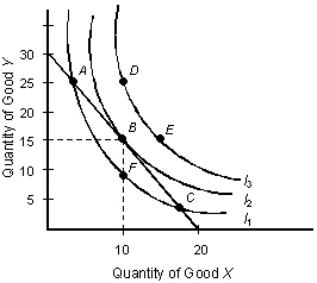 In Figure 6.3, the consumer is in equilibrium at point:
 (Multiple Choice)
4.8/5 (85)
(85) "Throwing good money after bad" is also known as the _____ effect.
(Multiple Choice)
4.9/5 (74)
(74) The below figure shows the various combinations of the goods X and Y that yield different levels of utility. Figure 6.3 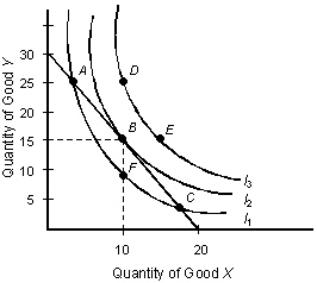 Refer to Figure 6.3.The consumer prefers _____ to _____.
 (Multiple Choice)
4.8/5 (68)
(68) 
Filters
- Essay(0)
- Multiple Choice(0)
- Short Answer(0)
- True False(0)
- Matching(0)