



 Chat with AI
Exam 8: Consumer Choice

Exam 1: Economics: The World Around You90 Questions
Exam 2: Choice, Opportunity Costs, and Specialization94 Questions
Exam 3: Markets, Demand and Supply, and the Price System97 Questions
Exam 5: The Market System and the Private and Public Sector97 Questions
Exam 4: Elasticity: Demand and Supply126 Questions
Exam 6: National Income Accounting104 Questions
Exam 7: an Introduction to the Foreign Exchange Market and the Balance of Payments90 Questions
Exam 8: Consumer Choice132 Questions
Exam 9: Supply: The Costs of Doing Business106 Questions
Exam 10: Unemployment and Inflation129 Questions
Exam 11: Macroeconomic Equilibrium: Aggregate Demand and Supply122 Questions
Exam 12: Profit Maximization122 Questions
Exam 13: Aggregate Expenditures115 Questions
Exam 14: Perfect Competition135 Questions
Exam 15: Income and Expenditures Equilibrium134 Questions
Exam 16: Monopoly118 Questions
Exam 17: Fiscal Policy93 Questions
Exam 18: Monopolistic Competition and Oligopoly111 Questions
Exam 19: Antitrust and Regulation100 Questions
Exam 10: Money and Banking125 Questions
Exam 21: Market Failures, Government Failures, and Rent Seeking121 Questions
Exam 22: Monetary Policy141 Questions
Exam 23: Macroeconomic Policy: Tradeoffs, Expectations, Credibility, and Sources of Business Cycles112 Questions
Exam 24: Resource Markets112 Questions
Exam 25: Macroeconomic Viewpoints: New Keynesian, Monetarist, and New Classical99 Questions
Exam 26: The Labor Market114 Questions
Exam 27: Capital Markets100 Questions
Exam 28: Economic Growth99 Questions
Exam 29: Development Economics104 Questions
Exam 30: the Land Market and Natural Resources55 Questions
Exam 31: Aging, Social Security and Health Care88 Questions
Exam 32: Globalization84 Questions
Exam 33: Elasticity: Demand and Supply126 Questions
Exam 34: Income Distribution, Poverty and Government Policy115 Questions
Exam 35: World Trade Equilibrium112 Questions
Exam 36: Consumer Choice132 Questions
Exam 37: International Trade Restrictions109 Questions
Exam 38: World Trade Equilibrium112 Questions
Exam 39: Exchange Rates and Financial Links Between Countries132 Questions
Exam 40: International Trade Restrictions109 Questions
Exam 41: Supply: the Costs of Doing Business106 Questions
Exam 42: Exchange Rates and Financial Links Between Countries132 Questions
Exam 43: Profit Maximization122 Questions
Exam 44: Perfect Competition135 Questions
Exam 45: Monopoly118 Questions
Exam 46: Monopolistic Competition and Oligopoly111 Questions
Exam 47: Antitrust and Regulation100 Questions
Exam 48: Market Failures, Government Failures, and Rent Seeking121 Questions
Exam 49: Resource Markets112 Questions
Exam 50: The Labor Market114 Questions
Exam 51: Capital Markets100 Questions
Exam 52: The Land Market and Natural Resources55 Questions
Exam 53: Aging, Social Security and Health Care87 Questions
Exam 54: Income Distribution, Poverty and Government Policy115 Questions
Exam 55: World Trade Equilibrium112 Questions
Exam 56: International Trade Restrictions109 Questions
Exam 57: Exchange Rates and Financial Links Between Countries132 Questions
Select questions type


The _____ effect indicates that an individual's income can buy more of all goods when the price of one good declines, everything else held constant.
(Multiple Choice)
4.9/5  (88)
(88) Following a decrease in the price of a good or service, an individual will purchase more of the now less expensive good and less of other more expensive goods.This is known as the _____ effect.
(Multiple Choice)
4.9/5 (85)
(85) According to neuroeconomists, the limbic portion of the brain called the amygdala is more primitive and deals with emotion.
(True/False)
4.9/5 (73)
(73) The table given below depicts the total utility derived from the consumption of a good. Table 6.1
 According to Table 6.1, the total utility from consuming all 5 units is _____.
 (Multiple Choice)
4.9/5 (90)
(90) An "all you can eat" restaurant illustrates the economic principle:
(Multiple Choice)
4.9/5 (79)
(79) Utility is easy to measure in the real world with recent advances in psychometric technology.
(True/False)
4.8/5 (82)
(82) A price change triggers the income effect but not the substitution effect.
(True/False)
4.9/5 (75)
(75) If the consumer purchases only two goods, X and Y, and if (MUx / Px)= (MUy / Py)then the consumer cannot reallocate her expenditures on X and Y to increase her utility, unless she has more money to spend.
(True/False)
4.9/5 (82)
(82) Suppose the prices of goods X, Y, and Z are $4, $1, and $5, respectively, and the last unit purchased of good X has a marginal utility MUx = 16 utils.At the point of equilibrium, the marginal utility of the last unit purchased of goods Y and Z will be:
(Multiple Choice)
4.9/5 (67)
(67) When economists describe the theory of consumer choice, they
(Multiple Choice)
4.9/5 (67)
(67) The figure given below represents two indifference curves I1 and I2 of an individual. Figure 6.2 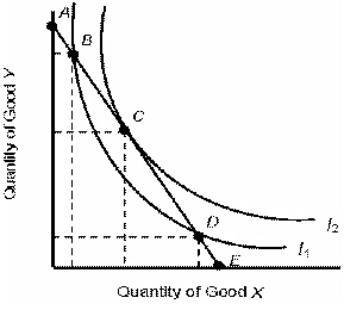 Refer to Figure 6.2.At which point in the figure above will the consumer maximize satisfaction?
 (Multiple Choice)
4.8/5 (72)
(72) If a consumer is buying only goods A and B, then he or she will be in equilibrium only when MUa = MUb.
(True/False)
4.8/5 (77)
(77) The term _____ refers to the idea that the value people place on money depends on where that money comes from.
(Multiple Choice)
4.8/5 (82)
(82) According to Table 6.2, marginal utility is positive _____.
(Multiple Choice)
5.0/5 (90)
(90) In economic theory, the idea of the equimarginal principle, or consumer equilibrium, means:
(Multiple Choice)
4.7/5 (68)
(68) If a consumer purchases more of a product, then most likely the marginal utility of _____.
(Multiple Choice)
4.8/5 (78)
(78) 
Filters
- Essay(0)
- Multiple Choice(0)
- Short Answer(0)
- True False(0)
- Matching(0)