



 Chat with AI
Exam 8: Consumer Choice

Exam 1: Economics: The World Around You90 Questions
Exam 2: Choice, Opportunity Costs, and Specialization94 Questions
Exam 3: Markets, Demand and Supply, and the Price System97 Questions
Exam 5: The Market System and the Private and Public Sector97 Questions
Exam 4: Elasticity: Demand and Supply126 Questions
Exam 6: National Income Accounting104 Questions
Exam 7: an Introduction to the Foreign Exchange Market and the Balance of Payments90 Questions
Exam 8: Consumer Choice132 Questions
Exam 9: Supply: The Costs of Doing Business106 Questions
Exam 10: Unemployment and Inflation129 Questions
Exam 11: Macroeconomic Equilibrium: Aggregate Demand and Supply122 Questions
Exam 12: Profit Maximization122 Questions
Exam 13: Aggregate Expenditures115 Questions
Exam 14: Perfect Competition135 Questions
Exam 15: Income and Expenditures Equilibrium134 Questions
Exam 16: Monopoly118 Questions
Exam 17: Fiscal Policy93 Questions
Exam 18: Monopolistic Competition and Oligopoly111 Questions
Exam 19: Antitrust and Regulation100 Questions
Exam 10: Money and Banking125 Questions
Exam 21: Market Failures, Government Failures, and Rent Seeking121 Questions
Exam 22: Monetary Policy141 Questions
Exam 23: Macroeconomic Policy: Tradeoffs, Expectations, Credibility, and Sources of Business Cycles112 Questions
Exam 24: Resource Markets112 Questions
Exam 25: Macroeconomic Viewpoints: New Keynesian, Monetarist, and New Classical99 Questions
Exam 26: The Labor Market114 Questions
Exam 27: Capital Markets100 Questions
Exam 28: Economic Growth99 Questions
Exam 29: Development Economics104 Questions
Exam 30: the Land Market and Natural Resources55 Questions
Exam 31: Aging, Social Security and Health Care88 Questions
Exam 32: Globalization84 Questions
Exam 33: Elasticity: Demand and Supply126 Questions
Exam 34: Income Distribution, Poverty and Government Policy115 Questions
Exam 35: World Trade Equilibrium112 Questions
Exam 36: Consumer Choice132 Questions
Exam 37: International Trade Restrictions109 Questions
Exam 38: World Trade Equilibrium112 Questions
Exam 39: Exchange Rates and Financial Links Between Countries132 Questions
Exam 40: International Trade Restrictions109 Questions
Exam 41: Supply: the Costs of Doing Business106 Questions
Exam 42: Exchange Rates and Financial Links Between Countries132 Questions
Exam 43: Profit Maximization122 Questions
Exam 44: Perfect Competition135 Questions
Exam 45: Monopoly118 Questions
Exam 46: Monopolistic Competition and Oligopoly111 Questions
Exam 47: Antitrust and Regulation100 Questions
Exam 48: Market Failures, Government Failures, and Rent Seeking121 Questions
Exam 49: Resource Markets112 Questions
Exam 50: The Labor Market114 Questions
Exam 51: Capital Markets100 Questions
Exam 52: The Land Market and Natural Resources55 Questions
Exam 53: Aging, Social Security and Health Care87 Questions
Exam 54: Income Distribution, Poverty and Government Policy115 Questions
Exam 55: World Trade Equilibrium112 Questions
Exam 56: International Trade Restrictions109 Questions
Exam 57: Exchange Rates and Financial Links Between Countries132 Questions
Select questions type


Which of the following sentences based on the findings of neuroeconomics is true?
(Multiple Choice)
4.8/5  (85)
(85) A ten-year-old boy spent his allowance on a soccer ball and a baseball glove.He said he could not be happier buying anything else.The price of the ball was $5, while the price of the glove was $10.If the marginal utility he received from the ball was 15 utils, then:
(Multiple Choice)
4.8/5 (89)
(89) If the marginal utility of a product is diminishing relative to the marginal utility of other products, then _____.
(Multiple Choice)
4.8/5 (75)
(75) _____ is a measure of the total satisfaction derived from consuming a quantity of some good or service.
(Multiple Choice)
4.9/5 (72)
(72) A consumer is in equilibrium when the slope of his or her indifference curve is equal to his or her budget constraint.
(True/False)
4.8/5 (81)
(81) The income and substitution effects of a price change occur because:
(Multiple Choice)
5.0/5 (80)
(80) The table below shows the total utility associated with various units of goods X and Y. Table 6.5
 Refer to Table 6.5.Given that the price of good X is $2 per unit, the price of good Y is $5 per unit, and that the consumer spends a total of $14 on both goods, what is the total utility associated with the utility-maximizing combination?
 (Multiple Choice)
4.8/5 (78)
(78) According to neuroeconomists, our logical brain knows we should spend as much as possible when we have money.
(True/False)
4.7/5 (73)
(73) The below figure shows the various combinations of the goods X and Y that yield different levels of utility. Figure 6.3 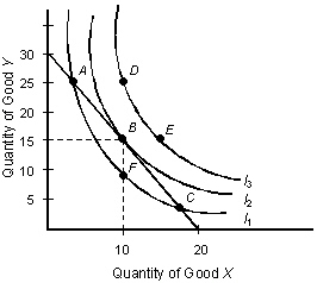 Refer to Figure 6.3.What combinations of X and Y are attainable by the consumer?
 (Multiple Choice)
4.8/5 (94)
(94) The below indifference map shows the various combinations of hours of music and apples that yield different levels of utility. Figure 6.1 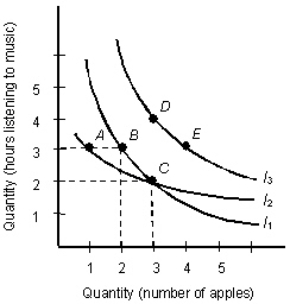 According to indifference curve I1 in Figure 6.1, for each extra apple the consumer eats, he or she must simultaneously sacrifice ____ of listening to music to keep total utility constant.
 (Multiple Choice)
5.0/5 (73)
(73) Which of the following statements concerning income and substitution effects is nottrue?
(Multiple Choice)
4.8/5 (67)
(67) Because incomes are limited, purchasing one thing means not being able to purchase other things.This indicates that:
(Multiple Choice)
4.7/5 (86)
(86) The table below shows the total utility associated with various units of goods X and Y. Table 6.5
 Refer to Table 6.5.Given that the price of good X is $2 per unit, the price of good Y is $5 per unit, and that the consumer spends a total of $14 on both goods, what is the total utility associated with the utility-maximizing combination?
 (Multiple Choice)
4.9/5 (75)
(75) When the price of a good changes, the substitution effect occurs because:
(Multiple Choice)
4.8/5 (78)
(78) In utility analysis, it is assumed that marginal utility diminishes as consumption of a product decreases.
(True/False)
4.7/5 (91)
(91) Suppose two out for coffee and donuts at the local donut store.The first donut you eat tastes incredibly good.The second one also tastes pretty good.The third donut seems just okay.With the fourth donut you are turning somewhat green.The fifth donut makes you sick.Your friend, an economist, describes your experience as the principle of:
(Multiple Choice)
4.8/5 (90)
(90) As the price of a good increases, the marginal utility per dollar spent on that good will also increase.
(True/False)
4.7/5 (85)
(85) The principle that people would rather leave things as they are is called _____.
(Multiple Choice)
4.9/5 (84)
(84) The demand curve for a product slopes downward and to the right because:
(Multiple Choice)
4.9/5 (85)
(85) Suppose that apples and bananas both cost the same, but the marginal utility of bananas is twice as high as that for apples.The consumer should purchase more apples and fewer bananas in order to maximize utility.
(True/False)
4.7/5 (80)
(80) 
Filters
- Essay(0)
- Multiple Choice(0)
- Short Answer(0)
- True False(0)
- Matching(0)