



 Chat with AI
Exam 17: Origins and Evolution

Exam 1: Microbial Life: Origin and Discovery69 Questions
Exam 2: Observing the Microbial Cell69 Questions
Exam 3: Cell Structure and Function72 Questions
Exam 4: Bacterial Culture, Growth, and Development70 Questions
Exam 5: Environmental Influences and Control of Microbial Growth70 Questions
Exam 6: Viruses70 Questions
Exam 7: Genomes and Chromosomes70 Questions
Exam 8: Transcription, Translation, and Bioinformatics76 Questions
Exam 9: Gene Transfer, Mutations, and Genome Evolution72 Questions
Exam 10: Molecular Regulation73 Questions
Exam 11: Viral Molecular Biology70 Questions
Exam 12: Biotechniques and Synthetic Biology72 Questions
Exam 13: Energetics and Catabolism77 Questions
Exam 14: Electron Flow in Organotrophy, Lithotrophy, and Phototrophy70 Questions
Exam 15: Biosynthesis70 Questions
Exam 16: Food and Industrial Microbiology73 Questions
Exam 17: Origins and Evolution70 Questions
Exam 18: Bacterial Diversity71 Questions
Exam 19: Archaeal Diversity70 Questions
Exam 20: Eukaryotic Diversity70 Questions
Exam 21: Microbial Ecology70 Questions
Exam 22: Microbes in Global Elemental Cycles70 Questions
Exam 23: Human Microbiota and Innate Immunity70 Questions
Exam 24: The Adaptive Immune Response70 Questions
Exam 25: Microbial Pathogenesis70 Questions
Exam 26: Microbial Diseases69 Questions
Exam 27: Antimicrobial Therapy72 Questions
Exam 28: Clinical Microbiology and Epidemiology75 Questions
Select questions type


Which energy-production reactions were likely to have been present in the earliest cells?
(Multiple Choice)
4.7/5  (77)
(77) In the domains of life, archaea and bacteria differ from each other in that
(Multiple Choice)
5.0/5 (77)
(77) Oparin at Moscow University, Miller and Urey at the University of Chicago, and Juan Oró at the University of Houston performed experiments throughout the twentieth century to prove that
(Multiple Choice)
4.7/5 (81)
(81) How can plants be so efficient photosynthetically if the chloroplast genome has fewer genes when compared with free-living cyanobacteria?
(Essay)
4.9/5 (77)
(77) In the study of rapid adaptive evolution through exposure to strongly selective environments, the energy cost to an organism that emerges as the fittest is that it is
(Multiple Choice)
4.9/5 (77)
(77) Evidence for microbial life on Earth dates back to ________ ago.
(Multiple Choice)
4.7/5 (79)
(79) The disease filariasis is caused by the ________, which harbors Wolbachia endosymbionts.
(Multiple Choice)
4.8/5 (73)
(73) Briefly discuss the types of geological evidence of early life and their advantages and limitations.
(Essay)
4.8/5 (73)
(73) Which branch of taxonomy deals with the sorting of life-forms into bins (categories) based on genetic relatedness and traits of the organisms?
(Multiple Choice)
4.8/5 (97)
(97) Fossil stromatolites and microfossils are used as evidence in studies of early life on Earth. What is a disadvantage of using these rock formations in these types of studies?
(Multiple Choice)
4.8/5 (83)
(83) Why and how is the gene for small subunit ribosomal RNA (SSU 16S rRNA) used to determine molecular phylogeny?
(Essay)
4.8/5 (79)
(79) The figure below shows two ways to represent phylogenetic relationships using rRNA from several thermophiles from Obsidian Pool in Yellowstone National Park. The principal advantage to unrooted trees, when compared to rooted trees, is that they 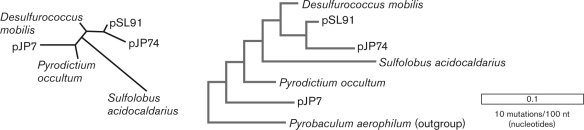
(Multiple Choice)
4.8/5 (86)
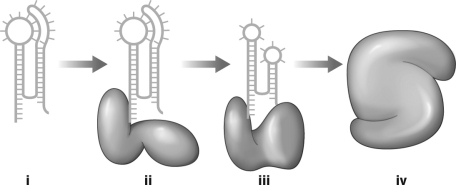
(86) Use the figure below to discuss how catalytic activity in enzyme proteins could have evolved from catalytic RNA.
(Essay)
4.8/5 (81)
(81) Which of the following is NOT used as a criterion to define a prokaryotic species?
(Multiple Choice)
4.9/5 (70)
(70) Describe the intracellular endosymbiosis between algae of the genus Chlorella and Paramecium. Why is this symbiosis considered reversible?
(Essay)
4.8/5 (82)
(82) 
Filters
- Essay(0)
- Multiple Choice(0)
- Short Answer(0)
- True False(0)
- Matching(0)