



 Chat with AI
Exam 20: Eukaryotic Diversity


Compare and contrast radiolarians and foraminiferans.

 (81)
 Verified
Answers will vary.
Amebas that form needlelike pseudopods form the clade Rhizaria, which includes the interesting shelled amebas known as radiolarians and foraminiferans. Both groups grow in marine and freshwater habitats. The shell (or test) in radiolarians is made of silica, which is perforated, allowing the pseudopods to radiate in all directions, hence the name "radiolarian." Foraminiferans have shells formed of calcium carbonate arranged as chambers laid down in a helical manner; the pseudopods extend from one opening in the most recent chamber.
The shells are part of reefs, sedimentary rock, and beach sand. Foraminiferans are indicators of oil deposits in geological strata, as the shells fossilize well and can be found in some rock types that are associated with fossil fuels.
Why would an organism benefit from undergoing more than one endosymbiotic event throughout evolution? Give an example to support your argument.
(79) VerifiedAnswers will vary.
Primary endosymbiosis includes events that lead to the formation of a mitochondrion (from an ancestral proteobacterium) or a chloroplast (from an ancestral cyanobacterium). If an organism with a mitochondrion were then to undergo a secondary endosymbiosis event with an organism containing a chloroplast, this new organism would gain two different mechanisms of energy production, namely photosynthesis and aerobic respiration. While primarily phototrophic, some diatoms can live in the absence of light using heterotrophy, assuming that an appropriate carbon source is available. This gives such organisms the advantage to easily adapt to multiple environments.
The figure below depicts two paramecia during conjugation. Use the numbered arrows to briefly describe the steps in this phenomenon. The figure can be used to describe what happens in one of the cells.
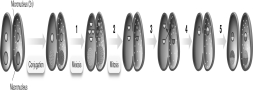
(78) All of the following are characteristics of eukaryotic organisms EXCEPT
(81) Which organisms are considered the possible "missing link" in the evolution from microbial eukaryotes to multicellular animals due to shared genes?
(90) Describe how the life cycle of the slime mold Dictyostelium discoideum is dependent upon prokaryotic organisms.
(67) The figure below shows the life cycle of an ascomycete. What is INCORRECTLY labeled? 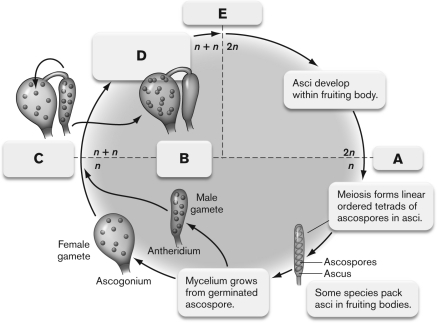
(95) The Rhodophyta alga Porphyra is known to colonize aquatic environments deeper than the Chlorophyta algae Spirogyra. Why does this happen? What advantages does Porphyra have by inhabiting this niche?
(85) Why are coral endosymbionts, known as zooxanthellae, important indicators of ocean health?
(75) Use the figure below and describe the differences between primary and secondary algae. Provide examples of both types.
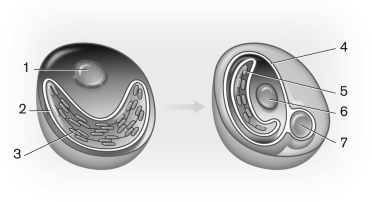
(90) Amebas that have filopodial movement structures can be found in which categories?
(83) The structural characteristic that defines the clade Heterokonta is that they all
(78) The term "protist" describes single-cell and colonial eukaryotic organisms other than
(87) The Zygomycota taxon comprises saprophytes, mycorrhiza, and insect parasites. They are characterized by having nonmotile gametes that must grow toward each other to fuse and form a zygote (zygospore). Explain why this taxon is classified under the larger taxa of Opisthokonta, which includes organisms with flagellated reproductive cells.
(77) Describe how Trypanosoma brucei overwhelms the immune system of an infected animal host, and explain the possible current targets for drug therapy.
(71) The following are examples of challenges for classification of eukaryotes, EXCEPT
(62) 
Filters
- Essay(0)
- Multiple Choice(0)
- Short Answer(0)
- True False(0)
- Matching(0)