



 Chat with AI
Exam 20: Eukaryotic Diversity

Exam 1: Microbial Life: Origin and Discovery69 Questions
Exam 2: Observing the Microbial Cell69 Questions
Exam 3: Cell Structure and Function72 Questions
Exam 4: Bacterial Culture, Growth, and Development70 Questions
Exam 5: Environmental Influences and Control of Microbial Growth70 Questions
Exam 6: Viruses70 Questions
Exam 7: Genomes and Chromosomes70 Questions
Exam 8: Transcription, Translation, and Bioinformatics76 Questions
Exam 9: Gene Transfer, Mutations, and Genome Evolution72 Questions
Exam 10: Molecular Regulation73 Questions
Exam 11: Viral Molecular Biology70 Questions
Exam 12: Biotechniques and Synthetic Biology72 Questions
Exam 13: Energetics and Catabolism77 Questions
Exam 14: Electron Flow in Organotrophy, Lithotrophy, and Phototrophy70 Questions
Exam 15: Biosynthesis70 Questions
Exam 16: Food and Industrial Microbiology73 Questions
Exam 17: Origins and Evolution70 Questions
Exam 18: Bacterial Diversity71 Questions
Exam 19: Archaeal Diversity70 Questions
Exam 20: Eukaryotic Diversity70 Questions
Exam 21: Microbial Ecology70 Questions
Exam 22: Microbes in Global Elemental Cycles70 Questions
Exam 23: Human Microbiota and Innate Immunity70 Questions
Exam 24: The Adaptive Immune Response70 Questions
Exam 25: Microbial Pathogenesis70 Questions
Exam 26: Microbial Diseases69 Questions
Exam 27: Antimicrobial Therapy72 Questions
Exam 28: Clinical Microbiology and Epidemiology75 Questions
Select questions type


The figure below shows the cellular basis of extension of a fungal hypha. Which of the following is labeled correctly? 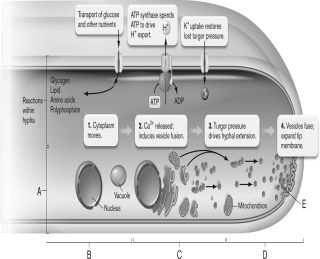
(Multiple Choice)
5.0/5  (80)
(80) The oomycete ("water fungus") ________ caused the Great Irish Famine in the 1840s.
(Multiple Choice)
4.9/5 (77)
(77) Plasmodium falciparum is a(n) ________ and is transmitted to the human host by the bite of a ________.
(Multiple Choice)
4.8/5 (64)
(64) Dinoflagellates are marine phototrophs responsible for the toxic red tide blooms. What pigments confer the red color to these organisms?
(Multiple Choice)
4.8/5 (78)
(78) Free living amebas are common soil predators that feed on bacteria, algae, rotifers, and so on. However, some species may harbor bacterial pathogens such as ________, which contaminates water supplies and air ducts.
(Multiple Choice)
4.9/5 (79)
(79) In the organism Saccharomyces cerevisiae, which of the following induces alternation of generations from a haploid to a diploid cell?
(Multiple Choice)
4.7/5 (72)
(72) Which of the following is NOT a common trait shared by most mycelium-forming fungi?
(Multiple Choice)
4.8/5 (83)
(83) Giardia lamblia is an infectious problem in day-care centers because it is a(n) ________ pathogen passed via ________.
(Multiple Choice)
5.0/5 (72)
(72) Why are phylogenetic data in the domain Eukarya overall harder to obtain than phylogenetic evidence in either the Bacteria or Archaea domains? How has this affected the systematics of Eukarya?
(Essay)
4.9/5 (75)
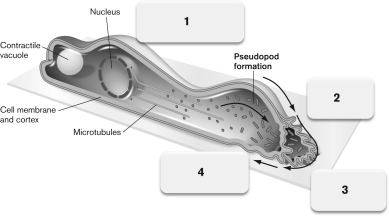
(75) Use the figure below to describe the mechanism of pseudopod motility in Amoebozoa.
(Essay)
5.0/5 (84)
(84) A kinetoplast is ________ containing a bundle of multiple copies of its circular genome.
(Multiple Choice)
4.9/5 (72)
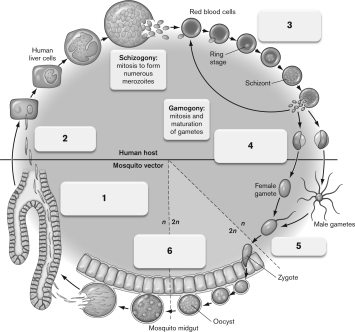
(72) Use the figure below as a guide to describe the cycle of Plasmodium falciparum transmission between mosquito and human in malaria.
(Essay)
4.8/5 (90)
(90) The figure below is a schematic representation of Chlamydomonas life cycle. What is INCORRECTLY labeled? 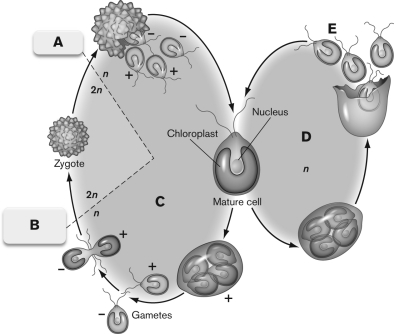
(Multiple Choice)
4.8/5 (84)
(84) A major group of marine phytoplankton that is essential to the marine food chain includes
(Multiple Choice)
4.9/5 (73)
(73) The apicomplexans have gone through extensive evolutionary reduction, in which the apicoplast has retained some genetic capabilities from an ancestral chloroplast in order to
(Multiple Choice)
4.9/5 (69)
(69) 
Filters
- Essay(0)
- Multiple Choice(0)
- Short Answer(0)
- True False(0)
- Matching(0)