



 Chat with AI
Exam 5: Environmental Influences and Control of Microbial Growth

Exam 1: Microbial Life: Origin and Discovery69 Questions
Exam 2: Observing the Microbial Cell69 Questions
Exam 3: Cell Structure and Function72 Questions
Exam 4: Bacterial Culture, Growth, and Development70 Questions
Exam 5: Environmental Influences and Control of Microbial Growth70 Questions
Exam 6: Viruses70 Questions
Exam 7: Genomes and Chromosomes70 Questions
Exam 8: Transcription, Translation, and Bioinformatics76 Questions
Exam 9: Gene Transfer, Mutations, and Genome Evolution72 Questions
Exam 10: Molecular Regulation73 Questions
Exam 11: Viral Molecular Biology70 Questions
Exam 12: Biotechniques and Synthetic Biology72 Questions
Exam 13: Energetics and Catabolism77 Questions
Exam 14: Electron Flow in Organotrophy, Lithotrophy, and Phototrophy70 Questions
Exam 15: Biosynthesis70 Questions
Exam 16: Food and Industrial Microbiology73 Questions
Exam 17: Origins and Evolution70 Questions
Exam 18: Bacterial Diversity71 Questions
Exam 19: Archaeal Diversity70 Questions
Exam 20: Eukaryotic Diversity70 Questions
Exam 21: Microbial Ecology70 Questions
Exam 22: Microbes in Global Elemental Cycles70 Questions
Exam 23: Human Microbiota and Innate Immunity70 Questions
Exam 24: The Adaptive Immune Response70 Questions
Exam 25: Microbial Pathogenesis70 Questions
Exam 26: Microbial Diseases69 Questions
Exam 27: Antimicrobial Therapy72 Questions
Exam 28: Clinical Microbiology and Epidemiology75 Questions
Select questions type


Which temperature is lethal to any mesophile?

Free
(Multiple Choice)
4.9/5  (91)
(91) Correct Answer: Verified
E
Why is death a logarithmic function and not an instantaneous event upon treatment?
Free
(Essay)
4.8/5 (83)
(83) Correct Answer:Verified
VerifiedFor one thing, all cells in a population may not be at the same level of fitness. Some cells may be more susceptible than others. Another aspect is the probability of the treatment causing a lethal hit. Cells contain many different proteins and genes. Hits to one may not be as deleterious as to another. Moreover, damage must accumulate. Only after enough molecules of an essential gene or protein have been affected in a cell will it die. For these reasons, the entire population does not die immediately upon treatment; instead, it will have an exponential demise.
Which of the following enzymes are stable in part because they contain relatively low amounts of the small amino acid glycine?
Free
(Multiple Choice)
5.0/5 (80)
(80) Correct Answer:Verified
VerifiedC
Organisms that grow at temperatures as high as 121°C as well as high pressure are known as
(Multiple Choice)
4.9/5 (66)
(66) Briefly describe three techniques used to culture anaerobes in the laboratory.
(Essay)
4.9/5 (76)
(76) If you have a food sample contaminated with anthrax spores, which sterilization approach would make sure the sample is free of spores without compromising the quality of the food sample-autoclaving or irradiation? Why?
(Essay)
4.8/5 (89)
(89) Which of the following have evolved to grow in conditions extremely different from those optimal for humans?
(Multiple Choice)
4.9/5 (83)
(83) An organism that requires atmospheric oxygen levels for growth is
(Multiple Choice)
4.9/5 (63)
(63) An organism that grows in the circled region of the tube of medium containing thioglycolate shown below is probably a(n) 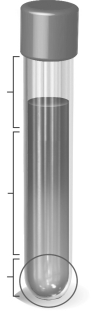
(Multiple Choice)
4.8/5 (89)
(89) A measure of the number of solute molecules in solution and is inversely related to water activity is known as
(Multiple Choice)
4.8/5 (68)
(68) Alkaliphiles use ________ force in addition to proton motive force to maintain pH.
(Multiple Choice)
4.8/5 (87)
(87) Filtration of samples to remove microbial cells typically use micropore filters with pore sizes of
(Multiple Choice)
4.8/5 (76)
(76) An organism that grows at the top of a tube of medium containing thioglycolate is probably a(n)
(Multiple Choice)
4.9/5 (86)
(86) Halophiles require high salt concentrations to survive. Describe a mechanism involving compatible solutes that has evolved to achieve low internal sodium ion concentrations.
(Essay)
4.9/5 (78)
(78) No one ever expected to find microbes thriving in our stomachs. What organism was found there, what problem does it cause, and how does it survive there?
(Essay)
4.7/5 (90)
(90) Why do some microorganisms produce antibiotics, and how do they avoid being harmed by the antibiotics they produce?
(Essay)
4.9/5 (79)
(79) How is the phenol coefficient calculated? Why is phenol the standard for testing other disinfectants?
(Essay)
4.8/5 (74)
(74) If a disinfectant is added to a culture containing 1 * 10⁶ CFU per milliliter and the D-value of the disinfectant is 2 minutes, how many viable cells are left after 4 minutes of exposure?
(Essay)
4.8/5 (67)
(67) Deinococcus radiodurans resists extreme drought and radiation by what mechanism?
(Multiple Choice)
5.0/5 (80)
(80) 
Filters
- Essay(0)
- Multiple Choice(0)
- Short Answer(0)
- True False(0)
- Matching(0)