



 Chat with AI
Exam 5: Environmental Influences and Control of Microbial Growth

Exam 1: Microbial Life: Origin and Discovery69 Questions
Exam 2: Observing the Microbial Cell69 Questions
Exam 3: Cell Structure and Function72 Questions
Exam 4: Bacterial Culture, Growth, and Development70 Questions
Exam 5: Environmental Influences and Control of Microbial Growth70 Questions
Exam 6: Viruses70 Questions
Exam 7: Genomes and Chromosomes70 Questions
Exam 8: Transcription, Translation, and Bioinformatics76 Questions
Exam 9: Gene Transfer, Mutations, and Genome Evolution72 Questions
Exam 10: Molecular Regulation73 Questions
Exam 11: Viral Molecular Biology70 Questions
Exam 12: Biotechniques and Synthetic Biology72 Questions
Exam 13: Energetics and Catabolism77 Questions
Exam 14: Electron Flow in Organotrophy, Lithotrophy, and Phototrophy70 Questions
Exam 15: Biosynthesis70 Questions
Exam 16: Food and Industrial Microbiology73 Questions
Exam 17: Origins and Evolution70 Questions
Exam 18: Bacterial Diversity71 Questions
Exam 19: Archaeal Diversity70 Questions
Exam 20: Eukaryotic Diversity70 Questions
Exam 21: Microbial Ecology70 Questions
Exam 22: Microbes in Global Elemental Cycles70 Questions
Exam 23: Human Microbiota and Innate Immunity70 Questions
Exam 24: The Adaptive Immune Response70 Questions
Exam 25: Microbial Pathogenesis70 Questions
Exam 26: Microbial Diseases69 Questions
Exam 27: Antimicrobial Therapy72 Questions
Exam 28: Clinical Microbiology and Epidemiology75 Questions
Select questions type


Many ________ bacteria cause horrific human diseases, such as tetanus, botulism, and gangrene.
(Multiple Choice)
4.8/5  (77)
(77) What piece of equipment is represented by the following schematic diagram? 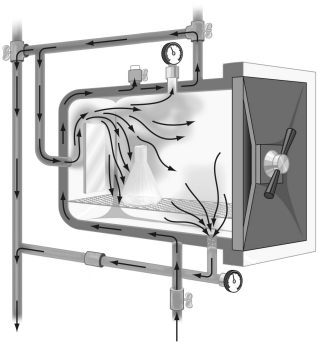
(Multiple Choice)
4.8/5 (75)
(75) A ________ medium is one of higher osmolarity than the cell.
(Multiple Choice)
4.8/5 (74)
(74) Microbes accumulate ________ in the cell to prevent cell water loss in a hypertonic environment.
(Multiple Choice)
5.0/5 (80)
(80) Why are many barophiles also psychrophiles, and how are the adaptations for barophiles and psychrophiles similar?
(Essay)
5.0/5 (69)
(69) Describe one method that enables researchers to study extremophilic organisms that we cannot culture in the laboratory.
(Essay)
4.7/5 (77)
(77) The general result of the Arrhenius equation is that growth rate roughly doubles for every ________°C rise in temperature.
(Multiple Choice)
4.9/5 (84)
(84) At the bottom of the ocean, hydrostatic pressure averages a crushing 400 atm (atmospheres) and can go as high as ________ atm.
(Multiple Choice)
4.7/5 (80)
(80) Disposable plasticware such as petri dishes can be sterilized using which of the following?
(Multiple Choice)
4.9/5 (70)
(70) Which of the following is an important signaling molecule that controls global gene expression during starvation?
(Multiple Choice)
4.8/5 (90)
(90) Which of the following are often chemolithotrophs that oxidize reduced metals and generate strong acids, such as sulfuric acid?
(Multiple Choice)
4.9/5 (74)
(74) How does pH affect proteins? Why do proteins have an optimum, minimum, and maximum pH at which they will function?
(Essay)
4.7/5 (85)
(85) Special channels for helping water move across the membrane quickly are called
(Multiple Choice)
4.8/5 (82)
(82) E. coli tolerates a pH range from 2 to 9, which is a ________-fold difference in hydrogen ion concentration.
(Multiple Choice)
4.7/5 (80)
(80) Organisms adapted to grow at overwhelmingly high pressures are called
(Multiple Choice)
4.9/5 (82)
(82) Why is oxygen so dangerous for cells and how do cells deal with these problems?
(Essay)
4.8/5 (72)
(72) Which of the following are prominent members of microbial communities beneath icebergs in the Arctic and Antarctic?
(Multiple Choice)
5.0/5 (99)
(99) 
Filters
- Essay(0)
- Multiple Choice(0)
- Short Answer(0)
- True False(0)
- Matching(0)