



 Chat with AI
Exam 9: Gene Transfer, Mutations, and Genome Evolution

Exam 1: Microbial Life: Origin and Discovery69 Questions
Exam 2: Observing the Microbial Cell69 Questions
Exam 3: Cell Structure and Function72 Questions
Exam 4: Bacterial Culture, Growth, and Development70 Questions
Exam 5: Environmental Influences and Control of Microbial Growth70 Questions
Exam 6: Viruses70 Questions
Exam 7: Genomes and Chromosomes70 Questions
Exam 8: Transcription, Translation, and Bioinformatics76 Questions
Exam 9: Gene Transfer, Mutations, and Genome Evolution72 Questions
Exam 10: Molecular Regulation73 Questions
Exam 11: Viral Molecular Biology70 Questions
Exam 12: Biotechniques and Synthetic Biology72 Questions
Exam 13: Energetics and Catabolism77 Questions
Exam 14: Electron Flow in Organotrophy, Lithotrophy, and Phototrophy70 Questions
Exam 15: Biosynthesis70 Questions
Exam 16: Food and Industrial Microbiology73 Questions
Exam 17: Origins and Evolution70 Questions
Exam 18: Bacterial Diversity71 Questions
Exam 19: Archaeal Diversity70 Questions
Exam 20: Eukaryotic Diversity70 Questions
Exam 21: Microbial Ecology70 Questions
Exam 22: Microbes in Global Elemental Cycles70 Questions
Exam 23: Human Microbiota and Innate Immunity70 Questions
Exam 24: The Adaptive Immune Response70 Questions
Exam 25: Microbial Pathogenesis70 Questions
Exam 26: Microbial Diseases69 Questions
Exam 27: Antimicrobial Therapy72 Questions
Exam 28: Clinical Microbiology and Epidemiology75 Questions
Select questions type


The transformasome necessary for cell competency in Gram-positive bacteria is regulated using which of the following methods?

Free
(Multiple Choice)
4.7/5  (85)
(85) Correct Answer: Verified
A
Genomes are considered to be mosaic. Which of the following statements provides the LEAST support for this idea?
Free
(Multiple Choice)
4.8/5 (83)
(83) Correct Answer:Verified
VerifiedA
In the figure below, which type(s) of mutation(s) is/are introducing frameshifts? 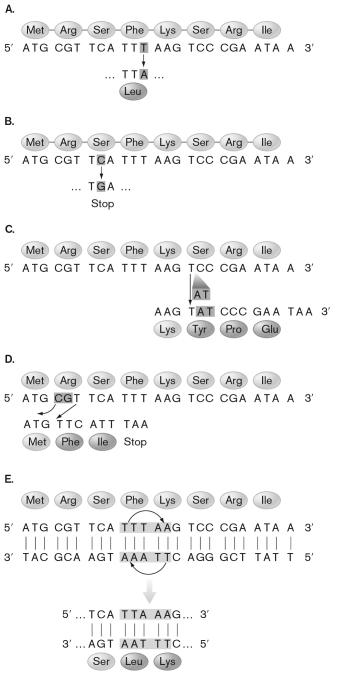
Free
(Multiple Choice)
4.9/5 (81)
(81) Correct Answer:Verified
VerifiedB
The following statements about superfamily proteins are true EXCEPT that
(Multiple Choice)
4.8/5 (83)
(83) The difference between generalized and specialized transduction is
(Multiple Choice)
4.8/5 (85)
(85) Consider a culture of 10,000 cells that double to 20,000 cells. If measuring 100 mutations in the population, the mutation frequency would be
(Multiple Choice)
4.8/5 (77)
(77) Which of the following is the activator of the SOS response?
(Multiple Choice)
4.9/5 (62)
(62) Why does a genetic experiment using recombination generally involve screening hundreds of millions of cells to find a few recombinants that form visible colonies?
(Essay)
4.9/5 (75)
(75) Describe two processes that may happen during the evolution toward pathogenicity.
(Essay)
4.8/5 (81)
(81) A difference between type II restriction enzyme and type I or type III restriction enzymes is that
(Multiple Choice)
4.8/5 (80)
(80) Which of the following mutagens does NOT cause point mutations?
(Multiple Choice)
4.9/5 (67)
(67) What are the differences between replicative and nonreplicative transposition?
(Essay)
4.9/5 (75)
(75) After extensive DNA damage, special DNA polymerases are expressed that sacrifice replication ________ to rescue the damaged genome.
(Multiple Choice)
4.8/5 (65)
(65) During conjugation, the DNA passes through the ________, NOT the ________.
(Multiple Choice)
4.7/5 (71)
(71) CRISPR is considered an example of adaptive immunity in bacteria and archaea because it
(Multiple Choice)
4.8/5 (68)
(68) In the figure shown below, product A is the result of ________ and product B is the result of ________. 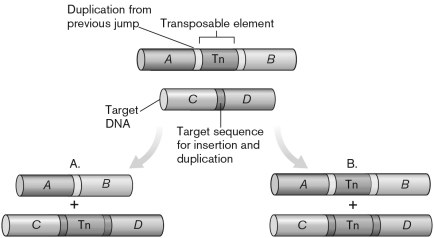
(Multiple Choice)
4.7/5 (74)
(74) Describe a frameshift mutation in terms of insertions and deletions. Does an insertion always result in a frameshift mutation? Will an insertion always render the gene product nonfunctional?
(Essay)
4.9/5 (86)
(86) When a population is under threat, which of the following would spread?
(Multiple Choice)
4.7/5 (76)
(76) 
Filters
- Essay(0)
- Multiple Choice(0)
- Short Answer(0)
- True False(0)
- Matching(0)