



 Chat with AI
Exam 6: Viruses

Exam 1: Microbial Life: Origin and Discovery69 Questions
Exam 2: Observing the Microbial Cell69 Questions
Exam 3: Cell Structure and Function72 Questions
Exam 4: Bacterial Culture, Growth, and Development70 Questions
Exam 5: Environmental Influences and Control of Microbial Growth70 Questions
Exam 6: Viruses70 Questions
Exam 7: Genomes and Chromosomes70 Questions
Exam 8: Transcription, Translation, and Bioinformatics76 Questions
Exam 9: Gene Transfer, Mutations, and Genome Evolution72 Questions
Exam 10: Molecular Regulation73 Questions
Exam 11: Viral Molecular Biology70 Questions
Exam 12: Biotechniques and Synthetic Biology72 Questions
Exam 13: Energetics and Catabolism77 Questions
Exam 14: Electron Flow in Organotrophy, Lithotrophy, and Phototrophy70 Questions
Exam 15: Biosynthesis70 Questions
Exam 16: Food and Industrial Microbiology73 Questions
Exam 17: Origins and Evolution70 Questions
Exam 18: Bacterial Diversity71 Questions
Exam 19: Archaeal Diversity70 Questions
Exam 20: Eukaryotic Diversity70 Questions
Exam 21: Microbial Ecology70 Questions
Exam 22: Microbes in Global Elemental Cycles70 Questions
Exam 23: Human Microbiota and Innate Immunity70 Questions
Exam 24: The Adaptive Immune Response70 Questions
Exam 25: Microbial Pathogenesis70 Questions
Exam 26: Microbial Diseases69 Questions
Exam 27: Antimicrobial Therapy72 Questions
Exam 28: Clinical Microbiology and Epidemiology75 Questions
Select questions type


Which of the following is INCORRECT about a virus?

Free
(Multiple Choice)
4.9/5  (72)
(72) Correct Answer: Verified
E
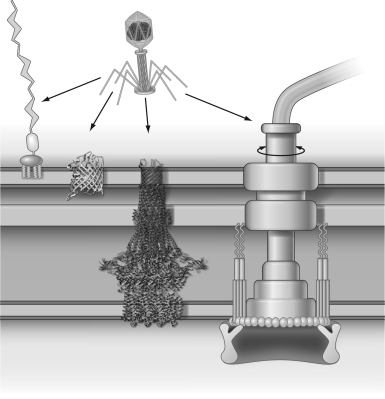
Name the different types of receptors shown in the figure below.
Free
(Essay)
5.0/5 (78)
(78) Correct Answer:Verified
VerifiedDifferent types of receptors shown include the following: LPS, which is a lipid polysaccharide molecule; ompF molecules, which are transport channels; and TOLC, which is a bacteria membrane protein.
Which structure of a virion protects it from degradation and enables it to be transmitted outside the host?
(Multiple Choice)
4.9/5 (92)
(92) How can a virus be used to transfer genes from one bacterial cell to another?
(Essay)
4.7/5 (71)
(71) Filamentous viruses are classified in part by the pattern of capsid monomers, which form a ________ tube around the genome.
(Multiple Choice)
4.8/5 (69)
(69) What phages have been used to nucleate the growth of crystalline "nanowires" for electronic devices?
(Multiple Choice)
4.8/5 (74)
(74) Some viral species may derive their ________ from intracellular membranes, such as the nuclear membrane or endoplasmic reticulum.
(Multiple Choice)
4.8/5 (89)
(89) The proteomic tree of bacteriophages is based on comprehensive analysis of viral
(Multiple Choice)
4.9/5 (76)
(76) Why are viruses not affected by antibiotics? Why are there so few antiviral drugs?
(Essay)
4.8/5 (98)
(98) During the eclipse period of a viral infection, why are the virions undetectable in the growth medium?
(Essay)
4.7/5 (81)
(81) To count the number of viruses in a solution, one can perform a plaque assay. Describe how a plaque is generated in the case of a lytic virus and how a virus that does not lyse its host can be detected.
(Essay)
5.0/5 (80)
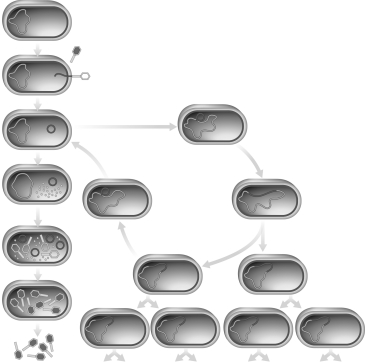
(80) Evaluate what determines which cycle a temperate phage will go through as shown in the figure below.
(Essay)
4.8/5 (81)
(81) Proteomic analysis predicts seven major evolutionary categories of phage species with subgroups based on
(Multiple Choice)
4.9/5 (81)
(81) 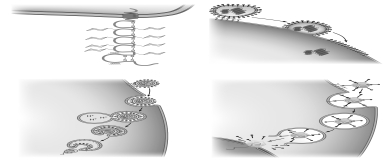
A key factor in the evolution of killer strains of influenza is that they
(Multiple Choice)
4.8/5 (71)
(71) Why do many RNA viruses encode their own RNA-dependent RNA polymerase and package them in viral particles? How do we take advantage of these viral-specific polymerases?
(Essay)
4.9/5 (74)
(74) 
Filters
- Essay(0)
- Multiple Choice(0)
- Short Answer(0)
- True False(0)
- Matching(0)